
AppsFromResearch
Ag Water icon

Ag Water

Evidence Tier:DOCUMENTED

Published in academic literature

For:Industry Professionals

App Summary

Ag Water helps produce growers comply with the FDA Produce Safety Rule by calculating their water's Microbial Water Quality Profile and assessing microbial contamination risk. The app's risk assessment feature is based on an evaluation study that quantified how environmental factors, such as rainfall and temperature, impact bacterial levels in irrigation sources. This tool assists growers in implementing risk-based water sampling strategies and making informed management decisions to reduce contamination and improve produce safety.

App Screenshots

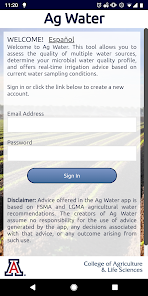
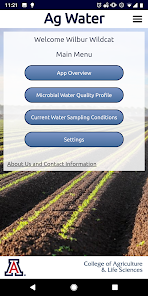
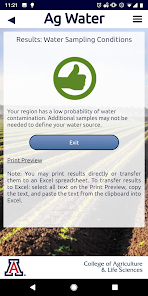
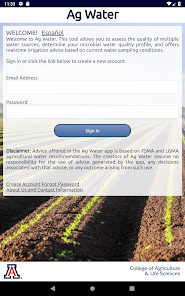
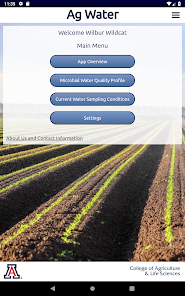
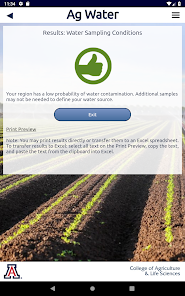
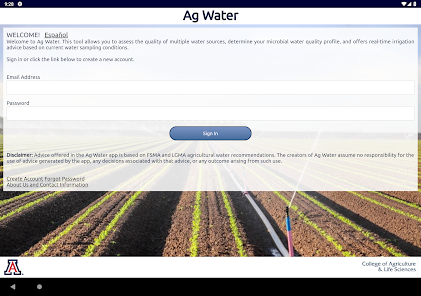
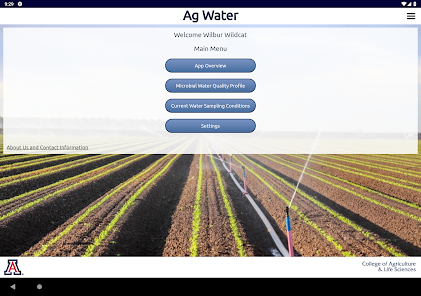
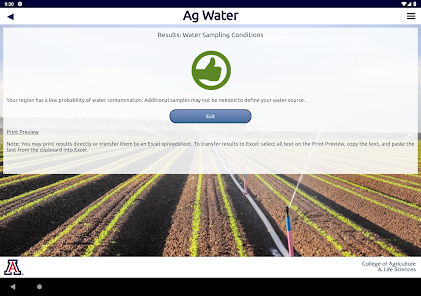
Ag Water screenshot 1 of 15Ag Water screenshot 2 of 15Ag Water screenshot 3 of 15Ag Water screenshot 4 of 15Ag Water screenshot 5 of 15Ag Water screenshot 6 of 15Ag Water screenshot 7 of 15Ag Water screenshot 8 of 15Ag Water screenshot 9 of 15Ag Water screenshot 10 of 15Ag Water screenshot 11 of 15Ag Water screenshot 12 of 15Ag Water screenshot 13 of 15Ag Water screenshot 14 of 15Ag Water screenshot 15 of 15

Detailed Description

Functionality & Mechanism

Developed with University of Arizona researchers, Ag Water is a computational tool for agricultural water management aligned with the FDA Produce Safety Rule. The system's primary module calculates a Microbial Water Quality Profile by ingesting user-provided E. coli sample data to determine the requisite Geometric Mean and Statistical Threshold Value. It facilitates both initial profile establishment and annual rolling updates. A secondary module evaluates microbial contamination probability by integrating environmental data, weather conditions, and site-specific water parameters.

Evidence & Research Context

  • The app's risk-assessment function is based on evaluation research that quantified the impact of environmental factors, including rainfall and water temperature, on microbial levels in irrigation sources.
  • The system is designed to operationalize federal Produce Safety Rule standards, which require growers to establish a microbial water quality profile to mitigate produce contamination risks.
  • An associated research article details the app's iterative development, which incorporated grower feedback to improve functionality and added a Spanish-language interface for broader accessibility.

Intended Use & Scope

This app is a decision-support tool for agricultural growers managing compliance with the Produce Safety Rule. Its primary utility is to perform required statistical calculations for a Microbial Water Quality Profile and provide risk-based guidance for sampling. The system does not conduct water testing; outputs are contingent on accurate user-inputted laboratory data.

Studies & Publications

3 publications

Peer-reviewed research associated with this app.

Non-Evaluative Reference

Testing Agricultural Water for Fruit and Vegetable Production and Postharvest Handling

Wszelaki et al. (2021) · WSU Extension Publications

Referenced in academic literature; no direct evaluation of the app
Abstract: Water is utilized extensively throughout fruit and vegetable production and postharvest handling for critical tasks such as cooling, frost protection, irrigation, fertigation, protective sprays, handwashing, and the cleaning and disinfecting of equipment and produce contact surfaces. Because water can harbor harmful bacteria like Salmonella and E. coli O157:H7, the use of contaminated water poses a significant risk of transferring pathogens to produce, potentially causing widespread foodborne illness. Consequently, it is imperative for producers to evaluate their on-farm water usage and develop a robust water testing plan to mitigate these risks. This publication outlines best practices for managing water-related risks and addresses the water standards established by the Food and Drug Administration (FDA) under the federal Produce Safety Rule. Based on Washington State University Extension Fact Sheet FS354E, here is a summary of the best practices for managing agricultural water quality: 1. Map and Inspect Water Systems Create a Map: Diagram all water sources and distribution systems to understand how water moves across the farm and identify potential entry points for contamination. Regular Inspections: Inspect the entire water system (wells, pumps, distribution lines) at the beginning of the growing season and periodically throughout. Identify Hazards: Look for risks such as broken well casings, wildlife access to surface water, trash/debris in open systems, or runoff from adjacent land (e.g., livestock areas). Correct any deficiencies immediately. 2. Implement a Water Testing Plan Test for Indicators: Test water for generic E. coli, which serves as an indicator of fecal contamination. Test All Production Water: This includes water used for irrigation, crop cooling, frost protection, and mixing pesticides, herbicides, or fertilizers. Frequency: Surface Water: Requires the most frequent testing due to high variability and susceptibility to contamination. Groundwater (Wells): Generally requires less frequent testing but should still be monitored. Public/Municipal Water: Typically does not need on-farm testing if you can obtain a report from the municipality. 3. Select Low-Risk Application Methods Avoid Contact: Whenever possible, use irrigation methods that prevent water from touching the edible portion of the crop. Drip vs. Overhead: Drip irrigation is preferred because it delivers water directly to the soil. Overhead irrigation is higher risk because it wets the produce, potentially transferring pathogens directly to the harvestable part. 4. Optimize Timing (Die-Off Interval) Time Interval: Maximize the time between the last water application and harvest. Natural Reduction: A longer interval allows environmental factors like UV radiation from sunlight and drying to naturally reduce pathogen levels on the produce. 5. Keep Detailed Records Documentation: Maintain records of all water test results, system inspections, and any corrective actions taken (e.g., repairs or water treatment). This is critical for both safety and compliance with the Produce Safety Rule. 6. Corrective Actions Act on Issues: If testing indicates high bacterial counts or inspections reveal physical problems, take immediate corrective actions. This may involve treating the water, switching to a safer water source, or repairing equipment.
... Read More
Development/Design Paper

UA Ag Water app-language expansion and practical grower-inspired improvements

Rock et al. (2017) · Center for Produce Safety

Describes the research-driven development of this app
Several tools have been developed in recent years to make it easier for growers to understand their microbial water quality profile (MWQP) as stated in the Produce Safety Rule and to determine if water meets the standards for unrestricted application to produce before harvest. The tools were also designed to assist with making food safety management decisions if water does not meet the standards, including calculation of die-off requirements. While extremely useful, the initial development of these tools was restricted to English only and had not been broadly evaluated by a diversity of grower/users of the tools attempting to implement the FSMA Produce Safety Rule. The University of Arizona team worked over the course of one year with the original Ag Water app developer to improve the functionality of the Ag Water app, based on grower feedback, as well as to translate all tools into Spanish.
... Read More

Ag Water

Free