
AppsFromResearch
Dizztinct icon

Dizztinct

Evidence Tier:DOCUMENTED

Published in academic literature

For:General Public & EnthusiastsPatients & Caregivers

App Summary

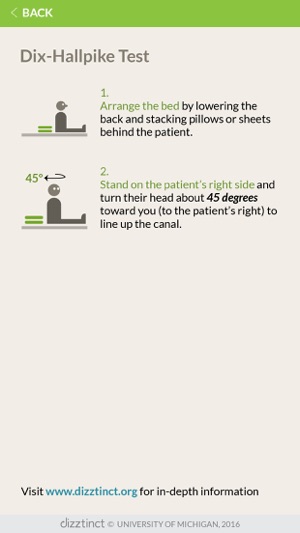
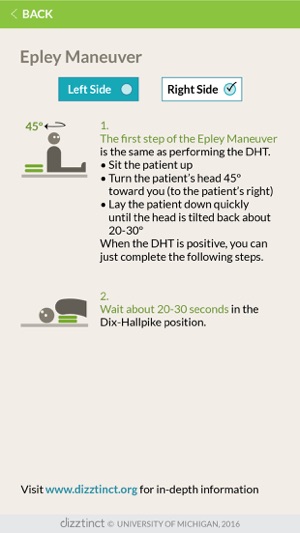
Dizztinct provides step-by-step visual guides for the Dix-Hallpike Test and Epley Maneuver to help clinicians and patients manage Benign Paroxysmal Positional Vertigo (BPPV). The app operationalizes these gold-standard, guideline-recommended maneuvers and is the subject of a stepped-wedge randomized trial designed to improve their use in the emergency department. The associated study protocol states that successfully increasing the use of these maneuvers would be an important step in implementing evidence-based processes of care for this common condition.

App Screenshots

Dizztinct screenshot 1 of 3Dizztinct screenshot 2 of 3Dizztinct screenshot 3 of 3

Detailed Description

Functionality & Mechanism Dizztinct is a clinical support tool designed to guide the application of evidence-based maneuvers for Benign Paroxysmal Positional Vertigo (BPPV). The interface delivers step-by-step visual instructions and concise instructional videos for performing the Dix-Hallpike Test for diagnosis and the Epley Maneuver for treatment. The system facilitates the correct and sequential execution of these procedures, serving as a point-of-care reference to ensure adherence to established clinical protocols for managing peripheral vestibular disorders.

Evidence & Research Context

  • The app's design and implementation strategy are detailed in a published protocol for the DIZZTINCT stepped-wedge randomized clinical trial.
  • This trial was designed to evaluate a multi-faceted intervention, incorporating this tool, aimed at increasing guideline-concordant BPPV care in emergency departments.
  • The primary endpoint for the associated research is the rate of clinical documentation for the Dix-Hallpike Test or a Canalith Repositioning Maneuver.
  • The underlying diagnostic and therapeutic processes are supported by extensive evidence, including numerous randomized controlled trials and systematic reviews establishing their efficacy.

Intended Use & Scope This tool is intended for clinicians as a point-of-care reference to facilitate the implementation of evidence-based BPPV assessment and treatment protocols. Its primary utility is procedural guidance. The system does not provide a differential diagnosis for dizziness and is not a substitute for comprehensive clinical evaluation and diagnosis by a qualified healthcare provider.

Studies & Publications

1 publication

Peer-reviewed research associated with this app.

Study Protocol

Implementation of evidence-based practice for benign paroxysmal positional vertigo: DIZZTINCT- A study protocol for an exploratory stepped-wedge randomized trial

Meurer et al. (2018) · Trials

Research study planned or in progress; results not yet available
Benign paroxysmal positional vertigo (BPPV) is the most common peripheral vestibular disorder, and accounts for 8% of individuals with moderate or severe dizziness. BPPV patients experience substantial inconveniences and disabilities during symptomatic periods. BPPV therapeutic processes – the Dix-Hallpike Test (DHT) and the Canalith Repositioning Maneuver (CRM) – have an evidence base that is at the clinical practice guideline level. The most commonly used CRM is the modified Epley maneuver. The DHT is the gold standard test for BPPV and the CRM is supported by numerous randomized controlled trials and systematic reviews. Despite this, BPPV care processes are underutilized. This is a stepped-wedge, randomized clinical trial of a multi-faceted educational and care-process-based intervention designed to improve the guideline-concordant care of patients with BPPV presenting to the emergency department (ED) with dizziness. The unit of randomization and target of intervention is the hospital. After an initial observation period, the six hospitals will undergo the intervention in five waves (two closely integrated hospitals will be paired). The order will be randomized. The primary endpoint is measured at the individual patient level, and is the presence of documentation of either the Dix-Hallpike Test or CRM. The secondary endpoints are referral to a health care provider qualified to treat dizziness for CRM and 90-day stroke rates following an ED dizziness visit. Formative evaluations are also performed to monitor and identify potential and actual influences on the progress and effectiveness of the implementation efforts. If this study safely increases documentation of the DHT/CRM, this will be an important step in implementing the use of these evidenced-based processes of care. Positive results will support conducting larger-scale follow-up studies that assess patient outcomes. The data collection also enables evaluation of potential and actual influences on the progress and effectiveness of the implementation efforts. ClinicalTrials.gov, ID: NCT02809599 . The record was first available to the public on 22 June 2016 prior to the enrollment of the first patients in October 2016.
... Read More

Dizztinct

Free