
AppsFromResearch
Elderly Mortality After Trauma icon

Elderly Mortality After Trauma

Evidence Tier:DOCUMENTED

Published in academic literature

For:Clinicians & Healthcare Professionals

App Summary

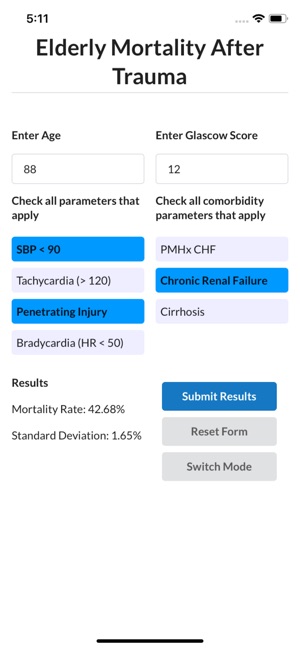
Elderly Mortality After Trauma (EMAT) is a clinical risk calculator for clinicians that estimates the probability of in-hospital mortality for patients aged 65 and older using key physiologic, injury, and comorbidity data. The associated research developed and validated the scoring system using a national trauma database (N=427,358), demonstrating high predictive accuracy with an area under the curve (AuROC) of 0.86 for the full score and 0.84 for the quick score. The authors conclude this tool can aid in clinical decision-making regarding patient transfers, family counseling, and palliative care utilization.

App Screenshots

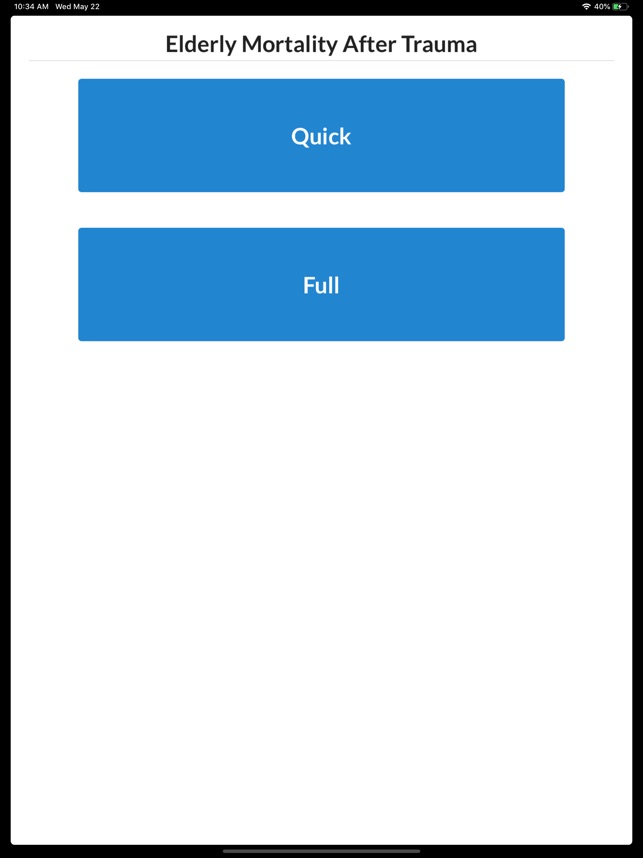
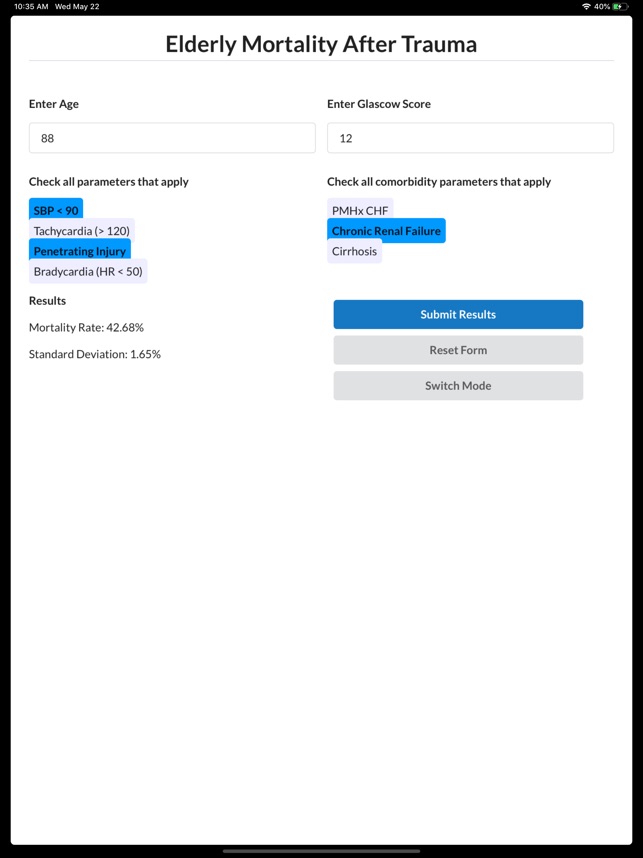
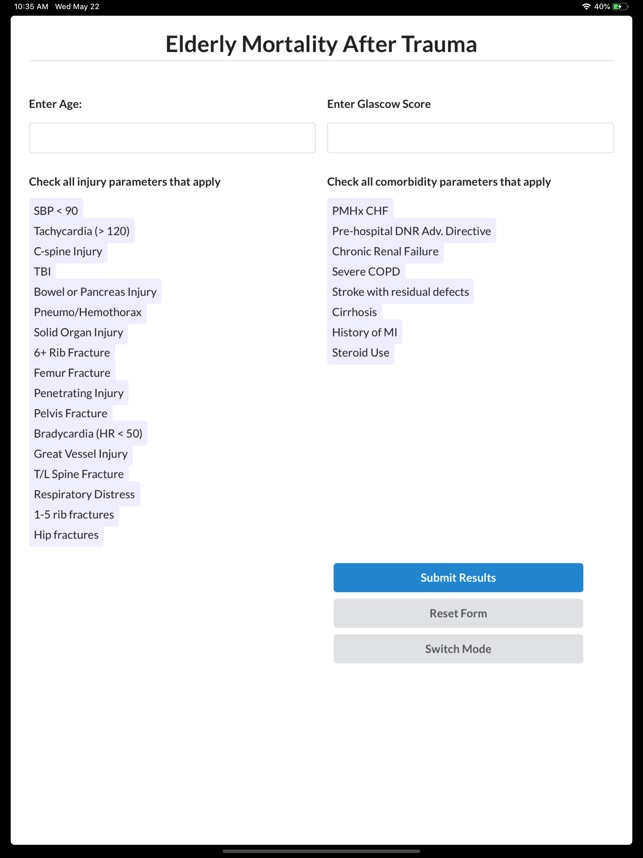
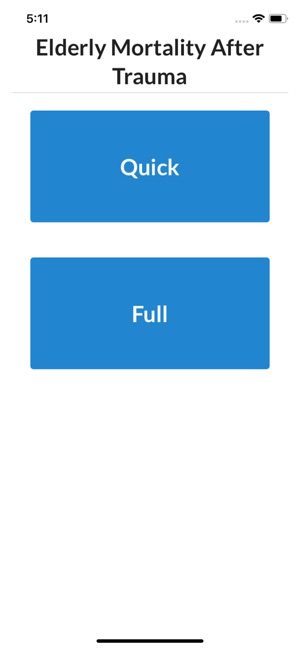
Elderly Mortality After Trauma screenshot 1 of 6Elderly Mortality After Trauma screenshot 2 of 6Elderly Mortality After Trauma screenshot 3 of 6Elderly Mortality After Trauma screenshot 4 of 6Elderly Mortality After Trauma screenshot 5 of 6Elderly Mortality After Trauma screenshot 6 of 6

Detailed Description

Functionality & Mechanism

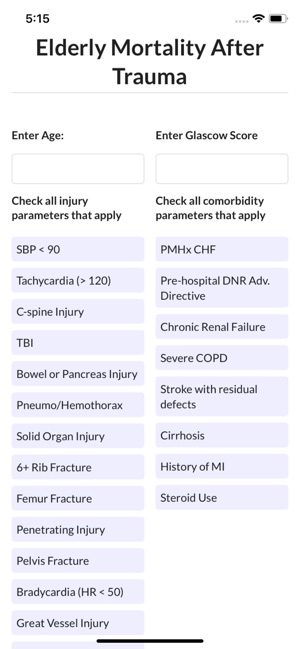
The Elderly Mortality After Trauma (EMAT) system calculates the probability of in-hospital mortality for geriatric trauma patients. The interface facilitates risk assessment via two distinct modules: a rapid Quick (qEMAT) score for initial presentation and a comprehensive Full (fEMAT) score for use after radiologic evaluation. The system captures input on patient age, comorbidities, physiologic parameters, and injury types to generate a predictive score, with the full module leveraging 26 factors for enhanced accuracy.

Evidence & Research Context

  • The EMAT scoring system was developed and validated in a large-scale epidemiological study using National Trauma Databank records from over 1.2 million patients aged 65 and older.
  • A validation study (N=427,358) demonstrated strong discrimination for predicting in-hospital mortality, with an Area Under the Curve (AuROC) of 0.86 for the fEMAT and 0.84 for the qEMAT.
  • The fEMAT model was shown to outperform other standard trauma mortality prediction tools, including the Trauma and Injury Severity Score (TRISS) and age plus Injury Severity Score (ISS).
  • In a comparative analysis using a regional trauma registry, the qEMAT model demonstrated superior predictive performance over the Geriatric Trauma Outcome Score (GTOS).

Intended Use & Scope

This clinical reference tool is intended for physicians and trauma care teams. Its primary utility is to provide rapid, data-driven mortality risk stratification to inform decisions regarding patient transfers, family counseling, and palliative care consultation. The scores estimate in-hospital mortality only and are not a substitute for comprehensive clinical judgment or a predictor of long-term outcomes.

Studies & Publications

1 publication

Peer-reviewed research associated with this app.

Development/Design Paper

Predictors of elderly mortality after trauma: A novel outcome score

Morris et al. (2020) · Journal of Trauma and Acute Care Surgery

Describes the research-driven development of this app
INTRODUCTIONElderly trauma patients are at high risk for mortality, even when presenting with minor injuries. Previous prognostic models are poorly used because of their reliance on elements unavailable during the index hospitalization. The purpose of this study was to develop a predictive algorithm to accurately estimate in-hospital mortality using easily available metrics.METHODSThe National Trauma Databank was used to identify patients 65 years and older. Data were split into derivation (2007–2013) and validation (2014–2015) data sets. There was no overlap between data sets. Factors included age, comorbidities, physiologic parameters, and injury types. A two-tiered scoring system to predict in-hospital mortality was developed: a quick elderly mortality after trauma (qEMAT) score for use at initial patient presentation and a full EMAT (fEMAT) score for use after radiologic evaluation. The final model (stepwise forward selection,p< 0.05) was chosen based on calibration and discrimination analysis. Calibration (Brier score) and discrimination (area under the receiving operating characteristic curve [AuROC]) were evaluated. Because National Trauma Databank did not include blood product transfusion, an element of the Geriatric Trauma Outcome Score (GTOS), a regional trauma registry was used to compare qEMAT versus GTOS. A mobile-based application is currently available for cost-free utilization.RESULTSA total of 840,294 patients were included in the derivation data set and 427,358 patients in the validation data set. The fEMAT score (median, 91; S.D., 82–102) included 26 factors, and the qEMAT score included eight factors. The AuROC was 0.86 for fEMAT (Brier, 0.04) and 0.84 for qEMAT. The fEMAT outperformed other trauma mortality prediction models (e.g., Trauma and Injury Severity Score—Penetrating and Trauma and Injury Severity Score—Blunt, age + Injury Severity Score). The qEMAT outperformed the GTOS (AuROC, 0.87 vs. 0.83).CONCLUSIONThe qEMAT and fEMAT accurately estimate the probability of in-hospital mortality and can be easily calculated on admission. This information could aid in deciding transfer to tertiary referral center, patient/family counseling, and palliative care utilization.LEVEL OF EVIDENCEEpidemiological Study, level IV.
... Read More

Elderly Mortality After Trauma

Free