
AppsFromResearch
FoalScore icon

FoalScore

Evidence Tier:EVALUATED

Assessed by researchers — did not demonstrate expected results

For:Clinicians & Healthcare Professionals

App Summary

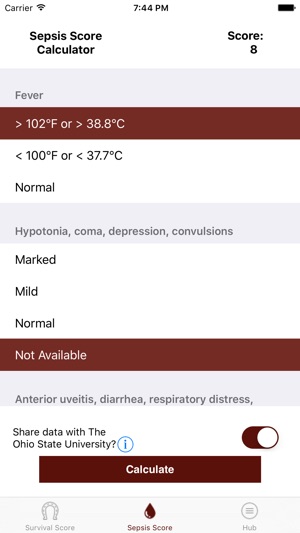
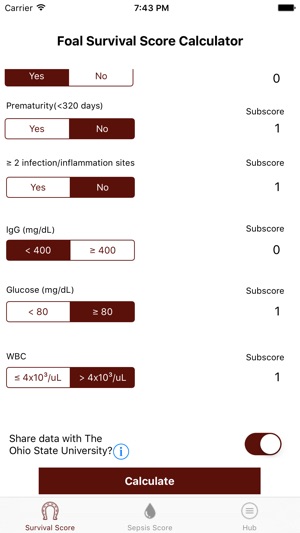
FoalScore is a clinical decision support tool for veterinarians that calculates the probability of survival and sepsis in critically ill newborn foals using published scoring systems. A prospective validation study (N=283) of the underlying survival score demonstrated a sensitivity of 96% and specificity of 71% for predicting outcomes in hospitalized foals. The associated research concludes that the score can be easily implemented to provide an objective, data-driven tool that aids in clinical decision-making and discussions with owners about prognosis.

App Screenshots

FoalScore screenshot 1 of 2FoalScore screenshot 2 of 2

Detailed Description

Functionality & Mechanism

Developed by researchers at The Ohio State University, FoalScore is a clinical assessment tool for equine neonates. The interface facilitates the entry of a foal's vital signs and relevant laboratory data based on admission findings. The system then calculates the probability of survival and likelihood of sepsis by leveraging two distinct, published scoring models. The application architecture permits the storage and electronic sharing of calculated scores to support clinical record-keeping and communication between veterinary professionals.

Evidence & Research Context

  • A validation study of the underlying survival score (N=283 hospitalized foals) demonstrated robust predictive performance with 96% sensitivity, 71% specificity, and a 91% positive predictive value.
  • An evaluation study (N=273 ill foals) confirmed the integrated sepsis score is significantly elevated in septic neonates compared to sick-nonseptic and healthy controls.
  • The development and validation of the survival score was conducted in a multi-site hospital setting, with authors noting the need for further evaluation in field conditions.

Intended Use & Scope

FoalScore is intended for veterinarians as a clinical decision-support tool to rapidly assess prognosis in critically ill newborn foals. Its primary utility is to quantify risk and facilitate objective communication with owners regarding medical management. The system is not a substitute for comprehensive clinical judgment and should be used as an adjunct to a full diagnostic evaluation.

Studies & Publications

2 publications

Peer-reviewed research associated with this app.

Evaluation Study

Evaluation of updated sepsis scoring systems and systemic inflammatory response syndrome criteria and their association with sepsis in equine neonates

Wong et al. (2018) · Journal of Veterinary Internal Medicine

Updated scoring systems did not improve sepsis prediction accuracy in foals.

Background The original equine sepsis score provided a method of identifying foals with sepsis. New variables associated with sepsis have been evaluated, but the sepsis score has not been updated. Objectives To evaluate the sensitivity and specificity of 2 updated sepsis scores and the systemic inflammatory response syndrome (SIRS) criteria in regard to detecting sepsis in foals. Animals Two?hundred and seventy?three ill foals and 25 healthy control foals. Methods Historical, physical examination, and clinicopathologic findings were used to calculate the original sepsis score and 2 updated sepsis scores. SIRS criteria were also evaluated. Sepsis scores and positive SIRS scores were statistically compared to foals with sepsis. Results One?hundred and twenty?six foals were septic and 147 sick?nonseptic. The original and updated sepsis scores were significantly higher in septic foals as compared to sick?nonseptic and healthy foals. The sensitivity and specificity of the updated sepsis scores to predict sepsis were not significantly better than those of the original sepsis score. One?hundred and twenty?seven of 273 (46.5%) foals met the original SIRS criteria and 88/273 (32%) foals met the equine neonatal SIRS criteria. The original SIRS criteria had similar sensitivity and specificity for predicting sepsis as did the 3 sepsis scores in our study. Conclusions and Clinical Importance The updated sepsis scores did not provide improved ability in predicting sepsis. Fulfilling the original SIRS criteria provided similar sensitivity and specificity in predicting sepsis as the modified sepsis score and might serve as a diagnostic aid in identifying foals at risk for sepsis.
... Read More
Development/Design Paper

Development of a likelihood of survival scoring system for hospitalized equine neonates using generalized boosted regression modeling

Dembek et al. (2014) · PLOS ONE

Describes the research-driven development of this app
Background Medical management of critically ill equine neonates (foals) can be expensive and labor intensive. Predicting the odds of foal survival using clinical information could facilitate the decision-making process for owners and clinicians. Numerous prognostic indicators and mathematical models to predict outcome in foals have been published; however, a validated scoring method to predict survival in sick foals has not been reported. The goal of this study was to develop and validate a scoring system that can be used by clinicians to predict likelihood of survival of equine neonates based on clinical data obtained on admission. Methods and Results Data from 339 hospitalized foals of less than four days of age admitted to three equine hospitals were included to develop the model. Thirty seven variables including historical information, physical examination and laboratory findings were analyzed by generalized boosted regression modeling (GBM) to determine which ones would be included in the survival score. Of these, six variables were retained in the final model. The weight for each variable was calculated using a generalized linear model and the probability of survival for each total score was determined. The highest (7) and the lowest (0) scores represented 97% and 3% probability of survival, respectively. Accuracy of this survival score was validated in a prospective study on data from 283 hospitalized foals from the same three hospitals. Sensitivity, specificity, positive and negative predictive values for the survival score in the prospective population were 96%, 71%, 91%, and 85%, respectively. Conclusions The survival score developed in our study was validated in a large number of foals with a wide range of diseases and can be easily implemented using data available in most equine hospitals. GBM was a useful tool to develop the survival score. Further evaluations of this scoring system in field conditions are needed.
... Read More

FoalScore

Free