
Gypsum Requirement
Published in academic literature
App Summary
App Screenshots
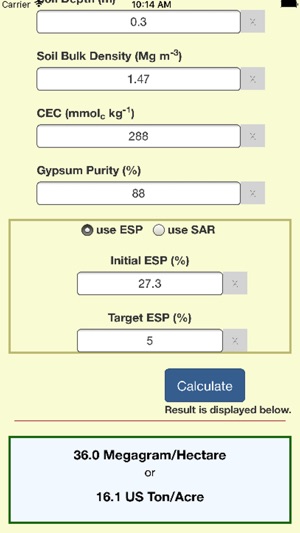
Detailed Description
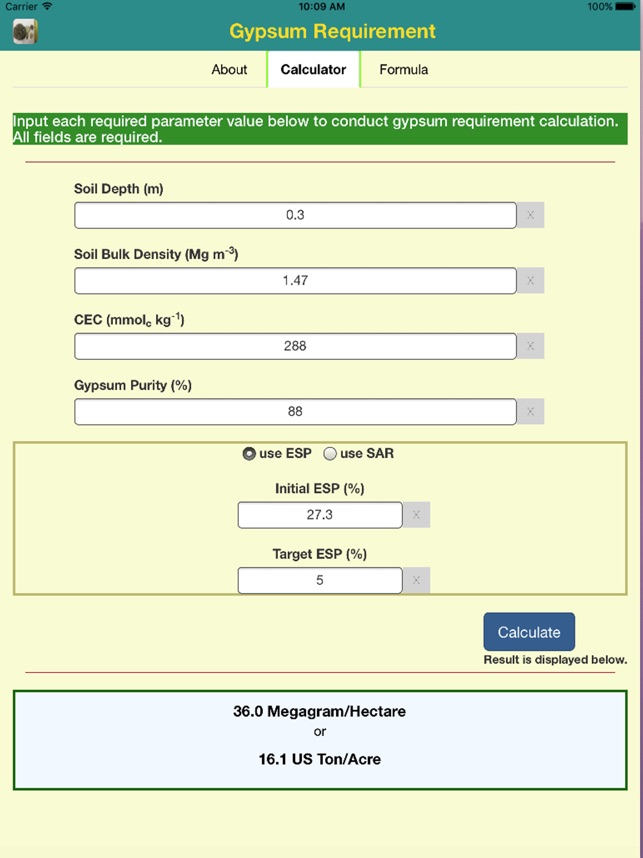
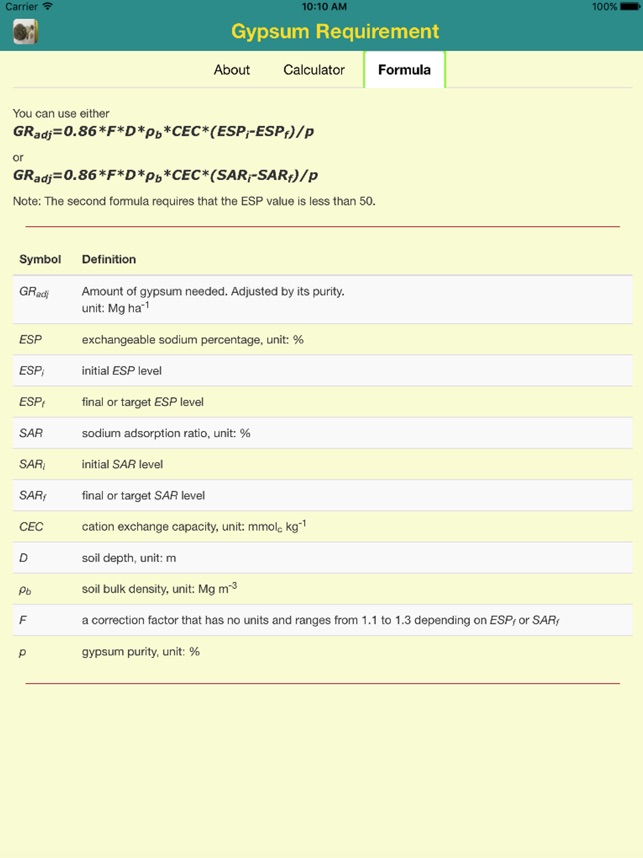
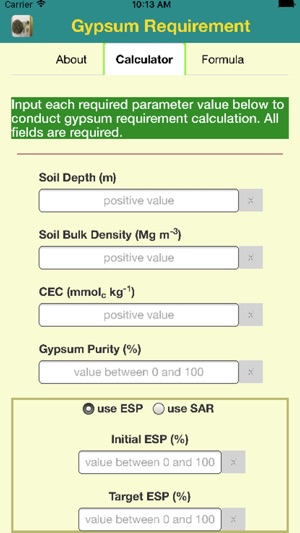
Functionality & Mechanism The Gypsum Requirement application, developed based on research from North Dakota State University, calculates the optimal amount of gypsum needed for sodic soil remediation. The interface prompts for the input of key soil analysis parameters, including initial and final Sodium Adsorption Ratio (SAR) or Exchangeable Sodium Percentage (ESP), soil bulk density, treatment depth, and cation exchange capacity. It also accounts for gypsum purity and application efficiency. Leveraging a standard remediation equation, the tool generates a precise gypsum requirement in metric (Mg/ha) or imperial (tons/acre) units.
Evidence & Research Context
- The app's methodology addresses sodicity, a condition where excess sodium degrades soil structure through chemical dispersion and swelling, impeding water infiltration and root growth.
- Associated research from North Dakota State University outlines a remediation protocol that requires a soluble calcium amendment, typically gypsum, to displace sodium from soil exchange sites.
- This research explicitly references the Gypsum Requirement app as a practical tool for calculating the necessary amendment quantity based on the established remediation equation.
- The scientific context provided distinguishes the remediation of naturally occurring sodic soils from the distinct chemical challenges presented by brine spills from oil extraction.
Intended Use & Scope This calculator is designed for agricultural professionals, soil scientists, and land managers involved in the remediation of sodic soils. Its primary utility is to provide a precise, site-specific gypsum requirement based on analytical soil data. The tool does not conduct soil analysis; its calculations depend entirely on user-provided laboratory results. For a comprehensive remediation plan, including drainage and leaching strategies, consultation with an agronomist is recommended.
Studies & Publications
Peer-reviewed research associated with this app.
Sodicity and Remediation of Sodic Soils in North Dakota
Franzen et al. (2024) · NDSU Extension
Referenced in academic literature; no direct evaluation of the appApp Information
Developer
North Dakota State UniversityCategory
Evidence Profile
Published in academic literature
Platforms
Updated
May 2018
© 2025 North Dakota State University
Tags



Gypsum Requirement
Free