
AppsFromResearch
i-Angel Sound icon

i-Angel Sound

Proven effective in research studies

For:Patients & Caregivers

App Summary

i-Angel Sound is an auditory rehabilitation app designed to help individuals, particularly those with cochlear implants, improve sound and speech discrimination skills through self-paced training modules at home. The app is based on the principle of targeted auditory training, which was shown in a study of 10 cochlear implant users to significantly improve speech recognition in noise, with gains from simple digit training generalizing to more complex sentence understanding. The associated research concludes that such auditory rehabilitation is a critical component for maximizing the benefits of an implant device and enhancing speech perception in challenging listening environments.

App Screenshots

i-Angel Sound screenshot 1 of 10i-Angel Sound screenshot 2 of 10i-Angel Sound screenshot 3 of 10i-Angel Sound screenshot 4 of 10i-Angel Sound screenshot 5 of 10i-Angel Sound screenshot 6 of 10i-Angel Sound screenshot 7 of 10i-Angel Sound screenshot 8 of 10i-Angel Sound screenshot 9 of 10i-Angel Sound screenshot 10 of 10

Detailed Description

Functionality & Mechanism

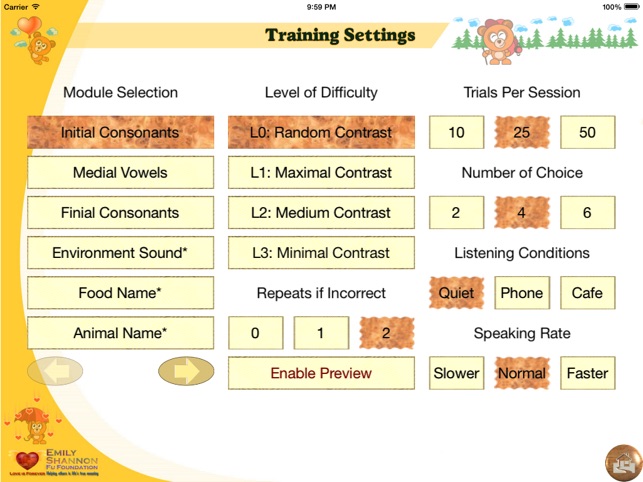
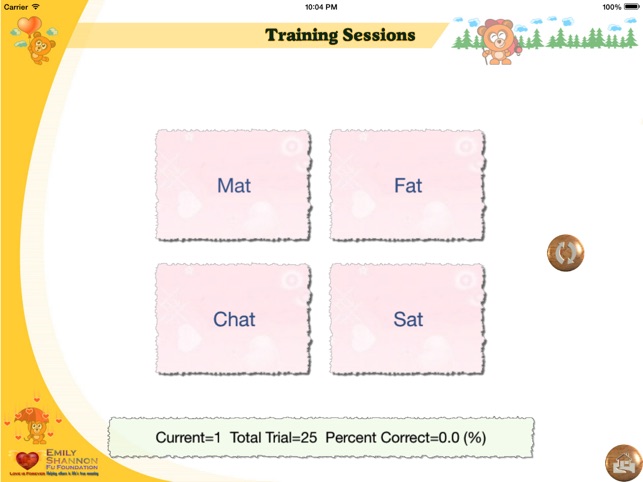
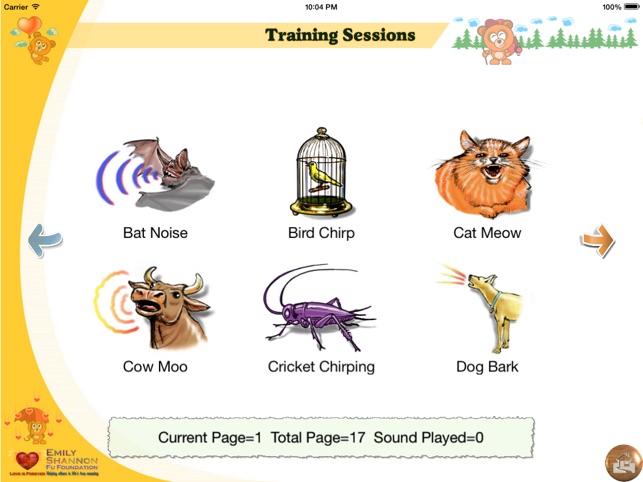
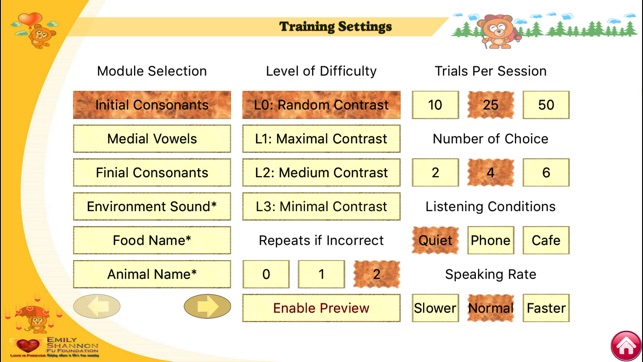
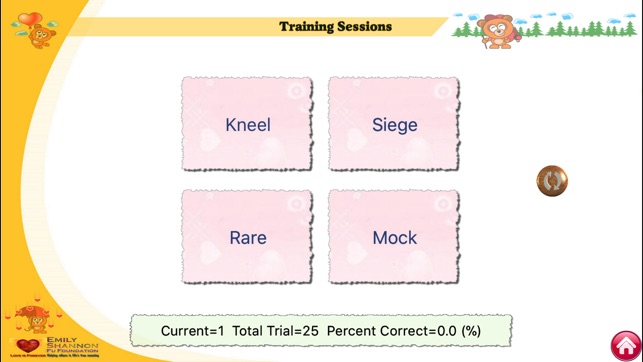
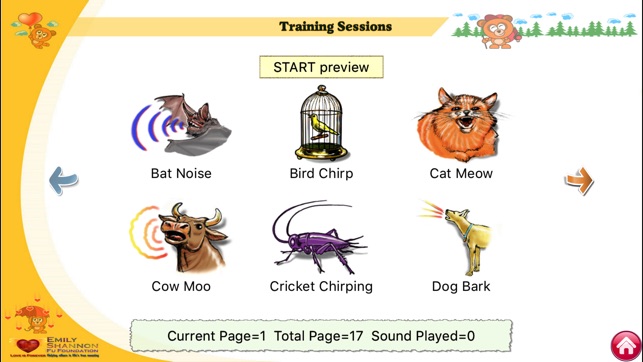
Developed by TigerSpeech Technology Inc., i-Angel Sound delivers an interactive, self-paced auditory training program for independent home use. The system presents modules containing thousands of environmental, lexical, and monosyllabic sounds for discrimination and identification practice. An adaptive difficulty mechanism adjusts to the user's skill level, and the interface provides immediate audio-visual feedback on performance. The core design leverages phonetic contrast training protocols to reinforce the user's ability to distinguish between phonemes, the foundational components of spoken language.

Evidence & Research Context

  • The app's methodology is supported by research where post-lingually deafened adult cochlear implant (CI) users (N=10) completed a similar home-based training protocol, resulting in significant improvements in speech understanding in noise.
  • In that study, training benefits with simple, closed-set stimuli (digits) generalized to improved performance on more complex, open-set sentence recognition tasks.
  • Performance gains from the training were largely retained at a one-month follow-up assessment, indicating durable learning.
  • Foundational research with normal-hearing listeners (N=16) established that targeted phoneme contrast training accelerates adaptation to spectrally shifted speech, a primary challenge for new CI users.

Intended Use & Scope

The system is designed as an adjunct auditory rehabilitation tool for individuals with hearing impairment, including cochlear implant users, to complement clinic-based therapy. Its primary utility is providing structured, independent listening practice. This program does not provide diagnostic services or replace professional guidance from an audiologist or speech-language pathologist.

Studies & Publications

3 publications

Peer-reviewed research associated with this app.

Effectiveness/Outcome Study

Digit training in noise can improve cochlear implant users' speech understanding in noise

Oba et al. (2011) · Ear and Hearing

Home-based digit training improved cochlear implant users' speech understanding in noisy environments.

Objective: This study investigated whether auditory training could improve cochlear implant (CI) users' speech recognition in noise and whether training with familiar stimuli in a relatively simple task (closed-set digit recognition) would generalize to improve recognition of unfamiliar stimuli in more complex tasks (open-set sentence recognition). Design: Ten post-lingually deafened adult CI users participated in a repeated-measures design. Baseline speech understanding was established by repeatedly measuring recognition of digits, Hearing in Noise Test (HINT) sentences, and IEEE sentences in both steady-state speech-shaped noise and multi-talker speech babble. Following baseline measures, participants engaged in a home-based training program using custom software. Training consisted of identifying random sequences of three digits presented in speech babble (a closed-set task) for approximately 30 minutes per day, 5 days per week, over a 4-week period (totaling ~10 hours). During training, the signal-to-noise ratio (SNR) was adaptively adjusted based on performance, and feedback was provided. Results: Post-training assessments revealed that digit training in babble significantly improved digit recognition in both the trained condition (babble) and the untrained condition (steady noise). Crucially, these training benefits generalized to open-set sentence recognition tasks: participants demonstrated improved recognition of HINT and IEEE sentences in both types of noise. Furthermore, these performance gains were largely retained in follow-up measures conducted one month after the training concluded. Conclusions: The findings demonstrate that targeted auditory training in noise can significantly enhance speech understanding for CI users in noisy environments. The study specifically highlights that training with simple, familiar stimuli in an easy listening task can effectively generalize to improve performance with more difficult, open-set speech materials.
... Read More
Effectiveness/Outcome Study

Auditory training with spectrally shifted speech: an implication for cochlear implant users' auditory rehabilitation

Shannon et al. (2008) · Journal of the Association for Research in Otolaryngology

Targeted training significantly improved recognition of altered speech sounds in listeners adapting to cochlear implant simulation.

After implantation, postlingually deafened cochlear implant (CI) patients must adapt to both spectrally reduced and spectrally shifted speech, due to the limited number of electrodes and the limited length of the electrode array. This adaptation generally occurs during the first three to six months of implant use and may continue for many years. To see whether moderate speech training can accelerate this learning process, 16 naïve, normal-hearing listeners were trained with spectrally shifted speech via an eight-channel acoustic simulation of CI speech processing. Baseline vowel and consonant recognition was measured for both spectrally shifted and unshifted speech. Short daily training sessions were conducted over five consecutive days, using four different protocols. For the test-only protocol, no improvement was seen over the five-day period. Similarly, sentence training provided little benefit for vowel recognition. However, after five days of targeted phoneme training, subjects' recognition of spectrally shifted vowels significantly improved in most subjects. This improvement did not generalize to the spectrally unshifted vowel and consonant tokens, suggesting that subjects adapted to the specific spectral shift, rather than to the eight-channel processing in general. Interestingly, significant improvement was also observed for the recognition of spectrally shifted consonants. The largest improvement was observed with targeted vowel contrast training, which did not include any explicit consonant training. These results suggest that targeted phoneme training can accelerate adaptation to spectrally shifted speech. Given these results with normal-hearing listeners, auditory rehabilitation tools that provide targeted phoneme training may be effective in improving the speech recognition performance of adult CI users.
... Read More

i-Angel Sound

Free