
AppsFromResearch
MAG3Renography icon

MAG3Renography

Evidence Tier:CLINICAL GRADE

Validated in clinical trials

For:Clinicians & Healthcare Professionals

App Summary

MAG3Renography is an educational tool designed to help clinicians and trainees improve their skill in interpreting diuretic renal scans for suspected kidney obstruction. The app's training cases are interpreted by an underlying expert system, which in a study of 95 patient scans (185 kidneys) demonstrated good agreement (weighted κ = 0.72) with a consensus interpretation from three expert readers. The associated research concludes that by allowing users to compare their interpretations with those from the expert system and human specialists, the tool can help supplement diagnostic acumen and assist trainees in gaining a higher level of expertise.

App Screenshots
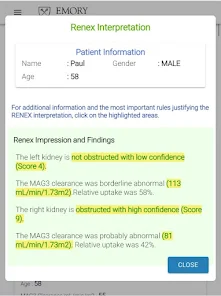
MAG3Renography screenshot 1 of 24MAG3Renography screenshot 2 of 24MAG3Renography screenshot 3 of 24MAG3Renography screenshot 4 of 24MAG3Renography screenshot 5 of 24MAG3Renography screenshot 6 of 24MAG3Renography screenshot 7 of 24MAG3Renography screenshot 8 of 24MAG3Renography screenshot 9 of 24MAG3Renography screenshot 10 of 24MAG3Renography screenshot 11 of 24MAG3Renography screenshot 12 of 24MAG3Renography screenshot 13 of 24MAG3Renography screenshot 14 of 24MAG3Renography screenshot 15 of 24MAG3Renography screenshot 16 of 24MAG3Renography screenshot 17 of 24MAG3Renography screenshot 18 of 24MAG3Renography screenshot 19 of 24MAG3Renography screenshot 20 of 24MAG3Renography screenshot 21 of 24MAG3Renography screenshot 22 of 24MAG3Renography screenshot 23 of 24MAG3Renography screenshot 24 of 24

Detailed Description

Functionality & Mechanism

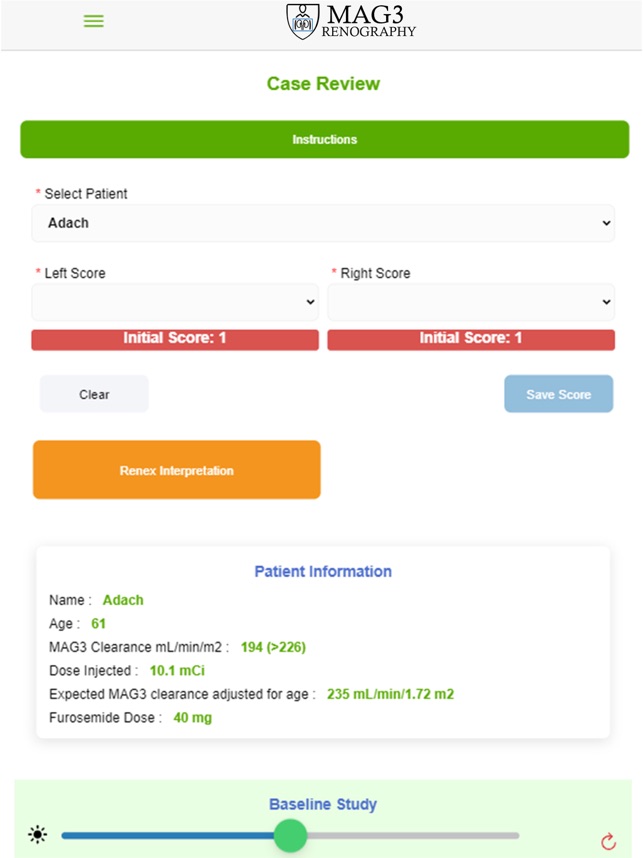
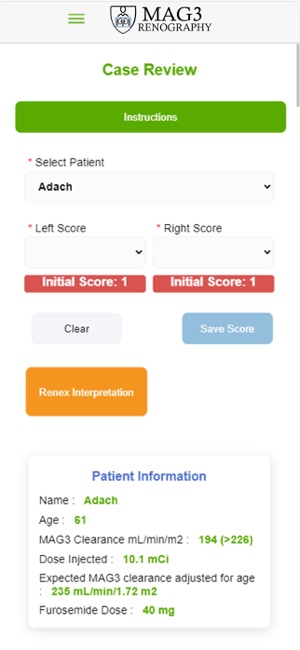
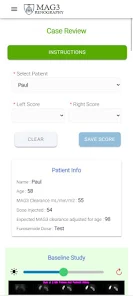
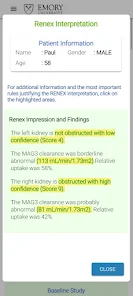
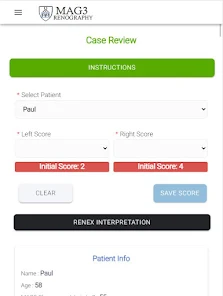
MAG3Renography delivers an interactive educational module for clinicians interpreting diuretic renal scans. The interface presents 10 Tc-99m MAG3 case studies, requiring the clinician to assess renal obstruction status and specify a confidence level. The system then displays an interpretation and justification generated by the integrated RENEX expert system. This allows the clinician to re-score the case before the platform reveals the final consensus interpretation and rationale from three experienced physicians, facilitating a direct comparison of diagnostic reasoning.

Evidence & Research Context

  • A validation study of the underlying RENEX expert system (N=185 kidneys) demonstrated good agreement with the consensus interpretation of three expert readers (weighted κ = 0.72) for assessing renal obstruction.
  • The system's diagnostic accuracy has been shown to be comparable to that of experts and greater than that of nuclear medicine residents; resident diagnostic accuracy improved after reinterpreting cases with access to RENEX.
  • An enhanced version (iRENEX) that incorporates clinical data demonstrated improved agreement with expert panels in a pilot study (N=100 kidneys), correctly identifying 95% of obstructed kidneys.
  • The system's justification engine, which provides the rationale for its conclusions, was evaluated in a prospective study (N=117 kidneys), demonstrating robust alignment with expert-identified variables.

Intended Use & Scope

This tool is designed for nuclear medicine physicians, radiologists, urologists, and trainees in these specialties. Its primary utility is as an educational module and decision support reference to augment interpretive skills for diuretic renography. The system does not provide treatment recommendations or replace expert clinical judgment, which remains the responsibility of the clinician.

Studies & Publications

6 publications

Peer-reviewed research associated with this app.

Development/Design Paper

An Interactive Teaching Website for Tc-99m MAG3 Diuretic Renography (https://MAG3renography.net)

Taylor et al. (2022) · Journal of Nuclear Medicine

Describes the research-driven development of this app
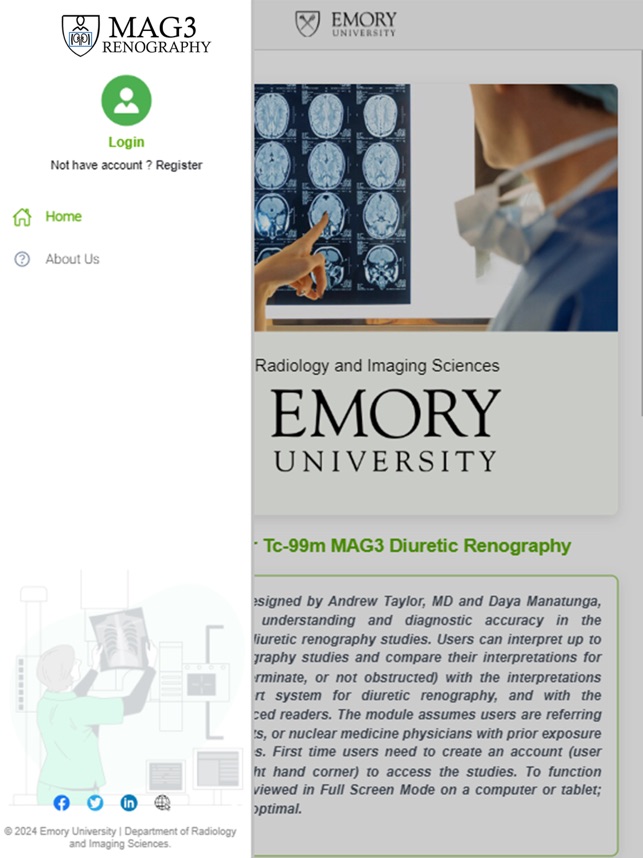
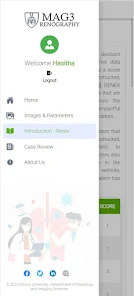
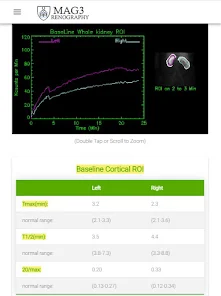
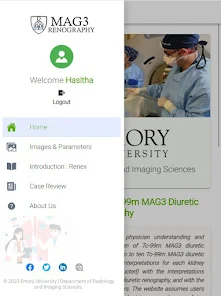
Introduction: The majority of the estimated 590,000 radionuclide renal scans performed annually in the United States are conducted at sites that perform fewer than 3 studies per week. Due to the relative infrequency of renal studies, some trainees may fail to acquire the expertise needed for a competent interpretation, a problem shared by radiologists whose nuclear medicine training was limited to 3-4 months. Limited training and experience may lead to incorrect scan interpretation, discourage use of the procedure, and negatively impact patient care. To address this problem, we developed software (RENEX) to assist in the interpretation of Tc-99m MAG3 diuretic renal scans [1-3]. RENEX is a heuristic or rule based decision support system that uses quantitative data derived from the renogram to determine the status of a potentially obstructed kidney (obstructed, indeterminate, or not obstructed). RENEX provides the justification (rules) for its interpretation and specifies a level of confidence [1,4]. RENEX has a diagnostic accuracy comprable to that of experts and greater diagnostic accuracy than that of nuclear medicine residents with one year of training; the diagnostic accuracy of these experienced residents improved when they reinterpreted the cases with access to RENEX [5]. RENEX also outperformed a second set of experienced nuclear medicine residents and diagnostic accuracy again improved with access to RENEX [6]. Following exposure to RENEX, these residents interpreted a new set of cases and had better agreement with experts than that obtained on the initial set [6]. Methods: We designed a website to supplement resident and physician exposure to Tc-99m MAG3 diuretic studies and make the teaching components of RENEX more broadly available. Results: The website is organized into a Home Page, Introduction Pages, a Case Review Page, RENEX and Expert Interpretation Pages. The Introduction Pages provide a sample study accompanied by an explanation of relevant renogram parameters, links to references and a description of RENEX. The user scores each kidney on the Case Review Page as obstructed, indeterminate, or not obstructed using a numerical scoring system. The RENEX Interpretation (score) and justification becomes available to the user after the kidneys in the assigned cases have been scored. After reviewing the scores and justification by RENEX, users are asked to re- score each kidney. They may re-enter their original scores or modify their initial scores based on input from RENEX. Once the cases re-scored, the user is given access to the scores and comments of 3 experienced readers Conclusions: This interactive web based format allows users to gain additional experience and supplement their diagnostic acumen by comparing their interpretations with the interpretations and rationale provided by RENEX and experts.
... Read More
Development/Design Paper

Computer-assisted diagnosis in renal nuclear medicine: Rationale, methodology and interpretative criteria for diuretic renography

Taylor et al. (2014) · Seminars in Nuclear Medicine

Describes the research-driven development of this app
The goal of artificial intelligence, expert systems, decision support systems and computer assisted diagnosis (CAD) in imaging is the development and implementation of software to assist in the detection and evaluation of abnormalities, to alert physicians to cognitive biases, to reduce intra and inter-observer variability and to facilitate the interpretation of studies at a faster rate and with a higher level of accuracy. These developments are needed to meet the challenges resulting from a rapid increase in the volume of diagnostic imaging studies coupled with a concurrent increase in the number and complexity of images in each patient data. The convergence of an expanding knowledge base and escalating time constraints increases the likelihood of physician errors. Errors are even more likely when physicians interpret low volume studies such as 99mTc-MAG3 diuretic scans where imagers may have had limited training or experience. Decision support systems include neural networks, case-based reasoning, expert systems and statistical systems. iRENEX (renal expert) is an expert system for diuretic renography that uses a set of rules obtained from human experts to analyze a knowledge base of both clinical parameters and quantitative parameters derived from the renogram. Initial studies have shown that the interpretations provided by iRENEX are comparable to the interpretations of a panel of experts. iRENEX provides immediate patient specific feedback at the time of scan interpretation, can be queried to provide the reasons for its conclusions and can be used as an educational tool to teach trainees to better interpret renal scans. iRENEX also has the capacity to populate a structured reporting module and generate a clear and concise impression based on the elements contained in the report; adherence to the procedural and data entry components of the structured reporting module assures and documents procedural competency. Finally, although the focus is CAD applied to diuretic renography, this review offers a window into the rationale, methodology and broader applications of computer assisted diagnosis in medical imaging.
... Read More

MAG3Renography

Free