
AppsFromResearch
Michigan MAGIC icon

Michigan MAGIC

Evidence Tier:VALIDATED

Proven effective in research studies

For:Clinicians & Healthcare Professionals

App Summary

Michigan MAGIC is a clinical decision support tool that helps healthcare providers apply evidence-based guidelines for the appropriate use of peripherally inserted central catheters (PICCs). A quasiexperimental study in 52 hospitals (N=38,592 PICCs) found that implementing the MAGIC criteria was associated with an increase in appropriate PICC use and a significant decrease in device-related complications from 14.7% to 10.7%. The associated research concludes that using these criteria can improve patient safety by reducing the odds of complications, including catheter occlusion, bloodstream infections, and venous thromboembolism.

App Screenshots

Michigan MAGIC screenshot 1 of 9Michigan MAGIC screenshot 2 of 9Michigan MAGIC screenshot 3 of 9Michigan MAGIC screenshot 4 of 9Michigan MAGIC screenshot 5 of 9Michigan MAGIC screenshot 6 of 9Michigan MAGIC screenshot 7 of 9Michigan MAGIC screenshot 8 of 9Michigan MAGIC screenshot 9 of 9

Detailed Description

Functionality & Mechanism

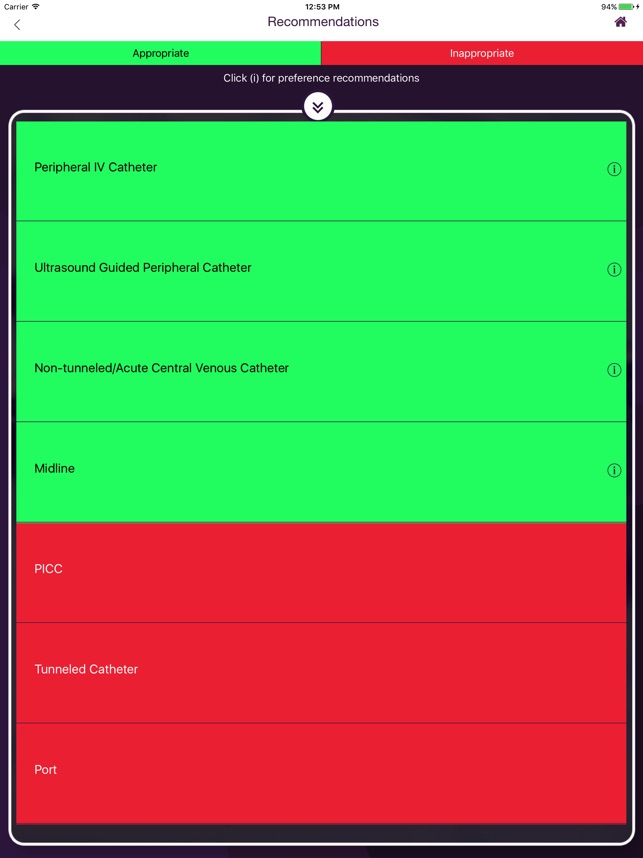
Michigan MAGIC is a clinical decision support framework based on the Michigan Appropriateness Guide for Intravenous Catheters. The system is designed for integration into electronic health record order sets. When initiating a request for venous access, the interface presents evidence-based criteria derived from the MAGIC guidelines. It prompts for key inputs—such as indication, infusate type, and anticipated duration of use—to facilitate appropriate selection of peripherally inserted central catheters (PICCs) and alternative vascular access devices.

Evidence & Research Context

  • A quasi-experimental study in 52 Michigan hospitals (N=38,592 PICCs) found that implementing MAGIC increased PICC appropriateness from 31.9% to 49.0% and decreased device-related complications from 14.7% to 10.7%.
  • The same study demonstrated that appropriate PICC use was associated with a significantly lower odds of complications (OR 0.29), including venous thromboembolism, catheter occlusion, and central line-associated bloodstream infection (CLABSI).
  • An analysis of national Medicare claims data found that the volume of PICC placements declined sharply after the 2015 publication of the MAGIC guidelines, suggesting a broad impact on clinical practice.
  • The underlying guidelines were developed by an international, multispecialty panel using the validated RAND/UCLA Appropriateness Method to systematically rate 665 clinical scenarios for venous access.

Intended Use & Scope

This framework is intended for clinicians, vascular access teams, and hospital quality improvement leaders. Its primary utility is as a point-of-care decision support tool to guide appropriate selection of intravenous catheters based on established criteria. The guidelines do not supplant individualized clinical judgment and do not provide instruction on catheter insertion or maintenance procedures.

Studies & Publications

4 publications

Peer-reviewed research associated with this app.

Effectiveness/Outcome Study

Improving peripherally inserted central catheter appropriateness and reducing device-related complications: a quasiexperimental study in 52 Michigan hospitals

Chopra et al. (2021) · BMJ Quality & Safety

PICC appropriateness improved by 17% and complications decreased by 4% after implementing MAGIC guidelines.

Background The Michigan Appropriateness Guide for Intravenous Catheters (MAGIC) provides evidence-based criteria for peripherally inserted central catheter (PICC) use. Whether implementing MAGIC improves PICC appropriateness and reduces complications is unknown. Methods A quasiexperimental study design to implement MAGIC in 52 Michigan hospitals was used. Data were collected from medical records by trained abstractors. Hospital performance on three appropriateness criteria was measured: short-term PICC use (≤5 days), use of multilumen PICCs and PICC placement in patients with chronic kidney disease. PICC appropriateness and device complications preintervention (January 2013 to December 2016) versus postintervention (January 2017 to January 2020) were compared. Change-point analysis was used to evaluate the effect of the intervention on device appropriateness. Logistic regression and Poisson models were fit to assess the association between appropriateness and complications (composite of catheter occlusion, venous thromboembolism (VTE) and central line-associated bloodstream infection (CLABSI)). Results Among 38 592 PICCs, median catheter dwell ranged from 8 to 56 days. During the preintervention period, the mean frequency of appropriate PICC use was 31.9% and the mean frequency of complications was 14.7%. Following the intervention, PICC appropriateness increased to 49.0% (absolute difference 17.1%, p<0.001) while complications decreased to 10.7% (absolute difference 4.0%, p=0.001). Compared with patients with inappropriate PICC placement, appropriate PICC use was associated with a significantly lower odds of complications (OR 0.29, 95% CI 0.25 to 0.34), including decreases in occlusion (OR 0.25, 95% CI 0.21 to 0.29), CLABSI (OR 0.61, 95% CI 0.46 to 0.81) and VTE (OR 0.40, 95% CI 0.33 to 0.47, all p<0.01). Patients with appropriate PICC placement had lower rate of complications than those with inappropriate PICC use (incidence rate ratio 0.987, 95% CI 0.98 to 0.99, p<0.001). Conclusions Implementation of MAGIC in Michigan hospitals was associated with improved PICC appropriateness and fewer complications. These findings have important quality, safety and policy implications for hospitals, patients and payors.
... Read More
Non-Evaluative Reference

Effects of the MAGIC Guidelines on PICC Placement Volume: Advanced Practice Provider and Physician Trends Amongst Medicare Beneficiaries from 2010-2018

Lindquester et al. (2020) · American Journal of Roentgenology

Referenced in academic literature; no direct evaluation of the app
BACKGROUND. The Michigan Appropriateness Guide for Intravenous Catheters (MAGIC) was published in 2015, recommending more restricted indications for peripherally inserted central catheter (PICC) placement, particularly for those placed by physicians. Changes in PICC placement volume since the publication of MAGIC is largely unknown. OBJECTIVE. The purpose of this article was to study the trends in volume and reimbursement for PICC placement by physicians and advanced practice providers (APPs) for Medicare enrollees from 2010 to 2018 with specific attention to the changes in volume after the publication of MAGIC in 2015. METHODS. Claims from the Medicare Part B Physician/Supplier Procedure Summary Master File for the years 2010–2018 were extracted using the Current Procedural Terminology code for PICC placement. Total volume and payment amounts (for the professional component) were analyzed. Trendline slopes for volume per 100,000 Medicare beneficiaries before and after the 2015 publication of MAGIC were compared. RESULTS. Volume for PICC placement by physicians and APPs steadily declined from 243,837 in 2010 to 130,361 in 2018 (46.5%). The PICC placement volume decreased sharply after the 2015 publication of the MAGIC guidelines. The slope of the trendline for all providers from 2010 to 2015 was ?3.4 compared with ?7.3 from 2015 to 2018. The change in slope was more pronounced for radiologists (?3.1 to ?5.6) than for APPs (0.0 to ?1.1). Professional payment per procedure for radiologists decreased from $78.04 in 2010 to $70.17 in 2018, and reimbursement for APPs proportionally decreased from $65.76 to $60.66 during this time. The relative share of PICC placement by radiologists declined from 77.0% in 2010 to 70.6% in 2018, with a corresponding increase in relative share by APPs from 13.5% to 18.4%. The percentage placed in outpatient procedures increased from 15.1% to 18.2%. CONCLUSION. The volume of PICC placements has steadily decreased since 2010, with a sharper decline between 2015 and 2016 corresponding with the publication of the MAGIC evidence-based guidelines. The role of APPs in PICC placement has increased over this time period. CLINICAL IMPACT. The findings of this study suggest that evidence-based guidelines impact clinical practice on a national level.
... Read More

In the Media

Short-Term Use of IV Devices Is Common and Risky

University of Michigan researchers developed Michigan MAGIC to reduce inappropriate short-term use of PICC devices in hospitals, analyzing data from 52 Michigan hospitals to improve patient safety. The study found that 1 in 4 PICC insertions involved patients who didn't need the device long enough to justify its risks, with nearly 1 in 10 short-term patients experiencing complications like infections or blood clots. "When PICCs first came out, they became an 'easy button' for vascular access, and the safety issues weren't recognized," says lead researcher Dr. David Paje.

MichiganmedicineRead article

How to Pick the Right PICC for a Patient? There's an App for That

The University of Michigan and VA Ann Arbor Healthcare System developed Michigan MAGIC to help clinicians choose appropriate vascular access devices at the point of care, using an evidence-based guide created from expert review of over 600 patient scenarios. "This app will make it even easier for clinicians to know when the use of a PICC is appropriate, and when other choices are the best," says Dr. Vineet Chopra, who spearheaded the effort. The free smartphone app is now available for both Apple iOS and Android devices to support bedside decision-making.

UmichRead article

PICC wisely: New best practice guidelines for catheters and IVs

Clinical teams from the University of Michigan and the VA Ann Arbor Health System developed Michigan MAGIC to reduce inappropriate PICC catheter use, providing color-coded charts that help clinicians choose the right intravenous method based on hundreds of scenarios and outcomes. Researchers found that 43 percent of 665 PICC scenarios examined were considered inappropriate, with lead author Vineet Chopra noting that "the easiest way to prevent these complications is not to place a PICC in the first place." The guidelines are currently being tested at 47 hospitals across Michigan and will inform updated national standards by the Infusion Nurses Society.

IadvanceseniorcareRead article

Take your PICC: New guide aims to decrease dangers from long-term IV devices

University of Michigan Medical School and VA Ann Arbor Healthcare System experts developed Michigan MAGIC to provide the first comprehensive guide for selecting appropriate intravenous devices, using an exhaustive review of evidence and international expert input. "The easiest way to prevent these complications is not to place a PICC in the first place," says lead author Vineet Chopra, M.D., M.Sc., emphasizing the guide's focus on avoiding unnecessary procedures. The MAGIC criteria are currently being tested in 47 Michigan hospitals through the Michigan Hospital Medicine Safety Consortium.

UmichRead article

Michigan MAGIC

Free