
AppsFromResearch
Nursing Home Mortality Index icon

Nursing Home Mortality Index

Evidence Tier:VALIDATED

Initial evidence from research studies

For:Clinicians & Healthcare Professionals

App Summary

The Nursing Home Mortality Index helps clinicians estimate the 12-month mortality risk for nursing home residents to guide treatment planning, particularly in dental care settings. A validation study (N=586) of the underlying model demonstrated a sensitivity of 0.79 and specificity of 0.53 for identifying residents in their last year of life, with an area under the curve of 0.68. The associated research concludes that the NHMI provides a practical way to incorporate a patient's prognosis into treatment decisions alongside their clinical needs and preferences.

App Screenshots

Nursing Home Mortality Index screenshot 1 of 8Nursing Home Mortality Index screenshot 2 of 8Nursing Home Mortality Index screenshot 3 of 8Nursing Home Mortality Index screenshot 4 of 8Nursing Home Mortality Index screenshot 5 of 8Nursing Home Mortality Index screenshot 6 of 8Nursing Home Mortality Index screenshot 7 of 8Nursing Home Mortality Index screenshot 8 of 8

Detailed Description

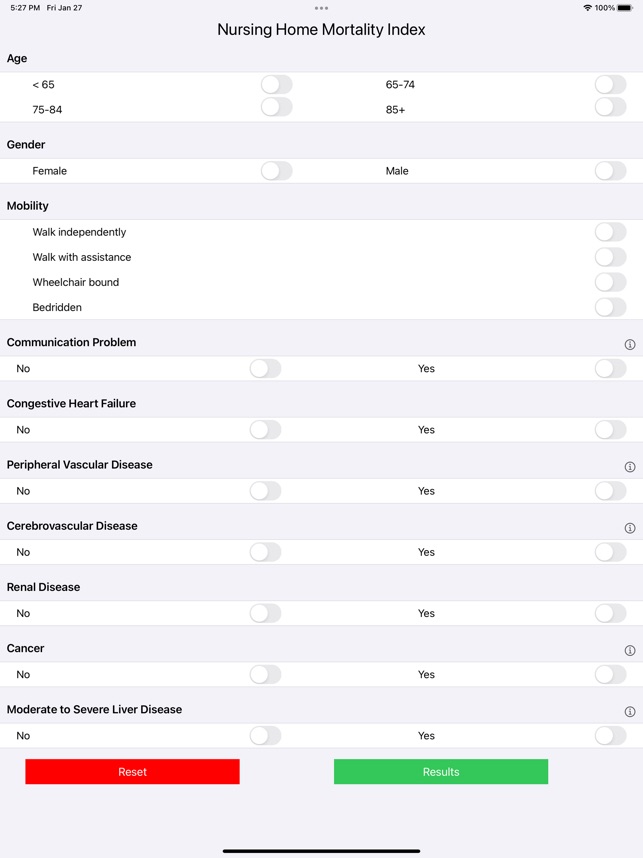
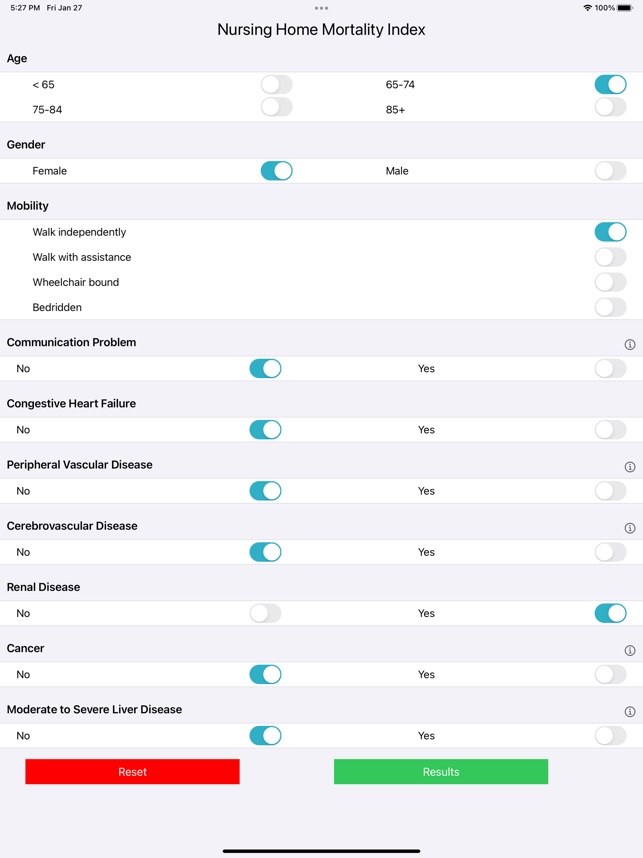
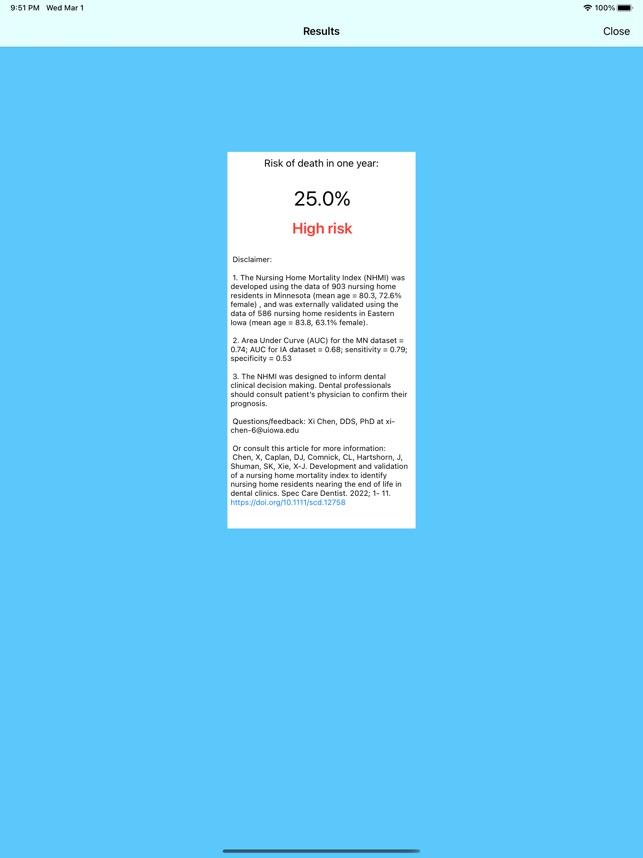
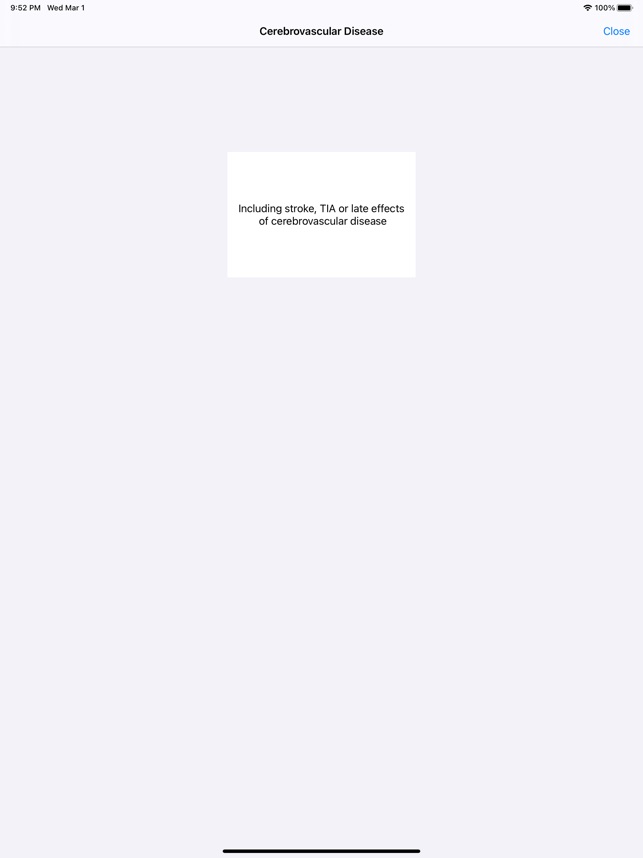
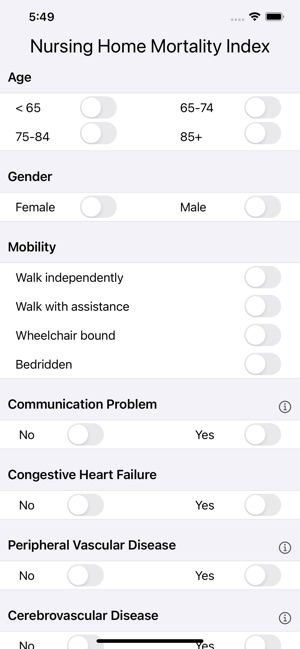
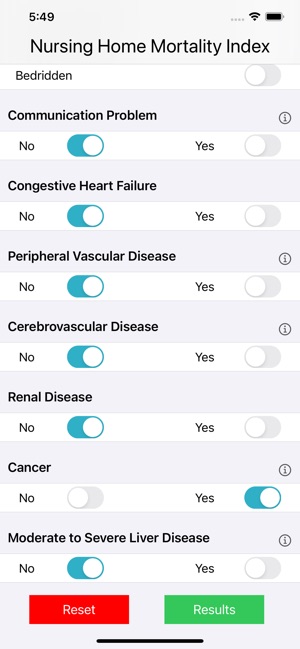
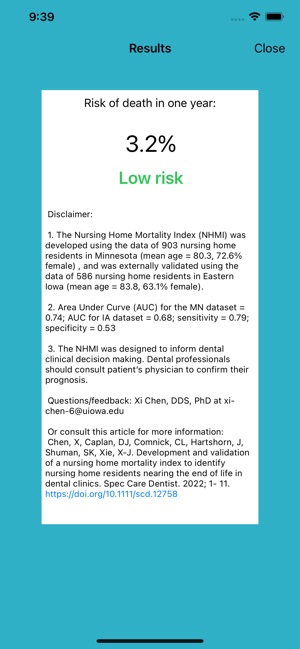
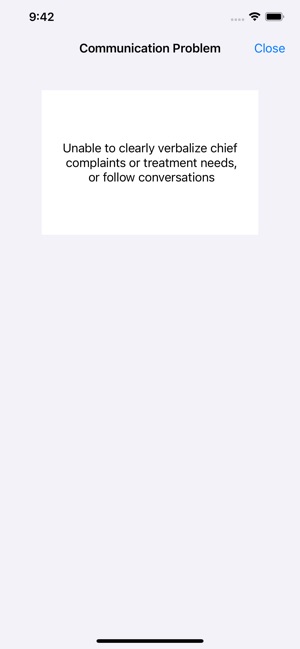
Functionality & Mechanism The Nursing Home Mortality Index is a clinical risk stratification tool designed to estimate 12-month mortality in nursing home residents. The interface captures input on ten validated predictors, including patient demographics, functional status (e.g., communication, mobility), and specific comorbidities. The system then calculates and displays an estimated mortality probability, categorized into low, moderate, or high-risk tiers. Informational icons provide definitions for each input category, facilitating rapid and accurate data entry during a clinical workflow.

Evidence & Research Context

  • A validation study informed the index's development using data from two nursing home resident cohorts (N=1489) receiving dental care.
  • The predictive model demonstrated an area under the curve (AUC) of 0.73 in the development cohort and 0.68 in the external validation cohort.
  • In the validation cohort, the index exhibited a sensitivity of 0.79 and a specificity of 0.53 for identifying mortality within one year.
  • The index integrates ten predictors, including age, gender, communication capacity, physical mobility, congestive heart failure, cancer, and cerebrovascular disease.

Intended Use & Scope This tool is intended for clinicians providing care for nursing home residents. Its primary utility is to support prognostic awareness and inform treatment planning, particularly when weighing the benefits and burdens of interventions near the end of life. The index provides a risk estimate, not a definitive prognosis, and must be integrated with comprehensive clinical judgment and patient-centered goals of care.

Studies & Publications

1 publication

Peer-reviewed research associated with this app.

Validation Study

Development and validation of a nursing home mortality index to identify nursing home residents nearing the end of life in dental clinics

Chen et al. (2022) · Special Care in Dentistry

Accurately predicted 1-year mortality risk in nursing home residents visiting dental clinics.

AbstractBackgroundNursing home (NH) residents seek care at dental offices, yet many of them are at the end of life. The uncertain life expectancy further complicates the care of NH residents. This study aimed to develop and validate a Nursing Home Mortality Index (NHMI) to identify NH residents in the last year of life.MethodsLogistic modeling was used to develop predictive models for death within 1 year after initial appointment by utilizing the new patient examination data and mortality data of 903 Minnesota NH residents. The final model was selected based on areas under the curve (AUC) and then validated using data from 586 Iowa NH residents. Based on the final model, the NHMI was developed with the estimated 1‐year mortality for the low, medium and high risk group.ResultsOne‐year mortalities were 21% and 26% in the development and validation cohorts, respectively. Predictors included age, gender, communication capacity, physical mobility, congestive heart failure, peripheral vascular disease, cancer, cerebrovascular disease, chronic renal disease and liver disease. AUCs for the development and validation models were 0.73 and 0.68, respectively. For the validation cohort, the sensitivity and specificity were 0.79 and 0.53, respectively. The estimated 1‐year mortality risks for three risk groups were 0%–10%, 11%–19%, and ≥20%, respectivelyConclusionThe high mortality rate of NH residents following a dental exam highlighted a need to incorporate patients' prognoses in treatment planning along with normative needs and patients' preferences. The NHMI provides a practical way to guide treatment decisions for end‐of‐life NH residents.
... Read More

Nursing Home Mortality Index

Free