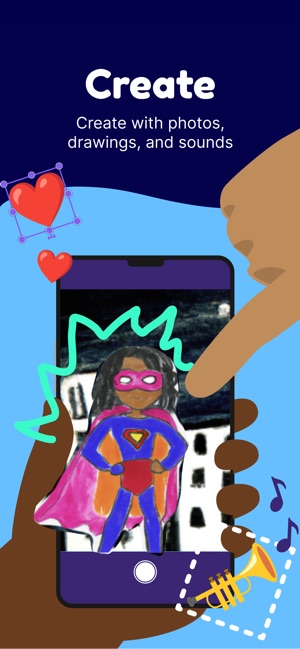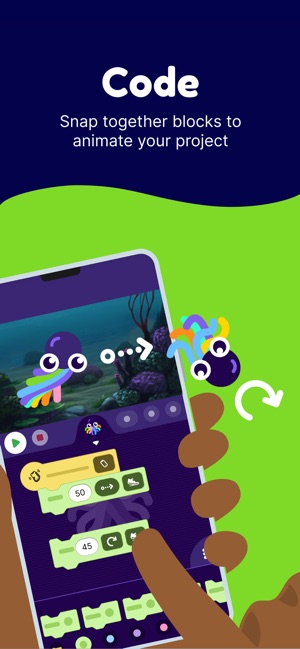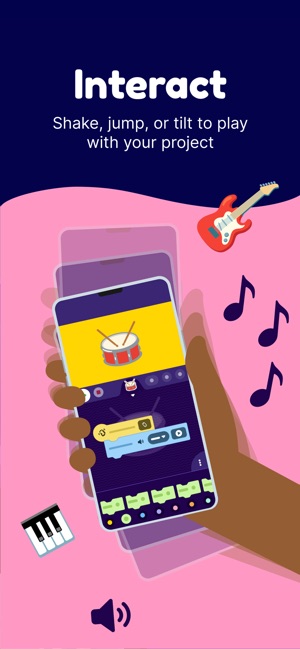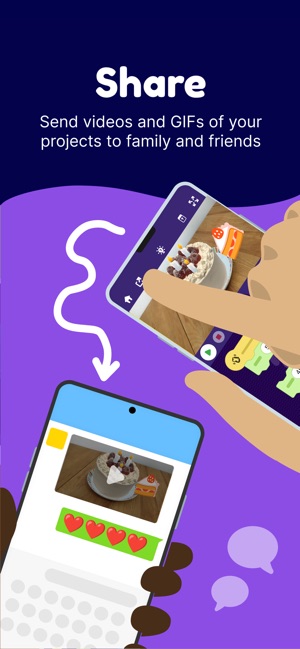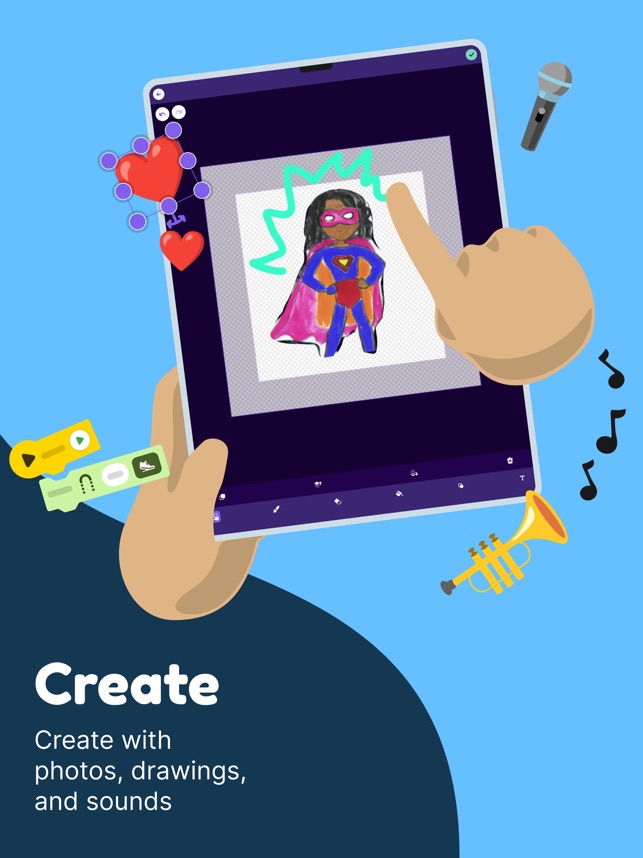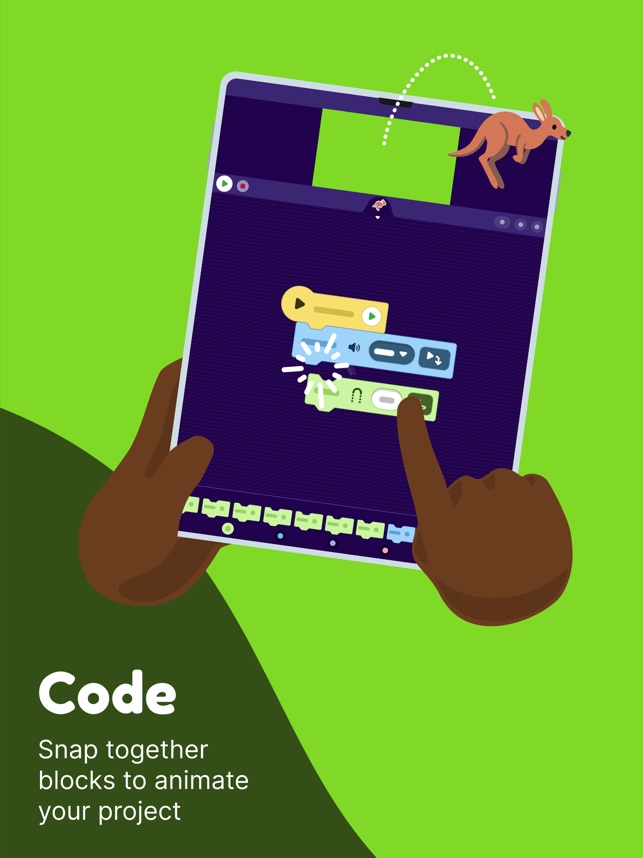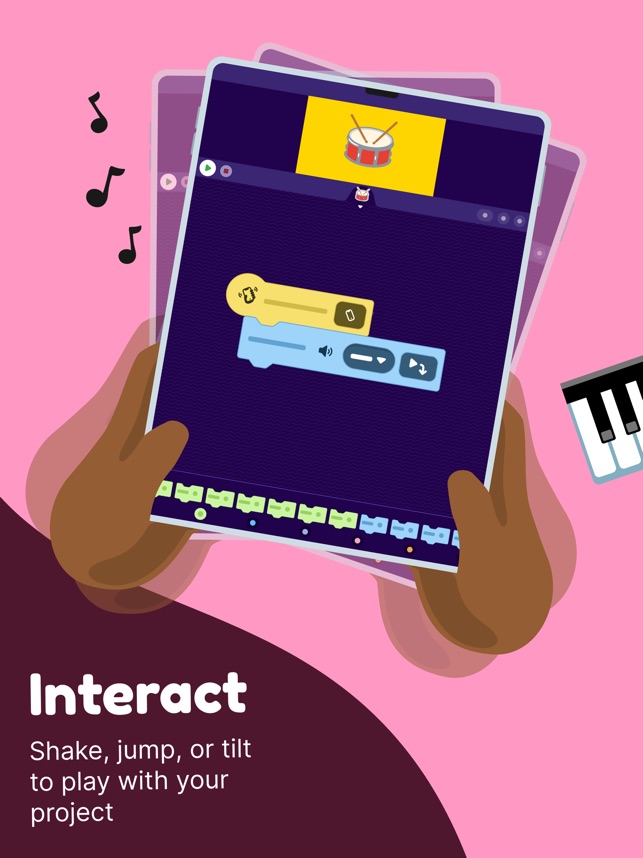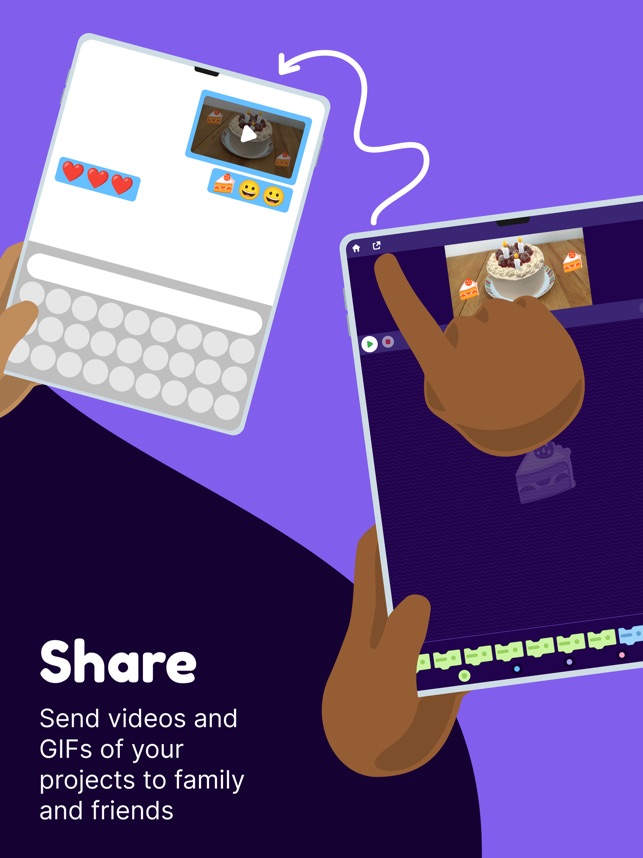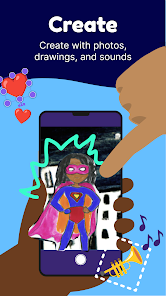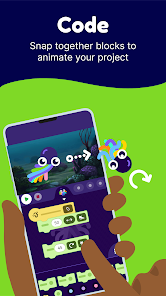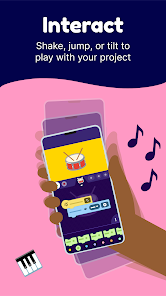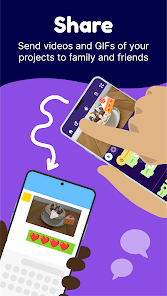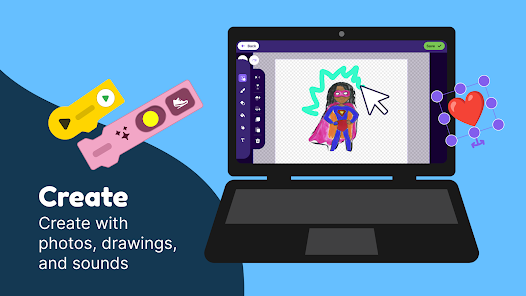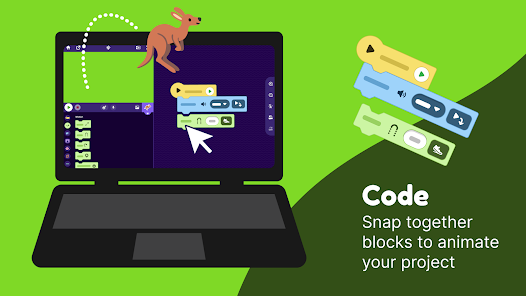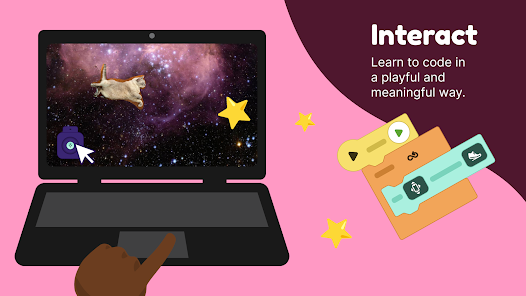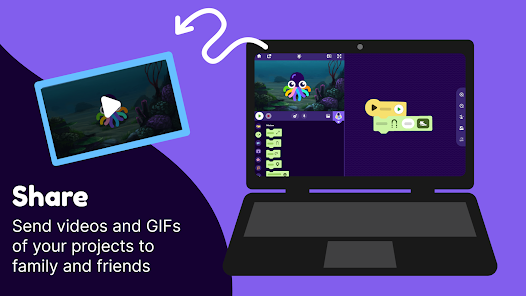

OctoStudio is a free mobile app from the creators of Scratch that enables children and families to create interactive games and animations, expanding access to computational learning in informal settings. The app's design is grounded in a "computational tinkering" approach that encourages hands-on, trial-and-error exploration using coding blocks with both text and icons to support varying literacy levels. By leveraging the physical sensors of mobile devices, the associated research concludes that OctoStudio bridges the gap between physical making and digital creation, thereby expanding opportunities for young people to engage with STEM.
App Screenshots
Detailed Description
Functionality & Mechanism
Developed by the MIT Media Lab's Lifelong Kindergarten group, OctoStudio is a mobile application for creating interactive animations and games via a block-based coding interface. The system leverages integrated device sensors (tilt, shake) and allows the import of photos and sounds. Each coding block combines text with an icon to support diverse literacy levels, facilitating a 'tinkering' approach where learners receive immediate feedback. Sessions involve assembling, testing, and revising code. The application functions without an internet connection.
Evidence & Research Context
The app was developed as a primary outcome of a National Science Foundation (NSF) collaborative research project focused on equitable computational tinkering in informal STEM education.
Its design is grounded in constructionist pedagogy, facilitating learning through a hands-on, iterative 'tinkering' process of creation, testing, and revision.
The interface integrates text and icons on coding blocks to support varying literacy levels and leverages device sensors to link coding with physical interaction.
The associated research details the app's utility for engaging youth and families, including those from underrepresented groups, in community-based settings like museums and libraries.
Intended Use & Scope
OctoStudio is intended for educators, families, and young learners in informal and formal educational settings to introduce foundational computational thinking skills. Its primary utility is pedagogical, designed to foster creative problem-solving through project-based learning. The application does not teach text-based programming languages and is not designed for professional software development.
Research study planned or in progress; results not yet available
There is a national need to expand opportunities to learn coding and computational thinking in informal science, technology, engineering, and mathematics (STEM) education. These skills are increasingly needed in STEM disciplines. As young people learn to code, they engage in computational thinking concepts and practices which are problem solving strategies that include repeated process (iterative) design skills. This project promotes innovation by designing and developing activities for tinkering spaces (a space filled with materials for hands-on exploration of STEM) combined with coding in informal learning organizations such as museums, and community centers. The project supports both tinkering and making as methods to meaningfully incorporate computational thinking in STEM learning experiences. The tinkering approach to learning is characterized by hands-on, trial and error engagement. Making is similar to tinkering with additional attention to learning with peer groups. The long-term goal of the project is to enable informal educators to engage in STEM programming with youth and families from underrepresented groups. The project brings together interdisciplinary teams from the Department of Information Science at the University of Colorado Boulder (CU Boulder), the Tinkering Studio at the Exploratorium, and the Lifelong Kindergarten research group at the Massachusetts Institution of Technology. In collaboration with local partner sites, the project team will design and disseminate a collection of six computational tinkering activity areas that engage learners in creative explorations using a combination of physical objects and computational code. The team will develop visual coding "microworlds" for each of the activity areas, specialized sets of coding blocks designed to provide scaffolding. Additionally, the project team will design and develop facilitation guides to document these activities and facilitation strategies, as well as workshops to better support facilitators in making and tinkering spaces. The project enhances knowledge building through investigations of what instructional supports informal educators need to develop effective facilitation practices that engage underrepresented youth and families in STEM computational learning experiences. Study participants will include informal educators in museum, library, and community-based settings with varying backgrounds and experiences facilitating computing activities. The project team will also engage youth and families from underrepresented groups through collaborative efforts with community-based partners. Research questions include: 1) What challenges and barriers do informal learning educator, face to engage their learners in design-based activities with computing? 2) What supports informal learning educators to take on key facilitation practices that support children and families in computational tinkering activities? 3) In jointly engaging in these computational tinkering activities, how do the activities and informal learning educators' facilitation of these activities impact children's and families' development of computational tinkering and identities as creators and learners with computing? To answer these research questions the project will use qualitative ethnographic methods to study the developing interactions between learners and facilitators at three local sites. Comparative case studies of facilitators across the local partner sites will also be used to examine what supports facilitators to take on key facilitation practices. Data sources will include participant observation of facilitators and families, documentation in the form of photos, videos, and audio recordings, project artifacts, bi-monthly short surveys with reflective prompts, and interviews with facilitators and families. This award is funded by the Advancing Informal STEM Learning (AISL) program, which seeks to advance new approaches to, and evidence-based understanding of, the design and development of STEM learning in informal environments. This includes providing multiple pathways for broadening access to and engagement in STEM learning experiences. This award reflects NSF's statutory mission and has been deemed worthy of support through evaluation using the Foundation's intellectual merit and broader impacts review criteria. Project Outcomes: This collaborative project between Lifelong Kindergarten group with the Creative Communities group at CU Boulder and the Tinkering Studio at the Exploratorium resulted in: (1) advancing understanding of equitable facilitation practices within community-based informal learning environments; (2) the development, testing, and implementation of new computationally-rich learning experiences for learners of all ages; (3) development and dissemination of new tools and resources to facilitate and expand equitable, culturally-rich, tinkering-based opportunities. Specific project outcomes include: OctoStudio: Launched by the Lifelong Kindergarten group at the MIT Media Lab in October 2023, OctoStudio is a new free coding app that enables children and families to create interactive projects on mobile phones and tablets. OctoStudio works well in areas with limited or no access to computers or internet, thus greatly expanding who can engage in creating with digital technologies. OctoStudio offers several innovations in block-based coding environments designed to make it easier for learners to create with code. First, OctoStudio is designed for learning through tinkering. Each coding block has both text and an icon, which helps learners of varying language and literacy abilities to recognize and understand the functions of each block. Learners can explore and receive immediate feedback as they try out coding blocks and see what happens, allowing them to easily assemble, test, and revise their code. In addition, OctoStudio leverages physical sensors that are built into mobile phones and tablets, enabling young people to create games and other interactive projects that engage with physical interactionincluding coding blocks that can sense shake, tilt, tap, or a magnet nearby. The portability of OctoStudio on mobile devices enables young people to embed their projects into the physical world, such as building an interactive scene into a larger cardboard construction. The app also can support peer collaboration across multiple devices, using local Bluetooth to send and receive a simple signal across devices. The OctoStudio app includes a core set of learning resources, including an introductory video, sample projects, and starter ideas that include code scripts to remix. The OctoStudio website introduces the app and provides additional information, support, and resources for children, families, and educators interested in learning more about creating with OctoStudio. Learners and educators are now using OctoStudio to create a wide variety of projects in diverse settings, including museums, libraries, community centers, and schools across the country. Download OctoStudio and access resources at: https://octostudio.org/ Computational Tinkering Explorations: The project collaborators created new activities and explorations grounded in a constructionist pedagogy and culturally-rich equitable practices, integrating physical and digital materials. The Tinkering Studio at the Exploratorium created a set of new online resources called "OctoStudio Explorations" which offer ideas for learners and educators to engage in computational tinkering across different exploration areas, such a playing with patterns, symmetry and mirrors, light and shadows, chain reaction, sound explorations, and other topics. These resources provide inspiring examples and support for using OctoStudio to bridge physical making and computational creation across multiple areas. Access Octo Explorations at: https://www.exploratorium.edu/tinkering/projects/octostudio-explorations Facilitator Dialogue Cards + Guide: A card deck and an accompanying guide were created in close collaboration with community-based educators. These resources are designed to foster dialogue about equity in facilitation of computationally-rich activities as well as highlight and share actionable practices educators can reflect and try out themselves. The resources emphasize the multidimensional and nuanced components of facilitation that are foundational but can be overlooked, drawing attention to fostering relationships and reflection. Experienced and emerging educators have used the cards to expand their facilitation approaches and have contributed their own practices to the card collection. Computational Tinkering Professional Development Workshops: The project partners collaborated to design and facilitate workshops at conferences for educators from libraries, museums, after-school programs and other community centers and organizations across the country. These workshops integrated OctoStudio along with other Facilitating Computational Tinkering resources and contributed to further refinement and iteration of FCT resources and tools. Leadership Institute at the Exploratorium:A leadership institute invited current and emerging leaders in the field of community-based informal education. Educators and staff from libraries, science centers, Computer Clubhouses, and other community-based organizations attended the two-day event to share ideas and perspectives, give feedback on the emerging research and materials, and create a plan for integrating the Computational Tinkering approach at their locations. Tinkering Together Newsletter: A quarterly publication highlighting research and development topics, and emerging outcomes of the core collaborating organizations allowed colleagues and curious caregivers to learn about, participate, and give feedback on the explorations and emergent findings. A variety of resources and results from the project are shared on the Facilitating Computational Tinkering website: https://www.facilitatingcomputationaltinkering.org/ Last Modified: 10/31/2024