

Passport for Care
Published in academic literature
App Summary
App Screenshots
Detailed Description
Functionality & Mechanism
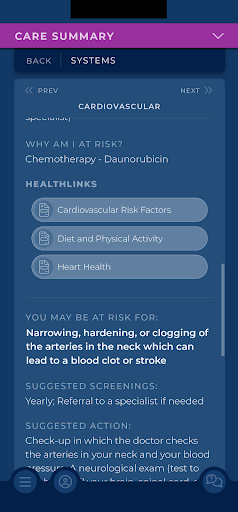
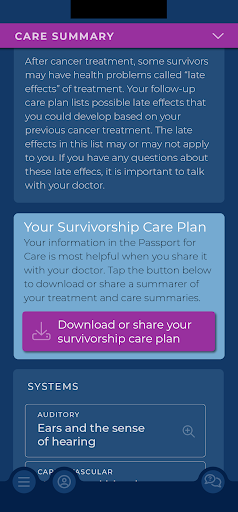
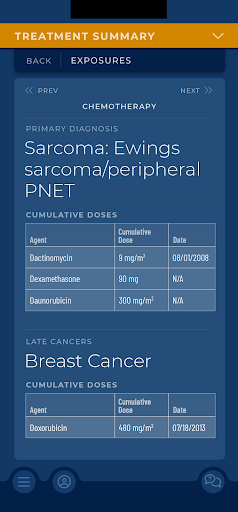
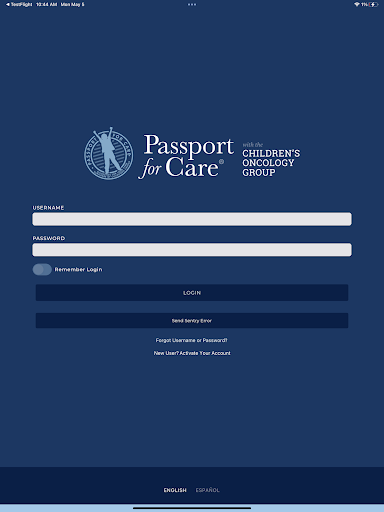
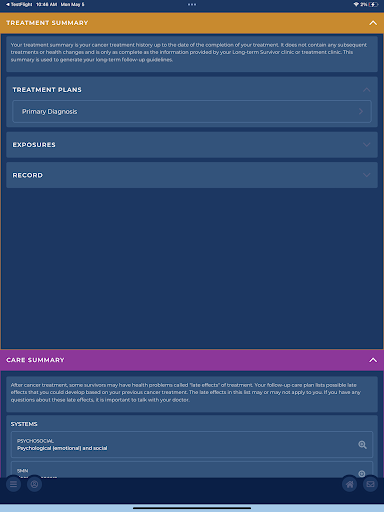
Passport for Care (PFC) is a free online resource tool developed to provide survivors of childhood cancer with access to their treatment summaries and long-term follow-up care recommendations. The system generates personalized survivorship care plans (SCPs) by applying advanced algorithms to user-entered exposure data and the Children's Oncology Group Long-Term Follow-Up Guidelines. This web-based clinical decision support tool is designed for use at the point of care to produce individualized screening recommendations.
Evidence & Research Context
- The Passport for Care has been documented in academic literature as a web-based support system for clinical decision-making. As of 2022, over 150 Long-Term Survivor clinics used PFC, generating more than 47,000 survivorship care plans.
- A 2021 survey of 148 clinician users (representing 64 clinics) found that 93% used PFC to generate personalized SCPs, an increase from 63% in 2012. Other common uses included determining surveillance recommendations, functioning as a clinical database (59%), and documenting late effects (51%).
- The same 2021 survey indicated that the perceived impact of PFC on accurate application of guidelines improved from 41% to 72% (p < 0.001), and on fostering conversations with survivors about late effect risks and screening improved from 44% to 70% (p < 0.001).
- While 87% of respondents were very or generally satisfied with PFC — essentially unchanged from 90% in 2012 — 48% felt data entry was a modest or significant barrier to application, with 45% estimating over 30 minutes per patient for data abstraction and entry. The peer-reviewed version of this survey reports 17% describing data entry as a significant or insurmountable barrier.
- A baseline survey conducted through Passport for Care with 528 survivors found that a significant proportion were unaware of their specific health risks from cancer and its treatment. This establishes the information gap PFC is designed to address rather than measuring the tool's effect.
Intended Use & Scope
Passport for Care is intended for survivors of childhood cancer and their healthcare providers to facilitate evidence-based long-term follow-up care. It supports the generation and management of personalized survivorship care plans. The tool does not replace direct medical consultation or clinical judgment; users should seek further guidance from their healthcare providers for specific medical advice or treatment.
Studies & Publications
Peer-reviewed research associated with this app.
Supporting Survivor-Centered Care Through Digital Health Integration.
Marchak et al. (2026) · Cancer
A survey assessed awareness of features and preferred information dissemination strategies for two digital tools among survivorship clinics.Clinician perceptions of Passport for Care, a web‐based clinical decision support tool for survivorship care plan delivery
King et al. (2022) · Pediatric Blood & Cancer
Clinicians reported that the app had a high impact on their adherence to guidelines in clinical practice.
App Information
Developer
Baylor College of MedicineCategory
Evidence Profile
Published in academic literature
Platforms
Updated
Jun 2026
© 2026 Baylor College of Medicine