
AppsFromResearch
Sideline Guidelines icon

Sideline Guidelines

Evidence Tier:DOCUMENTED

Published in academic literature

For:Clinicians & Healthcare Professionals

App Summary

Sideline Guidelines is a reference tool for clinicians treating high school, college, and professional athletes, providing quick access to information for diagnosing and managing injuries on the field. The associated research notes the app's content is based on expert consensus from a national faculty, compiling guidelines for a field where high-level evidence may be limited. The authors conclude that the app can serve as a useful "first port-of-call" for guiding early injury management and return-to-play decisions on the sideline.

App Screenshots

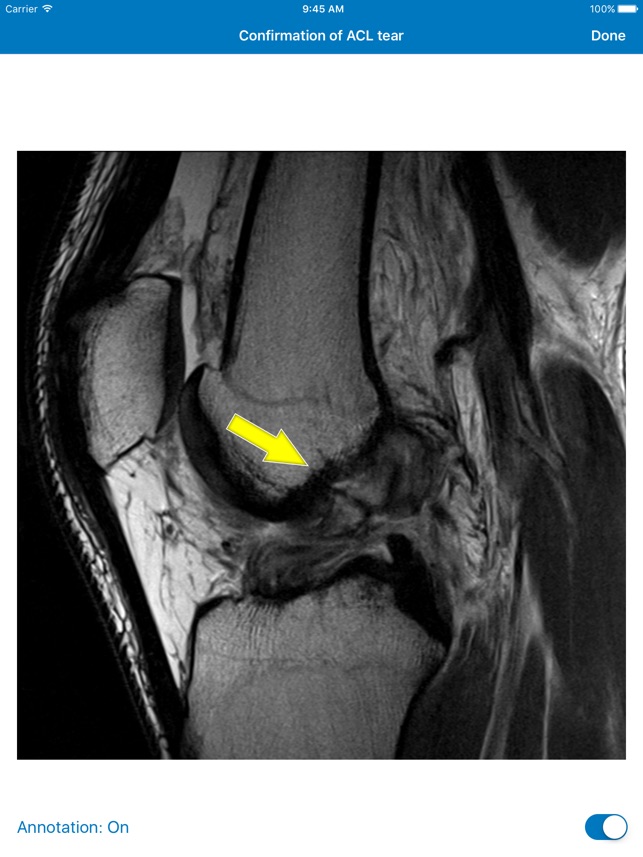
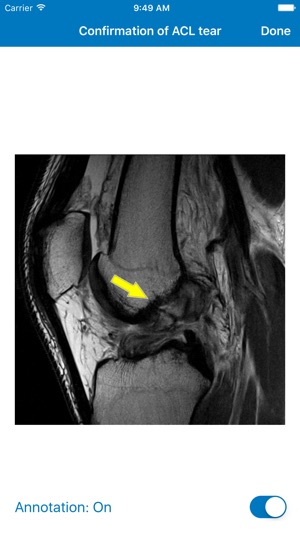
Sideline Guidelines screenshot 1 of 10Sideline Guidelines screenshot 2 of 10Sideline Guidelines screenshot 3 of 10Sideline Guidelines screenshot 4 of 10Sideline Guidelines screenshot 5 of 10Sideline Guidelines screenshot 6 of 10Sideline Guidelines screenshot 7 of 10Sideline Guidelines screenshot 8 of 10Sideline Guidelines screenshot 9 of 10Sideline Guidelines screenshot 10 of 10

Detailed Description

Functionality & Mechanism

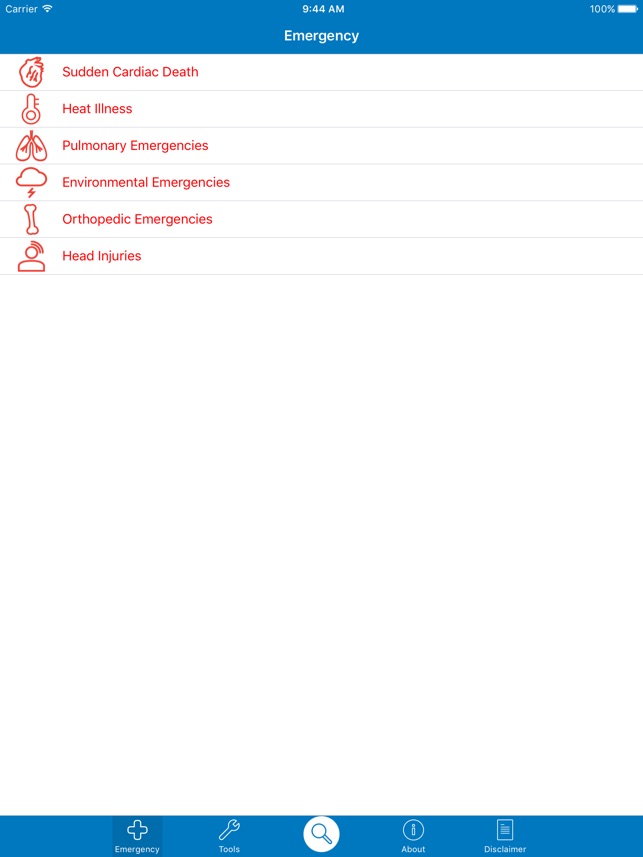
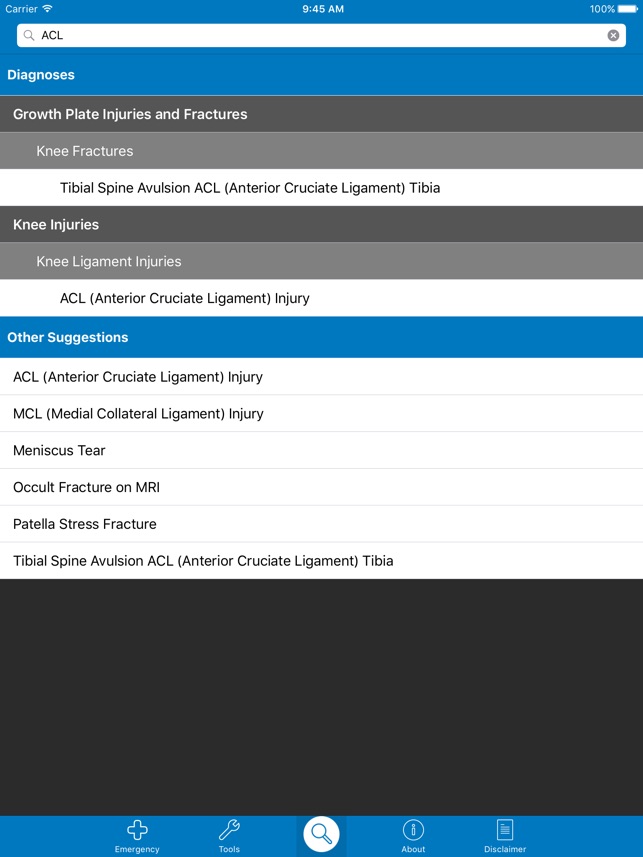
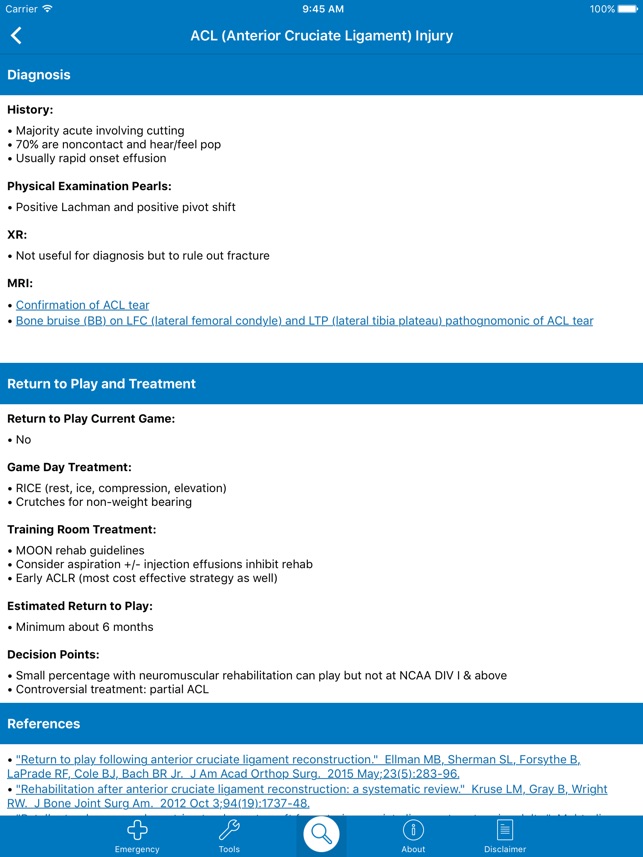
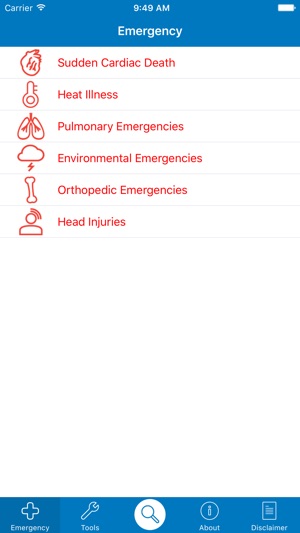
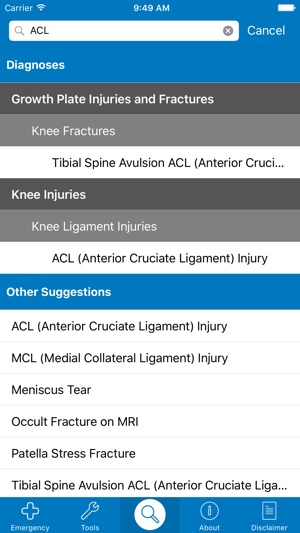
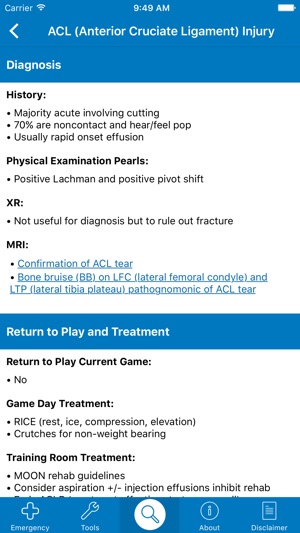
Developed by Cleveland Clinic Innovations, Sideline Guidelines is a clinical reference tool organized into three primary modules: 'Emergency,' 'Search,' and 'Tools.' The 'Emergency' module provides rapid access to protocols for critical events like cardiac arrest or heat illness. The 'Search' function allows lookup of specific injuries by diagnosis, presenting guidelines on history, physical examination, and treatment. The 'Tools' section contains reference materials for preseason, on-field, and concussion evaluations, such as the SCAT3 assessment.

Evidence & Research Context

  • The app's content is informed by a national faculty, consolidating expert opinion and consensus rather than systematically reviewed, evidence-based guidelines.
  • A published review noted the search function operates by diagnosis lookup, which may limit its utility for generating a differential diagnosis from presenting signs and symptoms.
  • The embedded assessment tools are provided for reference only and do not integrate data entry, scoring, or administrative functionalities within the interface.
  • Research commentary identifies its principal utility as a quick-reference electronic guide for early injury management and return-to-play considerations in specific athletic populations.

Intended Use & Scope

This tool is designed for sports medicine practitioners, including physicians, physiotherapists, and athletic trainers, managing high school, collegiate, and professional athletes. Its primary function is as a rapid-access educational guide to support sideline decision-making. The system does not facilitate differential diagnosis and is not a substitute for independent clinical judgment or evidence-based practice protocols.

Studies & Publications

1 publication

Peer-reviewed research associated with this app.

Development/Design Paper

'Sideline Guidelines' by Cleveland Clinic Innovations: A Smartphone Application for the On-Field Healthcare Practitioner

Lee et al. (2016) · British Journal of Sports Medicine

Describes the research-driven development of this app
A key role of the sports doctor, physiotherapist and athletic trainer is to detect, diagnose and treat sports injuries and medical emergencies on the sideline to ensure the health and safety of athletes.1 Sideline Guidelines, developed by Cleveland Clinic Innovations, is an app that is informed by a respected (US) national faculty, with the aim of assisting healthcare practitioners to manage sports injuries for high school, college and professional athletes from the sideline. The developers claim Sideline Guidelines to be the 'first of its kind'.2 The overall purpose of this app is to provide sports medicine practitioners with easily accessible information for a comprehensive list of sports injuries to assist diagnosis, postinjury evaluation and return-to-play decision-making. Sideline Guidelines contains three sections—'Emergency', 'Search' and 'Tools' (figure 1). The 'Emergency' section enables rapid reference to medical emergencies, including sudden cardiac arrest, heat illness, environmental, pulmonary and orthopaedic emergencies. The 'Search' section provides a list of common sports injuries (eg, anterior cruciate ligament strains) listed in alphabetical order. Although the guidelines in the 'Emergency' and 'Search' sections (figure 2) are succinct, the use of medical jargon (eg, 'apneic') and acronyms (eg, 'PPE') may prove challenging for clinicians without extensive sports medicine training. The 'Tools' section includes three subsections: preseason evaluation (eg, baseline testing); on-field evaluation (related to level of consciousness); and sideline concussion evaluation (eg, Sports Concussion Assessment Tool 3). However, the intended purpose of each test is not described, and the functional capacity of smartphones is not fully utilised (eg, data input, telecommunication). The disclaimer statement states that the app is not intended to replace the medical advice of a healthcare professional. Use in clinical practice Sideline Guidelines is intended for clinical practice but has several shortcomings. In standard clinical practice, the sideline clinician identifies and assesses the signs and symptoms of the injured athlete which then might inform diagnosis and management.3 Unfortunately, the 'Search' function in Sideline Guidelines operates counter-intuitively, where the user is expected to search for a diagnosis, rather than to use the signs and symptoms to inform a differential diagnosis. At most, this function allows the user to look up a suspected diagnosis to confirm its common signs and symptoms. Although the 'Tools' section houses a range of tests, it does not allow the user to administer the tests and thereby limits its clinical utility. Despite these caveats, the management and return-to-play subsections serve a useful purpose as a first port-of-call for guiding early management. In summary, Sideline Guidelines is a simple electronic pocket-guide, but its functional limitations and lack of evidence-based content warrant caution. This is a recurring theme—mobile apps often provide advice that is not anchored in evidence.4 Pros Information is well organised in the search function Easily accessible key points for injury management and return to play guidelines Rapid reference to sideline medical emergencies Cons Content is based on expert knowledge that lacks current evidence-based information Counter-intuitive process for differential diagnosis Limited target population to high school, college and professional athletes No data entry features and lack of functionality to administer sideline tests No function to directly contact hospitals and clinics to share information
... Read More

Sideline Guidelines

Free