AppsFromResearch
SkinTracker-NIH icon

SkinTracker-NIH

Initial evidence from research studies

For:Researchers & AcademicsPatients & Caregivers

App Summary

SkinTracker-NIH is a mobile platform for participants in dermatology clinical research, enabling them to remotely track their condition by submitting skin photos, surveys, and patient-reported outcomes. An observational study (N=28) of participants with atopic dermatitis found excellent agreement between disease severity scores derived from app-based photos and those from in-person clinical exams. The authors conclude that the app is a reliable and feasible tool for monitoring disease activity remotely, potentially improving patient access and data capture in dermatologic research.

App Screenshots

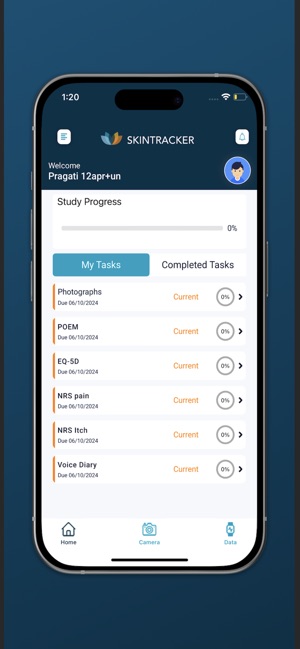
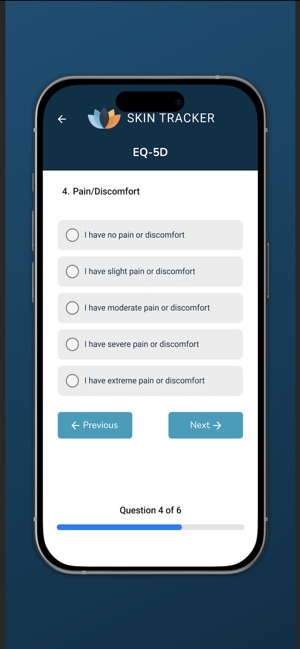
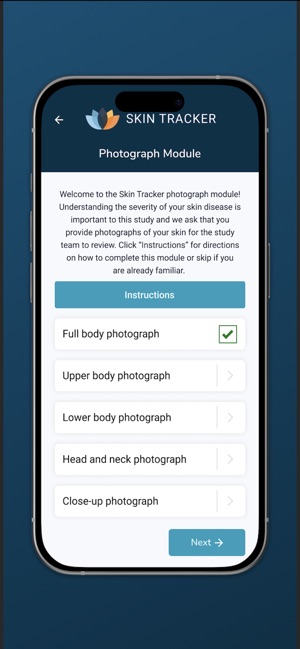
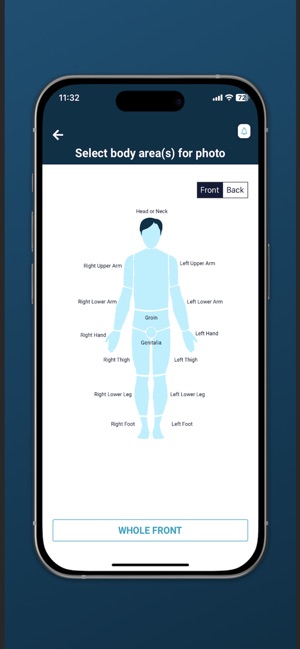
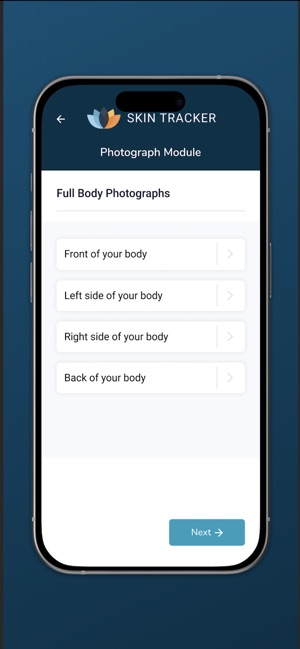
SkinTracker-NIH screenshot 1 of 6SkinTracker-NIH screenshot 2 of 6SkinTracker-NIH screenshot 3 of 6SkinTracker-NIH screenshot 4 of 6SkinTracker-NIH screenshot 5 of 6SkinTracker-NIH screenshot 6 of 6

Detailed Description

Functionality & Mechanism

SkinTracker-NIH is an integrated mobile application and web-based portal designed to facilitate remote dermatology clinical research. The system enables longitudinal data capture through a patient-facing interface for informed consent, medical history, standardized skin photography, and validated patient-reported outcomes (e.g., POEM, DLQI). It also integrates biometric data from wearables and incorporates modules for medication tracking, adverse event reporting, and secure communication with research teams. A corresponding web portal allows investigators to manage enrollment and visualize subject data.

Evidence & Research Context

  • A validation study (N=18 with atopic dermatitis) demonstrated excellent agreement between remote, app-based disease severity assessments and in-person clinical scores.
  • Across two preliminary studies (N=38 total), participants reported high compliance and satisfaction, indicating the platform's feasibility for remote research participation.
  • The app's development, detailed in a design paper, was guided by an iterative process involving dermatologists and clinical researchers to ensure clinical utility.
  • Published research has focused on atopic dermatitis in single-center studies; larger trials are needed to confirm generalizability across other conditions and settings.

Intended Use & Scope

SkinTracker-NIH is intended for use by clinical researchers and enrolled participants within formal research protocols for remote data collection. Its primary utility is to longitudinally monitor dermatologic conditions and capture patient-reported outcomes. The application is a research instrument, not a public-facing diagnostic or clinical management tool, and does not replace professional medical evaluation.

Studies & Publications

2 publications

Peer-reviewed research associated with this app.

Validation Study

Monitoring atopic dermatitis using mobile-app based photography and surveys

Marquez-Grap et al. (2025) · Journal of Dermatological Treatment

App-based photographs and surveys accurately matched in-person atopic dermatitis severity assessments.

Purpose/aim Remote clinical research has potential to increase study diversity, reduce costs for researchers and participants, and increase efficiency of studies. This study evaluates the reliability and feasibility of using SkinTracker, a mobile application, for remote AD severity assessment through mobile-app based photography and surveys. Methods This single-center observational study enrolled 28 participants (18 with AD and 10 healthy controls) in an eight-week hybrid clinical study. Participants completed bi-weekly tasks and submitted standardized skin photographs via the SkinTracker app, and clinic-based skin exams and digital single-lens reflex (SLR) photos were obtained at baseline and week 8. Eczema Area Severity Index and Investigator Global Assessment scores were assigned to the photographs by a grader. Intraclass correlation coefficients were used to evaluate agreement between app-based, in-person, and SLR assessments for the 18 participants with AD. Results App-based AD assessment scores had excellent agreement with in-person scores, indicating the reliability of SkinTracker to assess disease activity remotely. Furthermore, all participants had high compliance and satisfaction with app-based activities, indicating that using SkinTracker for remote clinical research is achievable and even preferred by participants. Conclusion Overall, these findings show that SkinTracker is both reliable and feasible for monitoring atopic dermatitis disease activity remotely.
... Read More
Development/Design Paper

Development of SkinTracker, an integrated dermatology mobile app and web portal enabling remote clinical research studies

Jin et al. (2023) · Frontiers in Digital Health

Describes the research-driven development of this app
In-person dermatology clinical research studies often face recruitment and participation challenges due to travel-, time-, and cost-associated barriers. Studies incorporating virtual/asynchronous formats can potentially enhance research subject participation and satisfaction, but few mobile health tools are available to enable remote study conduct. We developed SkinTracker, a patient-facing mobile app and researcher-facing web platform, that enables longitudinal collection of skin photos, patient reported outcomes, and biometric health and environmental data. Methods: Eight design thinking sessions including dermatologists, clinical research staff, software engineers, and graphic designers were held to create the components of SkinTracker. Following iterative prototyping, SkinTracker was piloted across six adult and four pediatric subjects with atopic dermatitis (AD) of varying severity levels to test and provide feedback on SkinTracker for six months. Results: The SkinTracker app enables collection of informed consent for study participation, baseline medical history, standardized skin photographs, patient-reported outcomes (e.g., Patient Oriented Eczema Measure (POEM), Pruritus Numerical Rating Scale (NRS), Dermatology Life Quality Index (DLQI)), medication use, adverse events, voice diary to document qualitative experiences, chat function for communication with research team, environmental and biometric data such as exercise and sleep metrics through integration with an Apple Watch. The researcher web portal allows for management and visualization of subject enrollment, skin photographs for examination and severity scoring, survey completion, and other patient modules. The pilot study requested that subjects complete surveys and photographs on a weekly to monthly basis via the SkinTracker app. Afterwards, participants rated their experience in a 7-item user experience survey covering app function, design, and desire for participation in future studies using SkinTracker. Almost all subjects agreed or strongly agreed that SkinTracker enabled more convenient participation in skin research studies compared to an in-person format. Discussion: To our knowledge, SkinTracker is one of the first integrated app-and web-based platforms allowing collection and management of data commonly obtained in clinical research studies. SkinTracker enables detailed, frequent capture of data that may better reflect the fluctuating course of conditions such as AD, and can be modularly customized for different skin conditions to improve dermatologic research participation and patient access.
... Read More

SkinTracker-NIH

Free