
AppsFromResearch
The Nernst/Goldman Equation Simulator icon

The Nernst/Goldman Equation Simulator

Evidence Tier:DOCUMENTED

Published in academic literature

For:Researchers & AcademicsStudents

App Summary

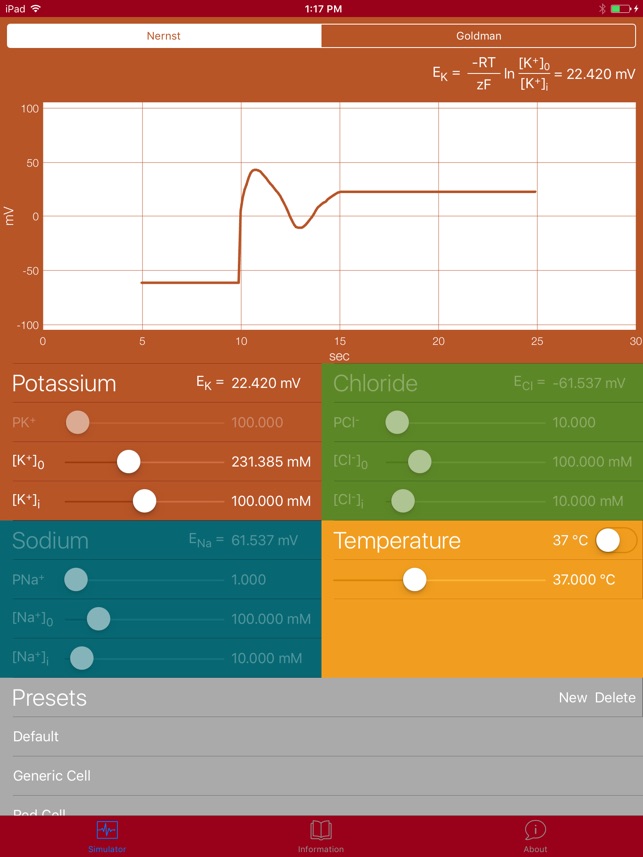
The Nernst/Goldman Equation Simulator is an educational tool designed for students and educators to visualize how ion movement across a cell membrane creates electrical potential. The associated research describes its use within a structured learning activity where students progressively build from foundational concepts of ion flow to complex, multi-variable simulations. The authors note this active learning approach enhances understanding of the relationship between ion gradients and membrane voltage, preparing students to compare and contrast the Nernst and Goldman equations.

App Screenshots

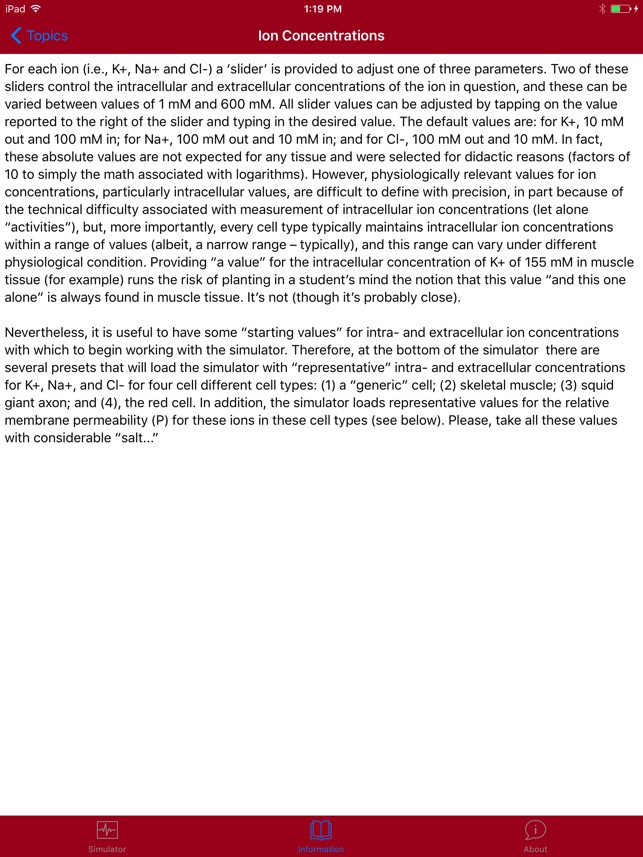
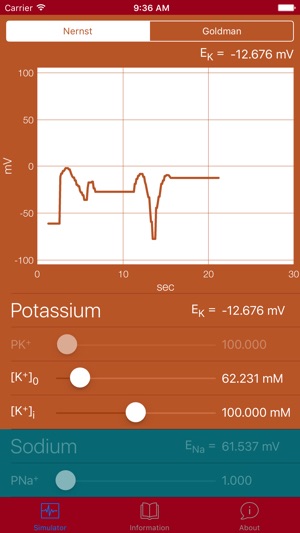
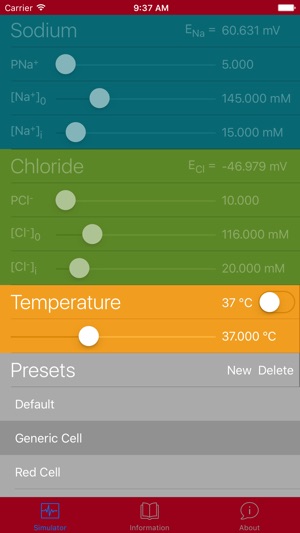
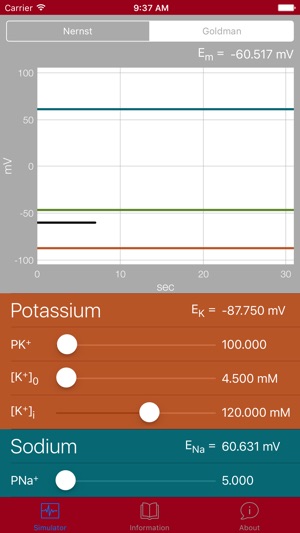
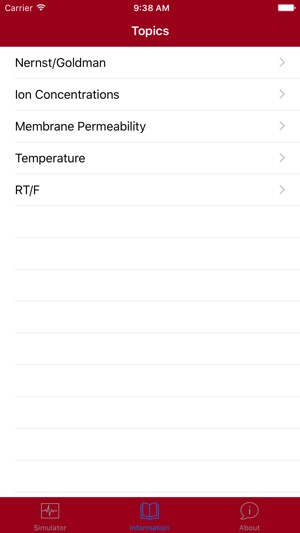
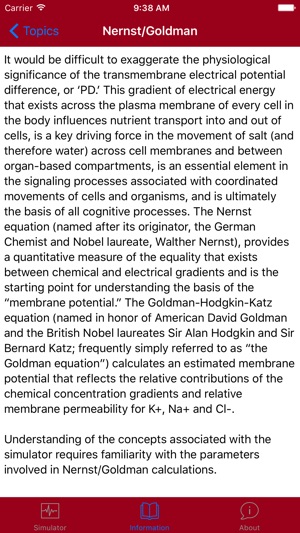
The Nernst/Goldman Equation Simulator screenshot 1 of 10The Nernst/Goldman Equation Simulator screenshot 2 of 10The Nernst/Goldman Equation Simulator screenshot 3 of 10The Nernst/Goldman Equation Simulator screenshot 4 of 10The Nernst/Goldman Equation Simulator screenshot 5 of 10The Nernst/Goldman Equation Simulator screenshot 6 of 10The Nernst/Goldman Equation Simulator screenshot 7 of 10The Nernst/Goldman Equation Simulator screenshot 8 of 10The Nernst/Goldman Equation Simulator screenshot 9 of 10The Nernst/Goldman Equation Simulator screenshot 10 of 10

Detailed Description

Functionality & Mechanism

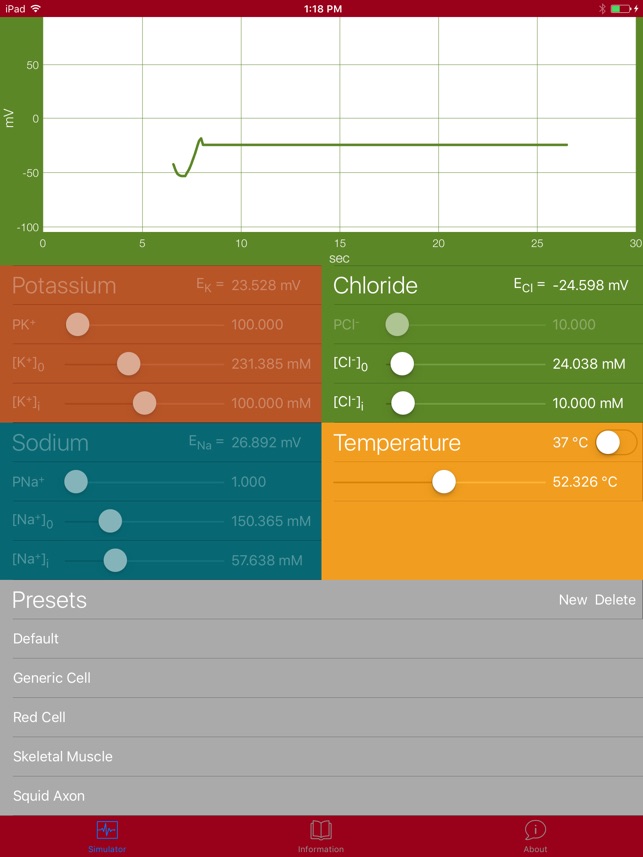
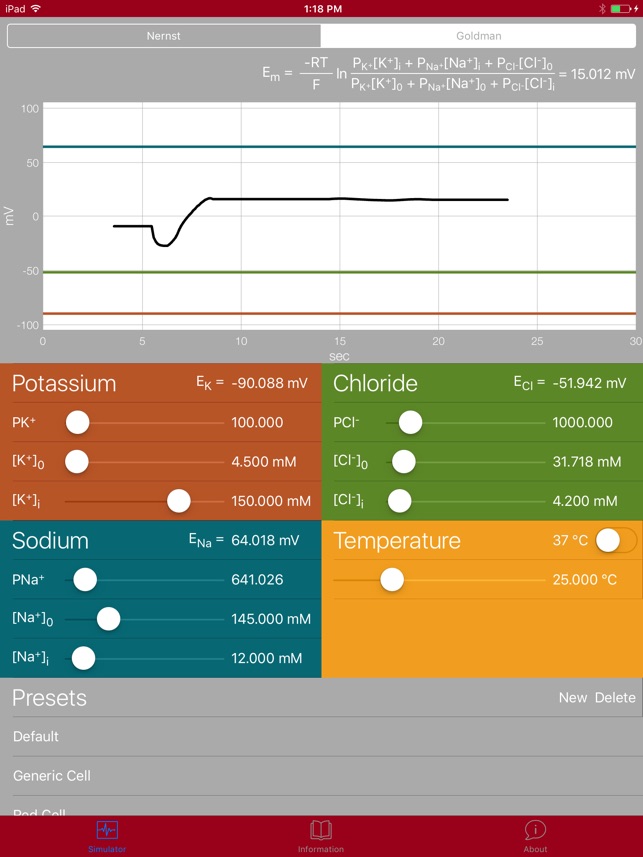
This simulator provides a real-time visualization of membrane electrophysiology based on the Nernst and Goldman equations. The interface facilitates the manipulation of key parameters, including the intracellular and extracellular concentrations and relative permeability of sodium, potassium, and chloride ions. The system dynamically recalculates and displays the resulting electrical potential difference. It also integrates preset values for common cell types to provide foundational reference points for comparative analysis, with sessions designed for completion within a single instructional period.

Evidence & Research Context

  • The associated research details a structured, active-learning module designed for undergraduate students in a single lab or lecture session.
  • The pedagogical framework guides students through concepts of increasing complexity, beginning with ion gradients and culminating in calculations using the Nernst and Goldman equations.
  • The simulator is leveraged as an interactive component, enabling students to directly observe how manipulating ion concentrations and permeability affects membrane potential.
  • The primary learning objective of the activity is to develop a comparative understanding of the principles underlying the two fundamental electrophysiology equations.

Intended Use & Scope

This tool is intended for educators and undergraduate students in physiology, neuroscience, and related biological sciences. Its primary scope is to serve as a pedagogical supplement for visualizing theoretical principles of membrane potential in a classroom or laboratory setting. The simulator is not intended for clinical diagnostics or predictive research modeling and should be used within a structured curriculum.

Studies & Publications

1 publication

Peer-reviewed research associated with this app.

Non-Evaluative Reference

Movement of ions across membranes: An active learning resource

Hall et al. (2025) · Advances in Physiology Education

Referenced in academic literature; no direct evaluation of the app
This paper describes a short ion flow activity that can be completed within one lab or lecture session. The activity is focused on the core concept of flow-down gradients and is geared toward undergraduates. No previous knowledge of equilibrium potentials or membrane potentials is required. Students are guided through a set of questions that build in complexity. First, the K+ gradient across the membrane is considered. Simple questions are posed that allow students to build a foundation of basic facts regarding ion flow. Next, students work with the Nernst equation to investigate equilibrium potentials. In this part of the activity, students are presented with several sets of conditions in which the K+ gradient is made more or less steep, and they are asked to calculate the effect on the equilibrium potential. Students then write a description of the relationship between the magnitude of the gradient and the equilibrium potential. This is preparation for moving on to use a Nernst/Goldman simulator that allows manipulating the K+, Na+, and/or Cl? gradients, as well as temperature and permeability. Finally, students answer questions that prompt them to summarize their knowledge regarding equilibrium potentials, membrane voltages, and the effect of temperature on the membrane voltage. By the end of the activity, students should be able to compare and contrast the Nernst and Goldman equations.
... Read More

The Nernst/Goldman Equation Simulator

Free