
The Zombie Ant Experience
Published in academic literature
App Summary
App Screenshots
Detailed Description
Functionality & Mechanism
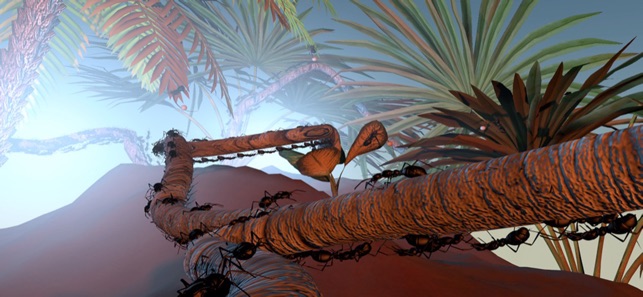
The Zombie Ant Experience leverages augmented reality to deliver an immersive simulation of parasite-host interaction. The system situates the participant within a digital forest environment from the perspective of an ant. Core modules simulate a parasitic fungal infection, progression to a behaviorally-manipulated state, and subsequent pathogen transmission to other simulated ants. The interface appears designed for use within a physical installation, guiding the participant through the complete fungal life cycle from a host-based view.
Evidence & Research Context
The simulation is grounded in established principles of behavioral ecology and parasitology.
- The app's scientific premise is based on research describing how certain parasites manipulate host behavior as an "extended phenotype" to directly benefit the parasite's life cycle.
- Associated research documents how parasitic infection can drastically alter an ant's societal and ecological role, inducing behaviors such as summiting, phototaxis, and substrate biting.
- The authors of the foundational research note that while striking examples exist, the precise mechanisms of parasite-induced behavioral manipulation in ants remain a developing area of scientific inquiry.
Intended Use & Scope
This simulation is intended for the general public and students in informal educational settings. Its primary utility is to deliver pedagogical content on parasite-host interactions and behavioral ecology. The experience serves as a conceptual visualization and is not a predictive ecological model or research tool. For comprehensive scientific detail, consultation of primary entomological and mycological literature is requisite.
Studies & Publications
Peer-reviewed research associated with this app.
The ants (Hymenoptera: Formicidae) and their parasites: Effects of parasitic manipulations and host responses on ant behavioral ecology
de Bekker et al. (2018) · Myrmecological News
Referenced in academic literature; no direct evaluation of the appIn the Media
'Research Art Collection' showcase in Old Main
The Huck SciArt traveling interdisciplinary project features Sonya Aboud's 2018 clay representation of the ascoma, the fruiting body of the Cordyceps fungus that grows from a zombie ant's head after death. The cross-section reveals spores from the spore-producing structure that emerges after the infected ant bites into the underside of a plant. The Research Art Collection showcase in Old Main reveals the invisible world of David Hughes' zombie ant research through artistic interpretation.
Zombie Ant Experience' invades Penn State Berks
Penn State Berks introduced "The Zombie Ant Experience," an augmented reality exhibition that transforms visitors into ants living beneath the forest canopy through interactive art installation technology. The exhibit serves as both an art installation and teaching tool that illustrates spore trajectories as visitors experience being attacked by a simulated fungus that turns them into zombie ants. The augmented reality project resulted from collaboration between artists and scientists to create an immersive educational experience.
'Zombie Ant' sculpture brings interactive art to Penn State Behrend
Penn State Behrend's School of Science complex installed an interactive augmented reality sculpture called "The Zombie Ant Experience" that transforms visitors into ants through augmented reality technology. The installation serves as both an art piece and a teaching tool, allowing visitors to experience being attacked by a simulated Cordyceps fungus that turns them into zombie ants beneath the forest canopy. The clever educational experience teaches spore trajectories through an immersive, interactive format.
The 'Zombie Ant Experience' comes to Penn State Harrisburg
Penn State Harrisburg's Mukund S. Kulkarni Theatre hosted the touring exhibition "The Zombie Ant Experience" during common hour on select days in April, offering a live multimedia presentation about the life cycle of the zombie ant fungus. The unique experience, offered in partnership with Penn State University Park's Huck Institute of Life Science, was free and open to students, faculty, and staff. The interactive presentation took visitors on a journey through the parasitic fungus's fascinating life cycle.
An invisible world: Explore the life of 'Zombie Ants' at the Arts Festival
Penn State's Daryl Branford, one of the minds behind the multimedia installation "The Zombie Ant Experience," returned to showcase the project at the Central Pennsylvania Festival of the Arts that first convinced him to join Penn State in the 1990s. The installation details the strange process by which a parasitic Cordyceps fungus infects and takes over the bodies of ants. The project represents a full-circle moment for Branford, combining art, science, and community engagement.
App Information
Developer
Pennsylvania State UniversityCategory
Evidence Profile
Published in academic literature
Platforms
Updated
Oct 2021
© 2025 Pennsylvania State University
Tags
Relevant Links
Privacy Policy

The Zombie Ant Experience
Free