
UAbacus
Published in academic literature
App Summary
App Screenshots
Detailed Description
Functionality & Mechanism
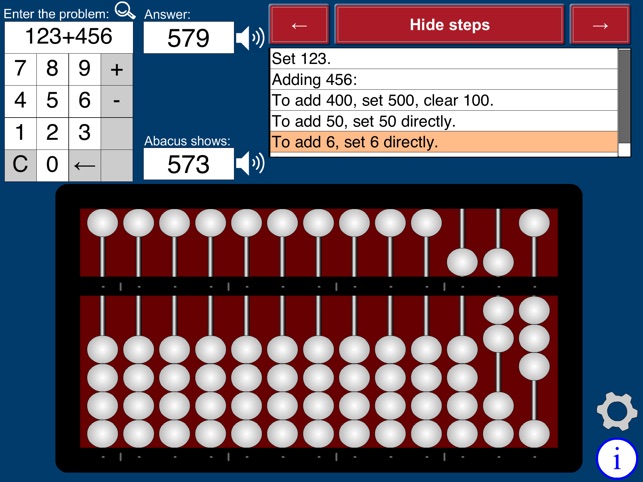
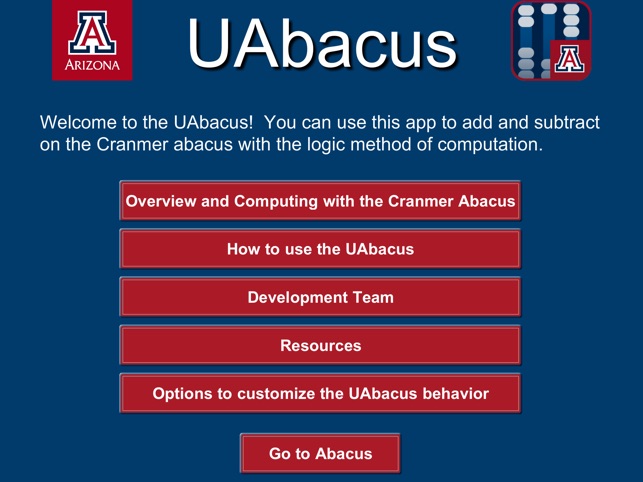
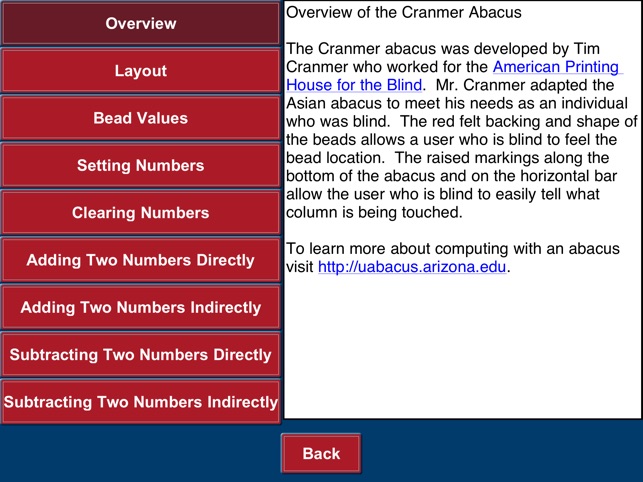
UAbacus is a digital training tool designed to deliver pedagogical content on abacus computation for addition and subtraction, leveraging the "logic method" for the Cranmer abacus. The interface provides step-by-step procedural guidance for problem-solving, allowing learners to receive assistance or verify answers. A parallel mode enables sighted instructors or assistants to track and support a user's progress on a physical abacus by mirroring the required computational steps, facilitating guided practice and verification.
Evidence & Research Context
The app's design aligns with established principles for assistive technology in mathematics education for individuals with visual impairments.
- Associated research identifies significant challenges in mathematical learning for visually impaired individuals, underscoring the need for accessible technology-based solutions.
- A systematic review of the field notes that effective digital solutions often integrate features like interactive feedback to enhance skill acquisition.
- The authors of the review suggest that smartphone-based applications represent a convenient and affordable modality for delivering mathematical learning content to this population.
Intended Use & Scope
This system is intended for individuals learning the Cranmer abacus, including students with visual impairments, and for educators or support personnel facilitating their instruction. Its primary utility is as a supplementary practice tool for foundational arithmetic. UAbacus is not a formal assessment instrument and is designed to augment, not replace, structured pedagogical methods and direct instruction.
Studies & Publications
Peer-reviewed research associated with this app.
Assistive technology-based solutions in learning mathematics for visually-impaired people: exploring issues, challenges and opportunities
Shoaib et al. (2023) · Multimedia Tools and Applications
Research evidence supports that audio feedback, tactile displays, and accessible math apps improve mathematical learning.App Information
Developer
University of ArizonaCategory
Evidence Profile
Published in academic literature
Platforms
Updated
Dec 2016
© 2025 University of Arizona
Tags

UAbacus
Free