

BeHere / 1942
Published in academic literature
App Summary
App Screenshots
Detailed Description
Functionality & Mechanism
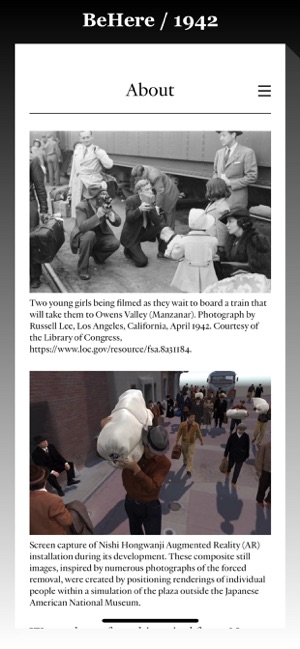
BeHere / 1942 is an augmented reality system developed by media artist Masaki Fujihata. It superimposes historical propaganda photographs of the Japanese American internment onto the contemporary environment of Little Tokyo, Los Angeles. The interface facilitates an interactive, site-specific experience, requiring participants to physically engage with the location. The system is designed to recontextualize the historical event through viewer participation and a critical engagement with archival media, reframing the act of photography as a performance of power.
Evidence & Research Context
- The system is detailed in a research article analyzing it as an intermedia work of art and a form of historical critique.
- The associated research describes the system's use of augmented reality to challenge dominant media narratives surrounding the 1942 internment of Japanese Americans.
- The project's design promotes a new understanding of historical photography by creating an interactive, participatory experience for the viewer within a specific physical space.
- A central theme examined in the research is the act of photography as a performance of power, which the system invites users to critically consider.
Intended Use & Scope
The system is intended for the general public, educators, and students as an experiential educational tool for historical engagement. Its primary utility is to foster critical reflection on a specific historical event through a site-specific, art-based augmented reality experience. It does not function as a comprehensive historical database but as a focused interpretive lens. Further academic resources are required for a complete historical understanding.
Studies & Publications
Peer-reviewed research associated with this app.
Performing the Power of the Photography BeHere/1942 by Masaki Fujihata
Kleczek et al. (2002) · Pamiętnik Teatralny
Referenced in academic literature; no direct evaluation of the appIn the Media
JANM exhibit uses augmented reality to visit WWII-era round-up of Little Tokyo Nikkei
UCLA and the Japanese American National Museum launched BeHere / 1942 to commemorate the 80th anniversary of Japanese American incarceration, using augmented reality technology to recreate the mass removal from Little Tokyo. The exhibit features a massive 200-person AR installation by Japanese media artist Masaki Fujihata that "hyper-enlarges" historical photographs to reveal reflections in subjects' eyes, allowing visitors to see what they saw. Visitors can experience the installation at the museum's outdoor plaza using smartphones or museum-provided devices, with the AR component remaining accessible even after the exhibit concludes on October 9.
Augmented Reality App Lets Users 'Witness' WWII Removal Of Japanese Americans
The Japanese American National Museum launched "BeHere/1942" to recreate the WWII eviction of 120,000 Japanese Americans using augmented reality technology that superimposes historical scenes over the museum's Little Tokyo courtyard. "Oh my God, it's incredible what they can do," said June Aochi Berk, a 89-year-old incarceration survivor whose digitized likeness appears in the installation, "It looks like I'm actually there waiting for the bus." The free exhibit opened Saturday and is currently available only for iPhones.
Exhibition puts viewers in midst of WWII-era removal of Japanese Americans
The Yanai Initiative of UCLA and Tokyo's Waseda University developed BeHere / 1942 to illuminate the 1942 Japanese American incarceration through augmented reality technology at the original Little Tokyo removal site. UCLA Professor Michael Emmerich explains, "This is an exhibit about what photographs reveal and what they conceal... it is about what happened here in Little Tokyo and all along the West Coast in 1942, but it is also about the present." The exhibition opened May 7, 2022, at the Japanese American National Museum, nearly 80 years after 3,475 Little Tokyo residents lost their homes and freedom on May 9, 1942.
Augmented reality exhibition places viewers in midst of WWII-era forced removal of Japanese Americans
The Yanai Initiative for Globalizing Japanese Humanities, a joint project of UCLA and Japan's Waseda University, developed BeHere / 1942 to recreate the 1942 forced removal of Japanese Americans through augmented reality at the actual Little Tokyo site where thousands were ordered to report. "This is an exhibit about what photographs reveal and what they conceal," said UCLA Professor Michael Emmerich, explaining how the AR experience transforms historic images to reveal previously hidden details like reflections in subjects' eyes. The exhibition opened May 7 at the Japanese American National Museum, launching almost 80 years to the day after 3,475 Little Tokyo residents lost their homes and freedom.
App Information
Category
Evidence Profile
Published in academic literature
Platforms
Updated
Sep 2026
© 2025 University of California, Los Angeles
Tags
Relevant Links
Privacy Policy


BeHere / 1942
Free