
AppsFromResearch
BifurcAID icon

BifurcAID

Evidence Tier:EVALUATED

Assessed for usability and quality

For:Clinicians & Healthcare Professionals

App Summary

BifurcAID is an educational and clinical decision support tool for clinicians that provides step-by-step procedural guidance for coronary bifurcation interventions alongside a novel risk score. The app's risk score was developed from a study of 1,896 patients, identifying 11 predictors that successfully stratified individuals into low, intermediate, and high-risk groups for major adverse cardiovascular events. The associated research concludes that this score may facilitate risk stratification and help guide patient-tailored treatment strategies for these complex procedures.

App Screenshots

BifurcAID screenshot 1 of 6BifurcAID screenshot 2 of 6BifurcAID screenshot 3 of 6BifurcAID screenshot 4 of 6BifurcAID screenshot 5 of 6BifurcAID screenshot 6 of 6

Detailed Description

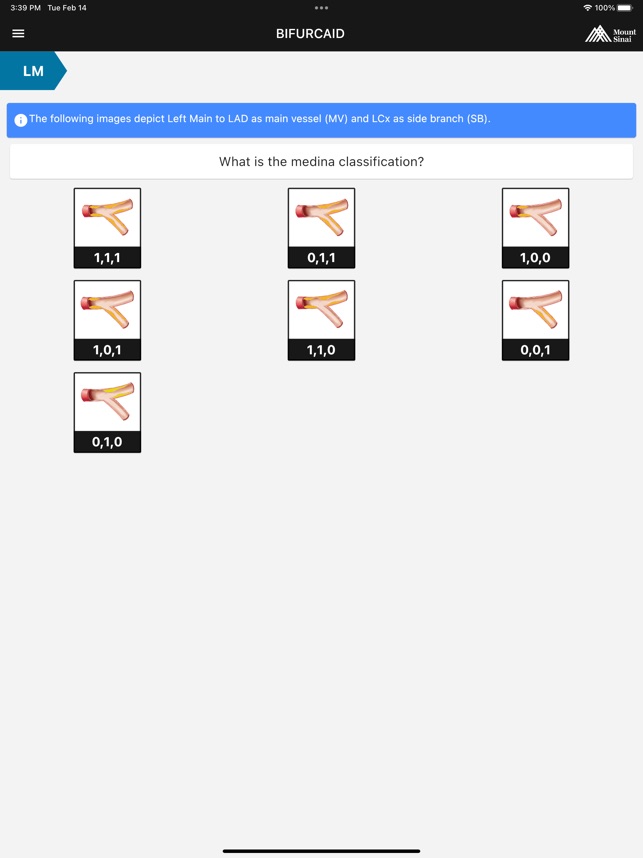
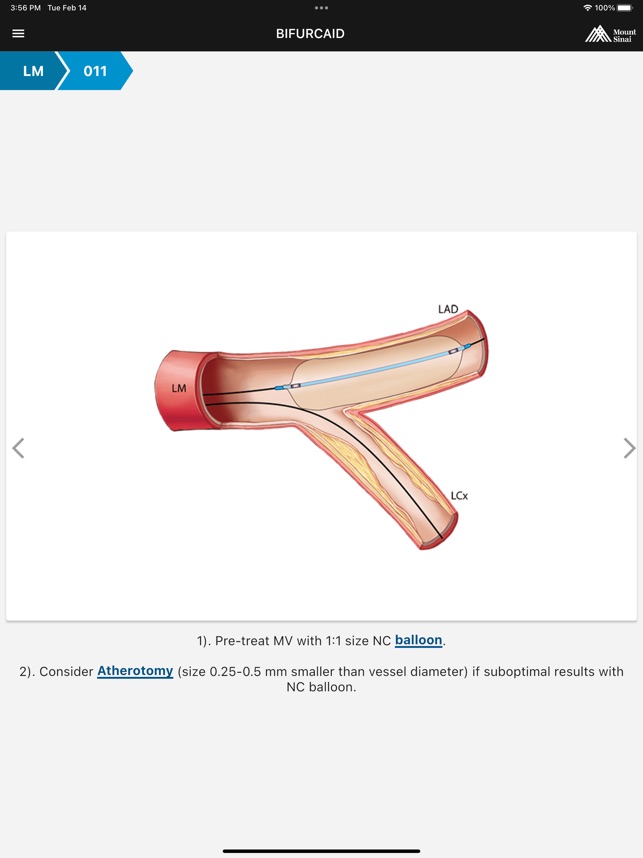
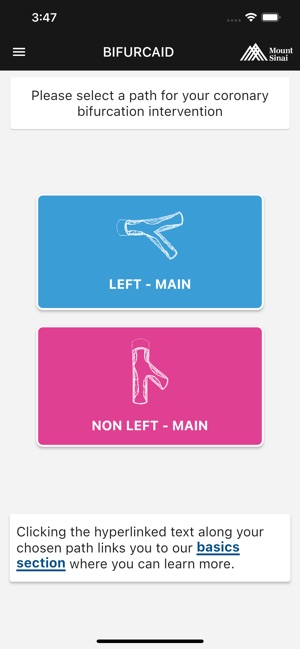
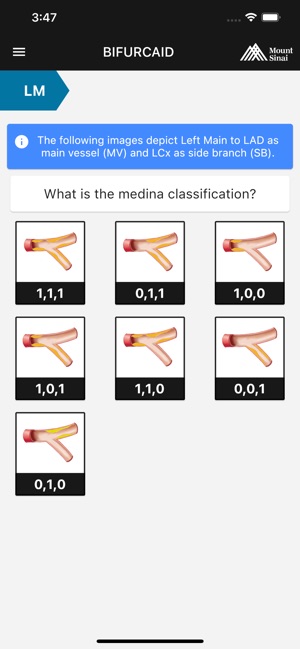
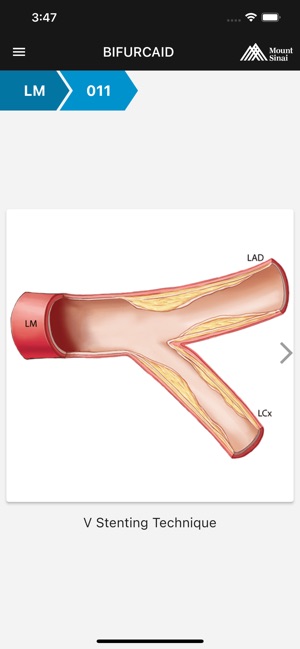
Functionality & Mechanism BifurcAID is an educational platform designed to clarify complex coronary bifurcation interventions. The system delivers pedagogical content through step-by-step illustrated guides detailing primary procedural techniques, such as provisional and dedicated two-stent strategies. The interface facilitates navigation through complex procedural algorithms to support clinical decision-making. An integrated module also enables calculation of the BifurcAID risk score, stratifying patient risk for major adverse cardiovascular events based on clinical and angiographic inputs.

Evidence & Research Context

  • A usability evaluation (N=26) indicated high user acceptance, yielding a mean System Usability Score (SUS) of 86.3, which surpasses the threshold for likely user recommendation.
  • The integrated BifurcAID risk score was developed and validated in a cohort study of 1,896 patients undergoing percutaneous coronary intervention (PCI) for true bifurcation lesions.
  • The score effectively stratifies 1-year major adverse cardiovascular event (MACE) risk, with rates of 4.9% in low-risk patients, 12.9% in intermediate-risk, and 25.4% in high-risk cohorts.
  • The app's pedagogical framework is designed to address the procedural complexities of coronary bifurcation lesions, which account for 15-20% of all percutaneous coronary interventions.

Intended Use & Scope This tool is intended for interventional cardiologists and cardiology fellows as an educational and procedural reference guide. Its primary utility is to reinforce understanding of complex bifurcation stenting techniques and facilitate pre-procedural risk stratification. The app is not a substitute for formal training, operator experience, or established treatment guidelines.

Studies & Publications

4 publications

Peer-reviewed research associated with this app.

Development/Design Paper

Development of a Novel BifurcAID Risk Score to Predict MACE Following Coronary True Bifurcation Intervention

Minatoguchi et al. (2025) · JACC: Cardiovascular Interventions

Describes the research-driven development of this app
Background Percutaneous coronary intervention (PCI) for true bifurcation lesions is associated with a higher risk of adverse clinical events. Objectives This study sought to establish a point-based score using clinical and angiographic characteristics in true bifurcation lesions before PCI to predict the risk of major adverse cardiovascular events (MACE). Methods A total of 1,896 consecutive patients undergoing PCI for true bifurcation lesions between 2012 and 2019 in our institution were included. All angiograms were reviewed by an independent core laboratory for classification of the bifurcation lesions. A multivariate model identified factors associated with 1-year MACE, comprising all-cause death, myocardial infarction, and target vessel revascularization. Points were assigned to each risk factor proportional to their regression coefficients to create a cumulative risk score. The score was used to stratify patients into low-, intermediate-, and high-risk cohorts. Results At 1-year post-PCI, MACE occurred in 185 patients (9.8%). Eleven predictors of MACE were identified: 5 clinical (insulin-dependent diabetes mellitus, left ventricular ejection fraction ?30%, non–ST-segment elevation myocardial infarction presentation, age >80 years, and non-white race/ethnicity), and 6 angiographic (left main or left circumflex-obtuse marginal coronary artery lesion, multivessel disease, side branch [SB] thrombus, SB moderate/severe calcium, and SB lesion length >10 mm). The rate of MACE was 4.9% in low-risk patients with a risk score 0 to 6 (reference group), 12.9% in intermediate-risk patients with a score 7 to 9 (OR: 2.63; 95% CI: 1.74-3.98; P < 0.001), and 25.4% in high-risk group with a score ?10 (OR: 5.18; 95% CI: 3.56-7.53; P < 0.001). Conclusions The BifurcAID risk score may facilitate risk stratification among patients undergoing true bifurcation PCI and guide patient-tailored treatment strategies.
... Read More
Non-Evaluative Reference

Treatment strategies for coronary bifurcation lesions made easy in the current era by introduction of the BIFURCAID app

Selan et al. (2019) · Future Cardiology

Referenced in academic literature; no direct evaluation of the app
Coronary bifurcation lesions account for 15–20% of all percutaneous coronary interventions. Percutaneous revascularization of these lesions is technically challenging and results in lower success rates than nonbifurcation lesions. There are unique procedural considerations and techniques that are employed in the percutaneous revascularization of these lesions. Our objective is to define the procedural complexities of treating coronary bifurcation lesions and describe the leading provisional and dedicated two stent techniques used to optimize procedural and clinical results, as described in the BIFURCAID app.
... Read More

BifurcAID

Free