
AppsFromResearch
Encyclopédie icon

Encyclopédie

Evidence Tier:DOCUMENTED

Published in academic literature

For:Researchers & AcademicsGeneral Public & Enthusiasts

App Summary

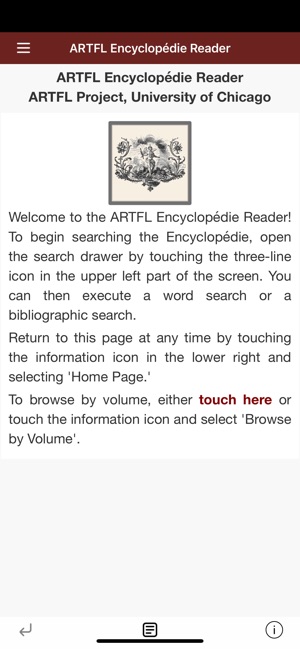
The Encyclopédie reader provides a powerful search and retrieval interface for scholars, students, and the public to explore the full text of Diderot and d'Alembert's 18th-century Enlightenment masterpiece. The associated research demonstrates how computational methods, such as topic modeling, can be applied to this digital text to uncover interdisciplinary discourses and connections not apparent in the original print version. The authors conclude that such digital resources are essential for revealing the text's complex structure, attesting to its enduring relevance and opening new avenues for historical studies.

App Screenshots

Encyclopédie screenshot 1 of 15Encyclopédie screenshot 2 of 15Encyclopédie screenshot 3 of 15Encyclopédie screenshot 4 of 15Encyclopédie screenshot 5 of 15Encyclopédie screenshot 6 of 15Encyclopédie screenshot 7 of 15Encyclopédie screenshot 8 of 15Encyclopédie screenshot 9 of 15Encyclopédie screenshot 10 of 15Encyclopédie screenshot 11 of 15Encyclopédie screenshot 12 of 15Encyclopédie screenshot 13 of 15Encyclopédie screenshot 14 of 15Encyclopédie screenshot 15 of 15

Detailed Description

Functionality & Mechanism

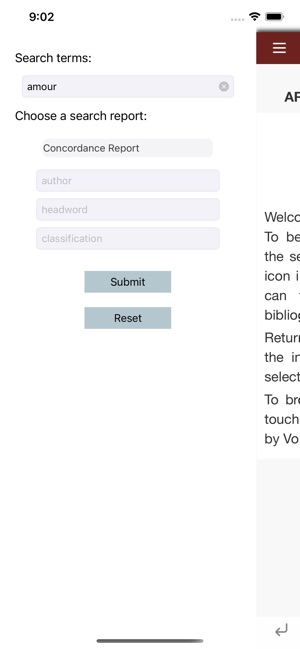
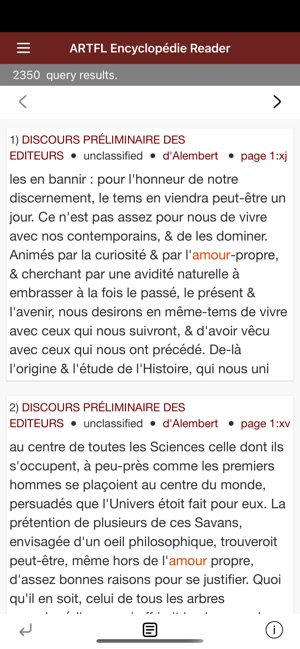
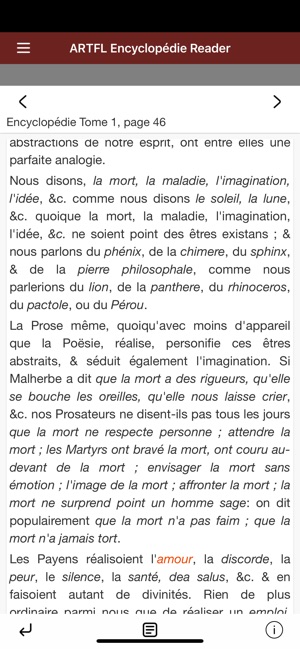
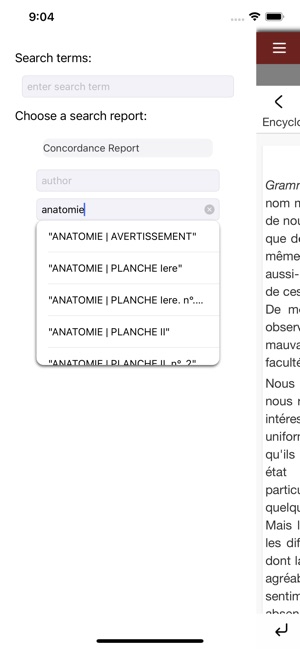
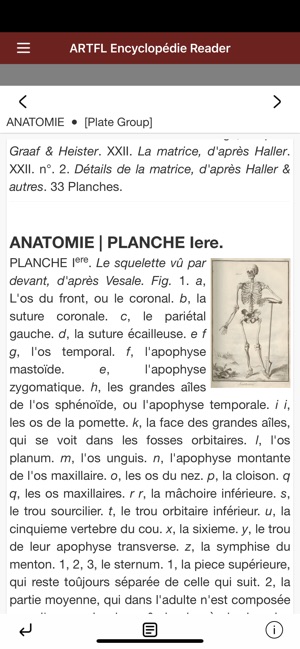
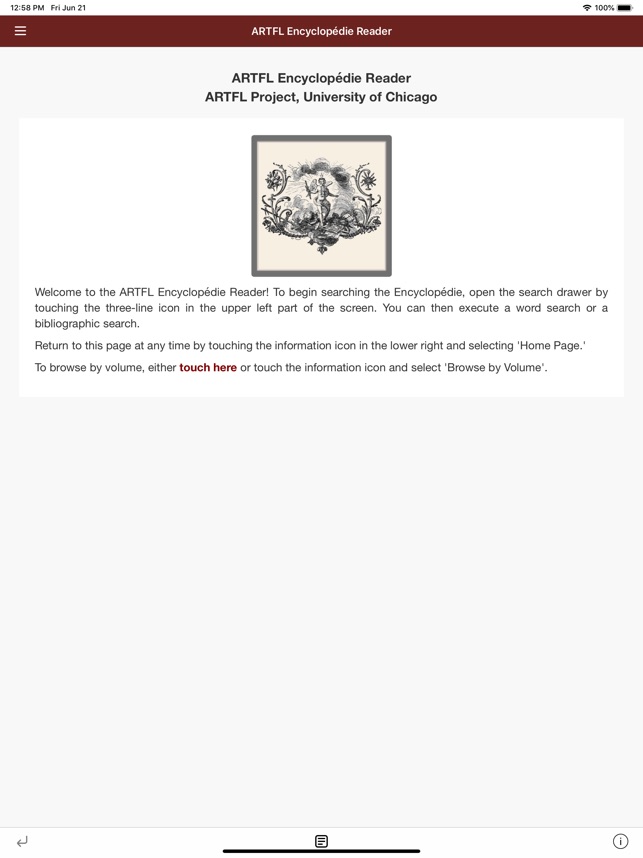
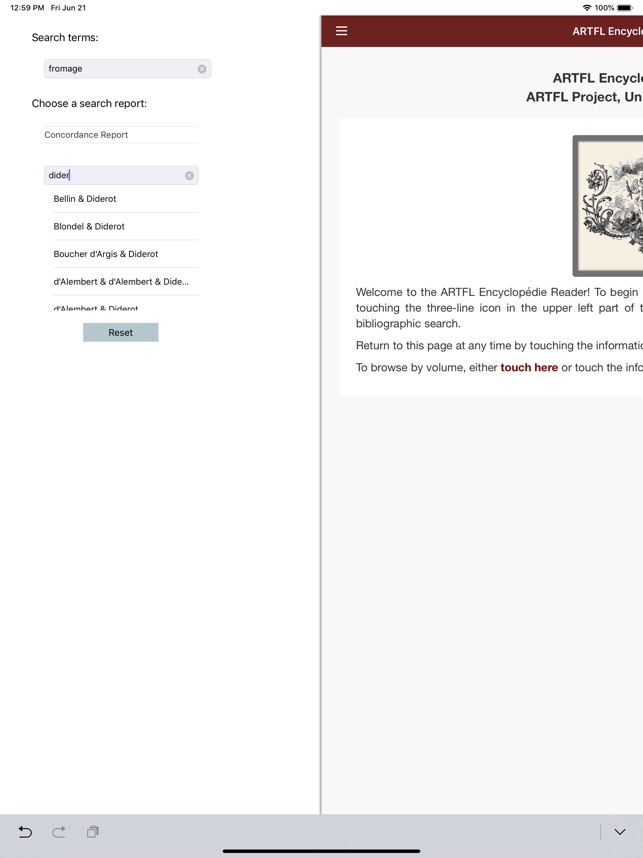
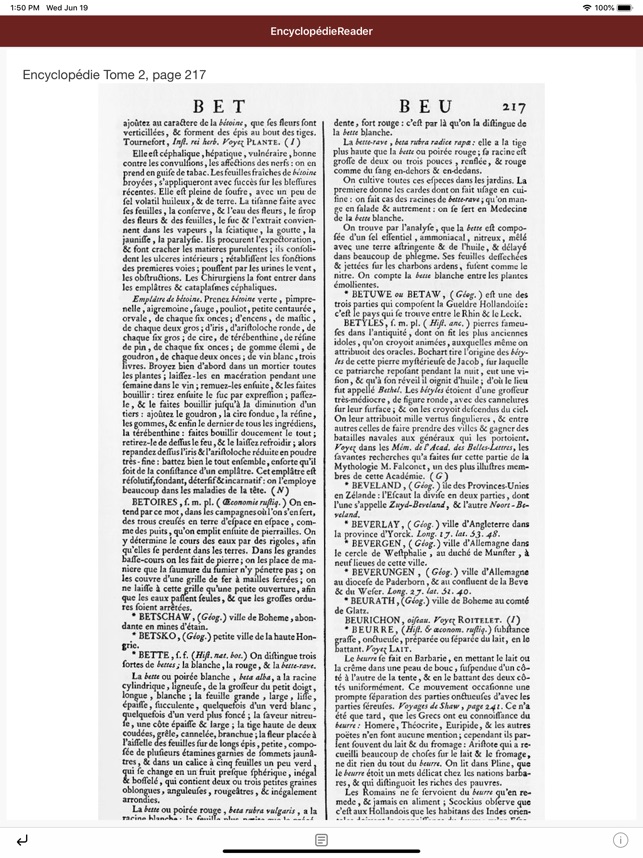
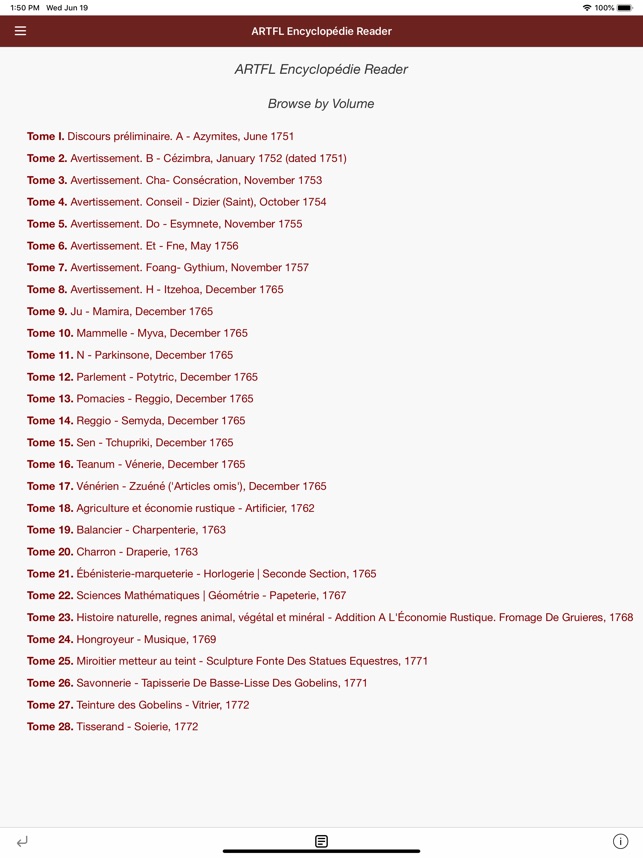
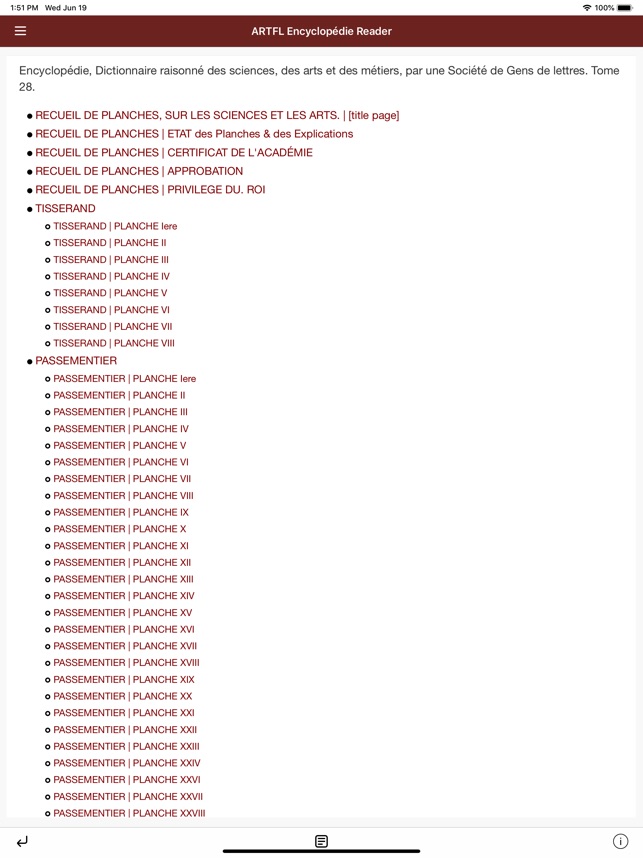
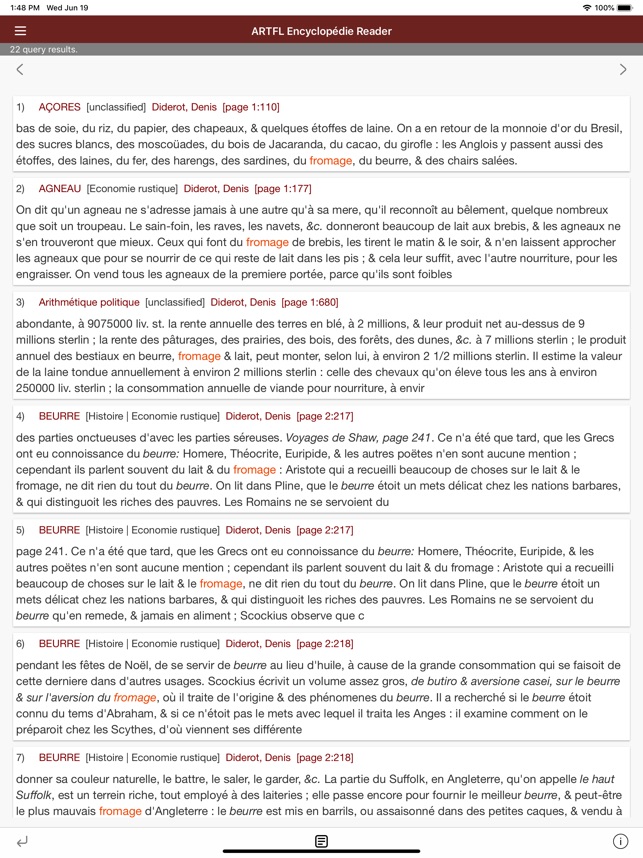
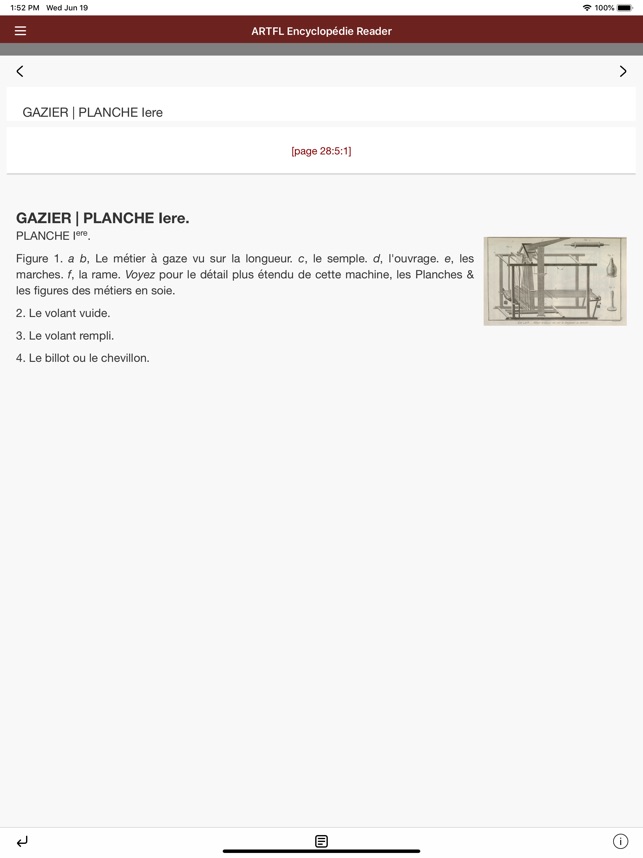
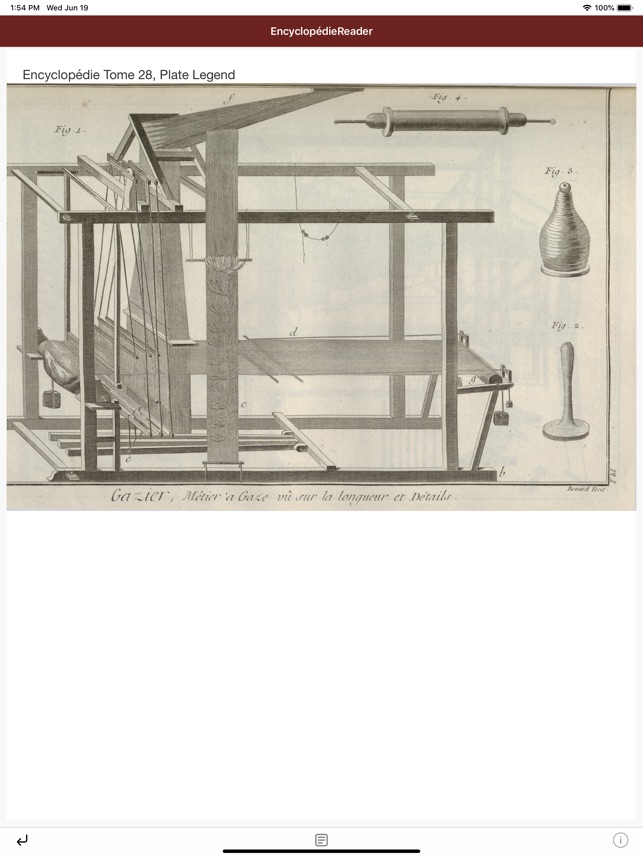
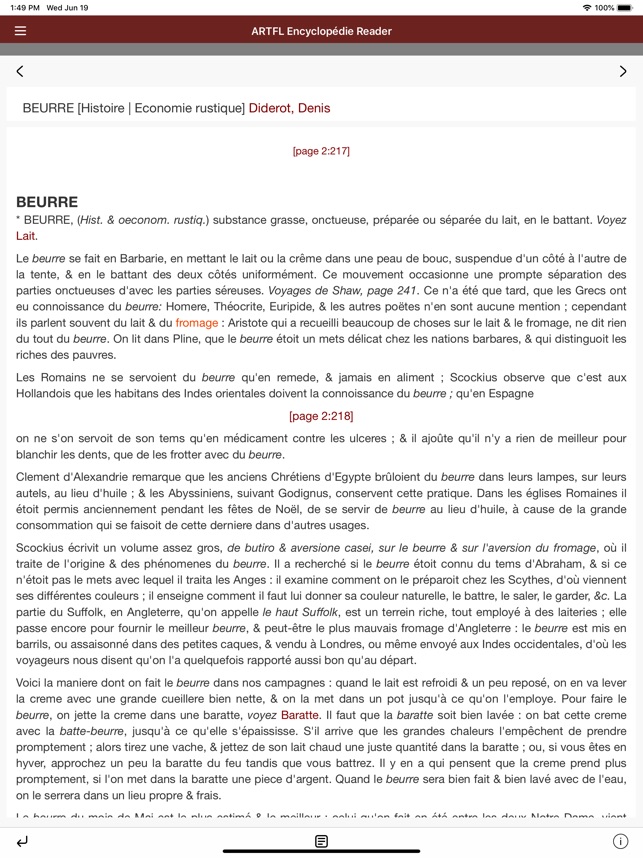
Developed by the ARTFL Project at the University of Chicago, Encyclopédie is a text search and retrieval interface for the full-text digital version of Diderot and d'Alembert's Encyclopédie. The system facilitates complex queries of the remote database, including accent-insensitive word and bibliographic searches with wildcard support. The interface presents results as either a concordance or a word frequency report. From these results, users can navigate to larger text segments, view high-resolution page and plate images, and bookmark passages.

Evidence & Research Context

  • The app provides a scholarly interface to the ARTFL Project's digital edition of the Encyclopédie, a canonical 18th-century reference work comprising 74,000 articles from over 130 contributors.
  • The underlying digital resource has been leveraged in computational humanities research to analyze the text's complex discursive and intellectual structures.
  • Associated research utilizes Latent Dirichlet Allocation (topic modeling) to identify inter-disciplinary discourses that extend beyond the work's original classification scheme, revealing new scholarly insights.
  • This application demonstrates how digital access facilitates novel methods of inquiry into historical primary sources, enabling analyses not possible with print editions.

Intended Use & Scope

This application is designed as a primary source research tool for scholars, educators, and students in history, literature, and digital humanities. Its scope is to enable deep textual analysis and content exploration of the Encyclopédie. The system is a dedicated portal to this single historical work and does not function as a general-purpose historical database or secondary reference tool.

Studies & Publications

2 publications

Peer-reviewed research associated with this app.

Non-Evaluative Reference

Discourses and Disciplines in the Enlightenment: Topic Modeling the French Encyclopédie

Roe et al. (2015) · Frontiers in Digital Humanities

Referenced in academic literature; no direct evaluation of the app
This paper describes the use of Latent Dirichlet Allocation (LDA), or topic modeling, to explore the discursive makeup of the18th-century Encyclopédie of Denis Diderot and Jean le Rond d'Alembert (1751-1772). Expanding upon previous work modeling the Encyclopédie's ontology, or classification scheme, we examine the abstractions used by its editors to visualize the various 'systems' of knowledge that the work proposes, considered here as heuristic tools for navigating the complex information space of the Encyclopédie. Using these earlier experiments with supervised machine learning models as a point of reference, we introduce the notion of topic modeling as a 'discourse analysis tool' for Enlightenment studies. In so doing, we draw upon the tradition of post-structuralist French discourse analysis, one of the first fields to embrace computational approaches to discursive text analysis. Our particular use of LDA is thus aimed primarily at uncovering inter-disciplinary 'discourses' in the Encyclopédie that run alongside, under, above, and through the original classifications. By mapping these discourses and discursive practices we can begin to move beyond the organizational (and physical) limitations of the print edition, suggesting several possible avenues of future research. These experiments thus attest once again to the enduring relevance of the Encyclopédie as an exemplary Enlightenment text. Its rich dialogical structure, whether studied using traditional methods of close reading or through the algorithmic processes described in this paper, is perhaps only now coming fully to light thanks to recent developments in digital resources and methods.
... Read More
Development/Design Paper

Re-Engineering a War-Machine: ARTFL's Encyclopedie

Andreev et al. (1999) · Literary and Linguistic Computing

Describes the research-driven development of this app
Current circumstances, specifically (i) competition from commercial developers and (ii) the need for compatibility between disparate data sources, suggest that it is crucially important to reconsider the ways in which the guidelines of the Text Encoding Initiative (TEI) are applied to computing projects in the humanities. Based on our work with Diderot and d'Alembert's Encycloédie, we contend that, in many cases light, automatically generated tagging is preferable to extensive manual mark-up. The massive size nd complex textual structures of this work made it imperative to devise procedures that would eliminate the need for hand editing. Data capture for this project was limited to clear typographic conventions using HTML conventions and simplified SGML-style tags. All identification of textual units (such as articles and cross-references) and textual attributes (such as authorship and subject headings) was then carried out automatically. The resulting hierarchical units (articles works, paragraphs) can be queried in diverse ways using systems developed by the ARTFL Project. These systems provide full-test retrieval and full-text searching, either in the full text or in a sub-corpus defined by the user. The proven viability of these procedures leads us to assert that this model could be applied profitably to a much wider range of projects where cost-effectiveness and flexibility are desirable.
... Read More

Encyclopédie

Free