AppsFromResearch
Husker Scope icon

Husker Scope

Evidence Tier:DOCUMENTED

Published in academic literature

For:Researchers & AcademicsIndustry Professionals

App Summary

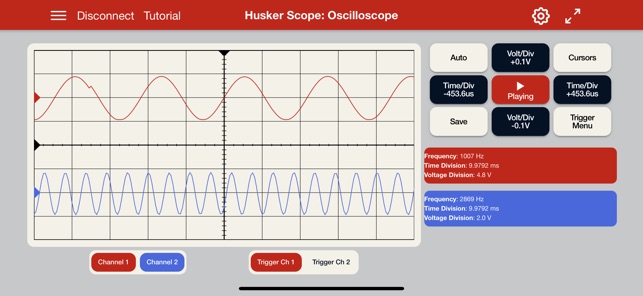
Husker Scope is a mobile application that provides a suite of electronic testing tools, including an oscilloscope and function generator, for use with a smartphone's audio jack or a custom hardware board. The associated research outlines the design of this external hardware, which utilizes a digital signal processor to bypass a phone's native audio limitations, enabling higher sampling rates and multi-channel inputs. This design allows the app to function as an accessible and portable alternative to traditional lab equipment, overcoming the typical performance bottlenecks of smartphone-based tools.

App Screenshots

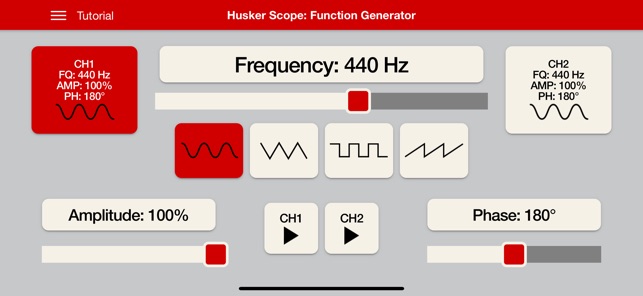
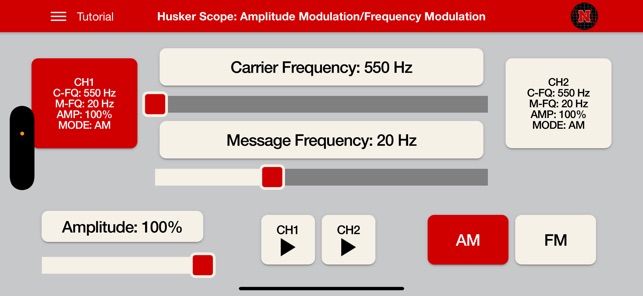
Husker Scope screenshot 1 of 10Husker Scope screenshot 2 of 10Husker Scope screenshot 3 of 10Husker Scope screenshot 4 of 10Husker Scope screenshot 5 of 10Husker Scope screenshot 6 of 10Husker Scope screenshot 7 of 10Husker Scope screenshot 8 of 10Husker Scope screenshot 9 of 10Husker Scope screenshot 10 of 10

Detailed Description

Functionality & Mechanism

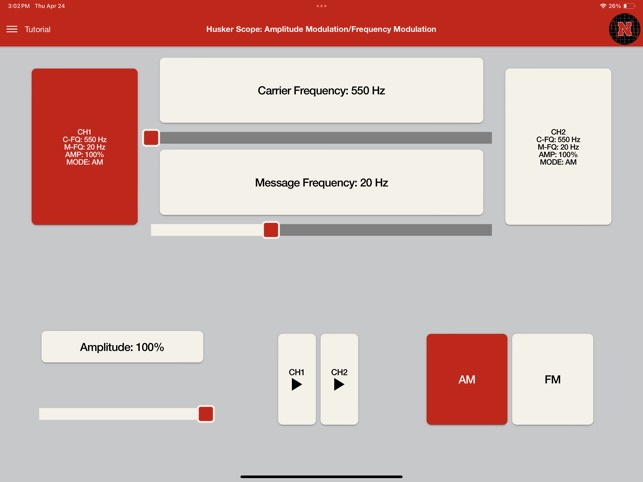
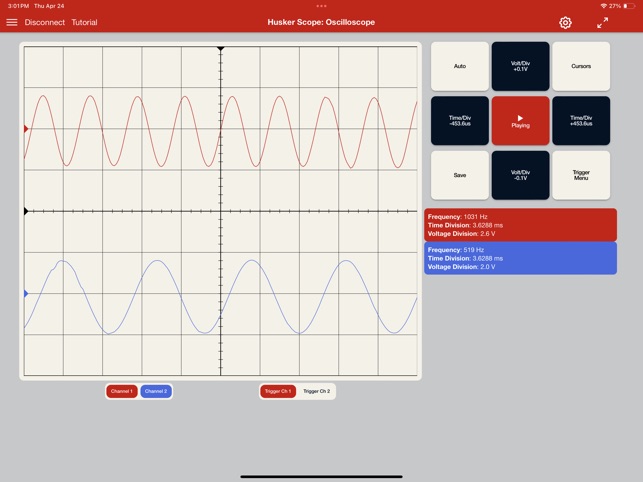
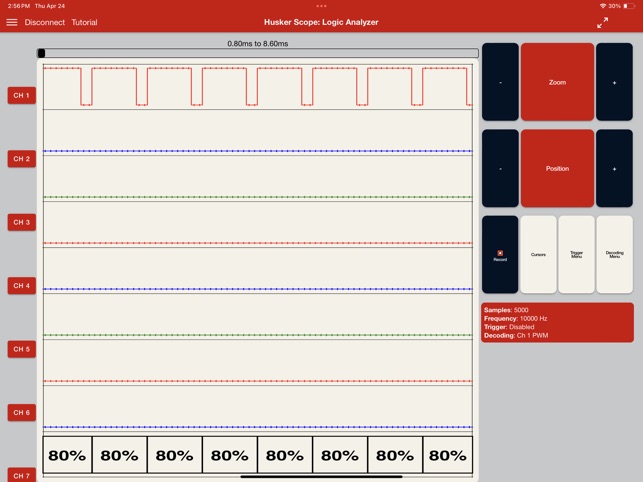
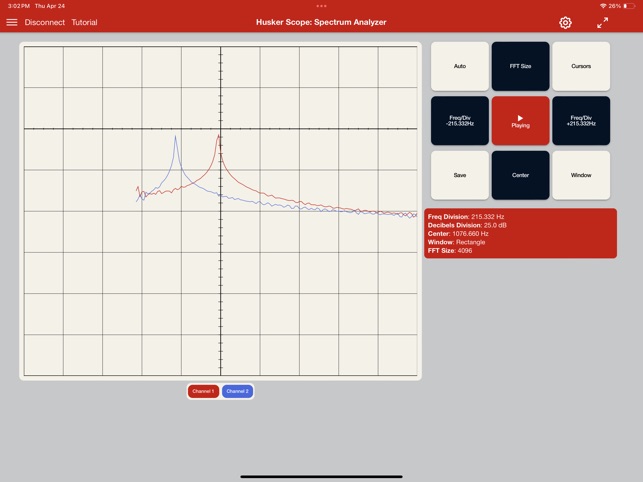
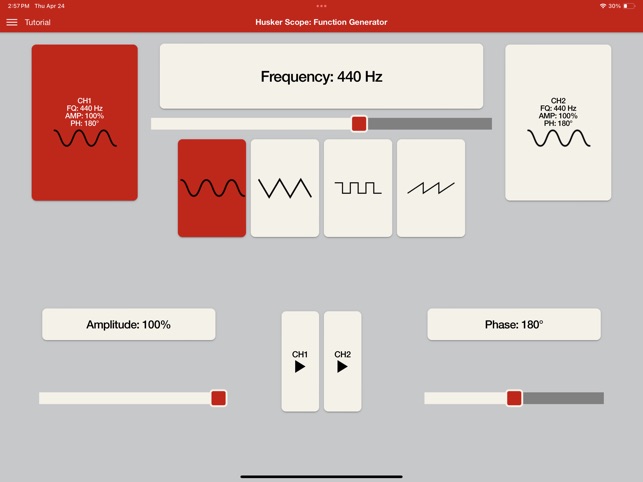
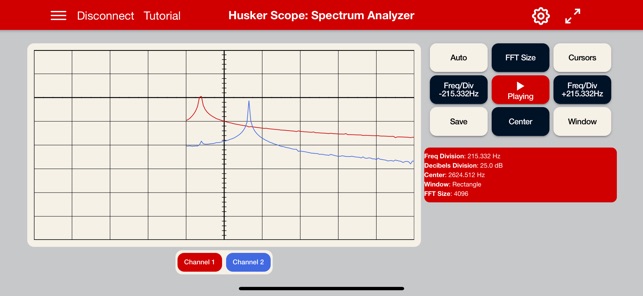
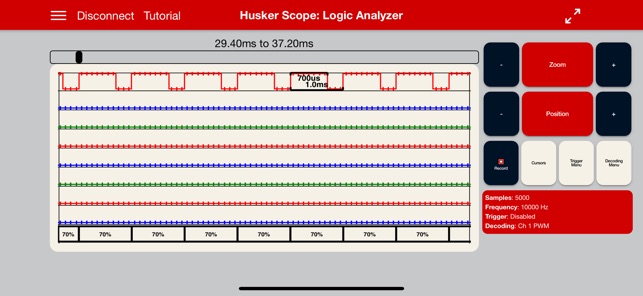
Husker Scope is an integrated instrumentation suite for signal generation and analysis. The cross-platform application features a Dual Channel Function Generator, AM/FM Modulator, Oscilloscope, Spectrum Analyzer, and 8-channel Logic Analyzer. The system leverages a device's native audio hardware for processing signals within the 20Hz–20kHz range. For extended capabilities, it interfaces with a custom hardware board via serial or Bluetooth connection, enabling multi-channel input and analysis of signals up to 500kHz, bypassing audio codec limitations.

Evidence & Research Context

  • The app's design is detailed in a protocol paper addressing the inherent limitations of smartphone-based oscilloscopes, such as sampling rate and voltage constraints imposed by audio codecs.
  • The associated research documents the development of external hardware to circumvent these limitations, enabling the processing of signals beyond the typical 20 kHz audio range.
  • This hardware architecture utilizes an external digital signal processor to handle higher-frequency inputs and transmit sample data digitally to the application, supporting true multi-channel analysis.

Intended Use & Scope

This tool is designed for engineers, educators, and researchers requiring portable signal generation and analysis capabilities. Its primary utility is for accessible electronic testing in laboratory or field settings. The application's performance is fundamentally limited to the audio frequency range unless paired with the custom external hardware, which is required for high-frequency measurements and multi-channel functions.

Studies & Publications

1 publication

Peer-reviewed research associated with this app.

Development/Design Paper

Design of hardware to aid smartphone-based oscilloscope app

Moran et al. (2022)

Describes the research-driven development of this app
A smartphone-based oscilloscope improves on traditional lab oscilloscopes in accessibility and portability but faces several performance limitations compared to traditional oscilloscopes. Among these, an oscilloscope app that uses the phone's audio to read voltage signals will have a sampling rate and voltage bottlenecked by the capabilities of the audio codec, which will rarely exceed a rate of 48 kHz and 1 volt, respectively. Additionally, smartphones lack the ability to read line-in audio, allowing only one channel input through the microphone. Direct connections to an audio source may not be possible due to requiring an audio jack connection, and different poles being used for voltage output and input. These limitations can be remedied with the use of external hardware to aid the oscilloscope app. An adapter can be used to connect voltage output from the left or right channels to the microphone channel, and a channel switch on the adapter can be used to partially alleviate the lack of two-channel input. A digital signal processor external from the phones audio codec can be utilized to process signals higher than 20 kHz that would otherwise be unreadable based on a 48 kHz sampling rate. This processor can send samples digitally to the app, which allows for input of as many channels as the external process has physical connections for.
... Read More

Husker Scope

Free