

MESA Risk Score
Validated in clinical trials · Initial evidence
App Summary
App Screenshots
Detailed Description
Functionality & Mechanism
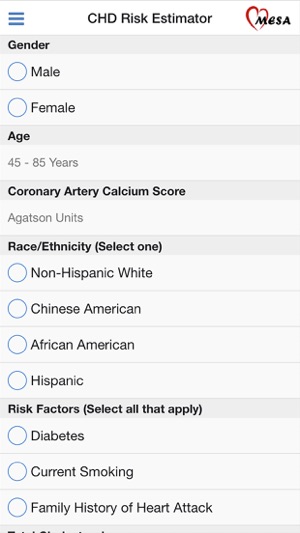
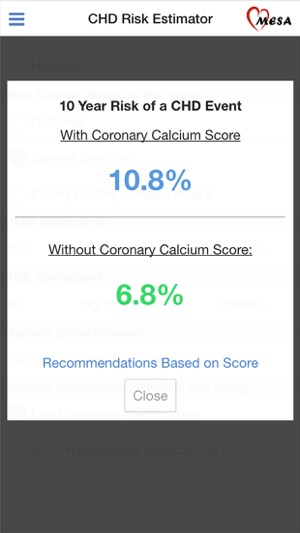
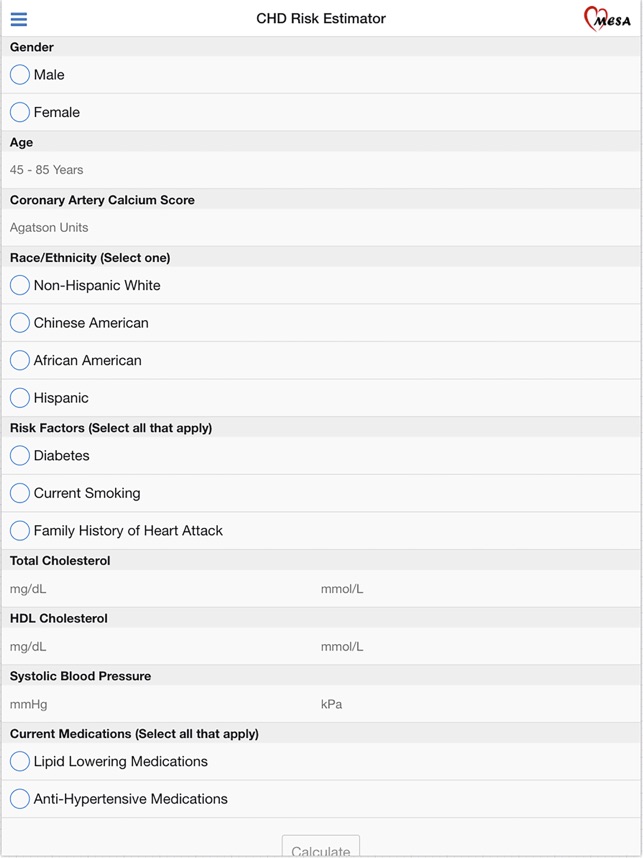
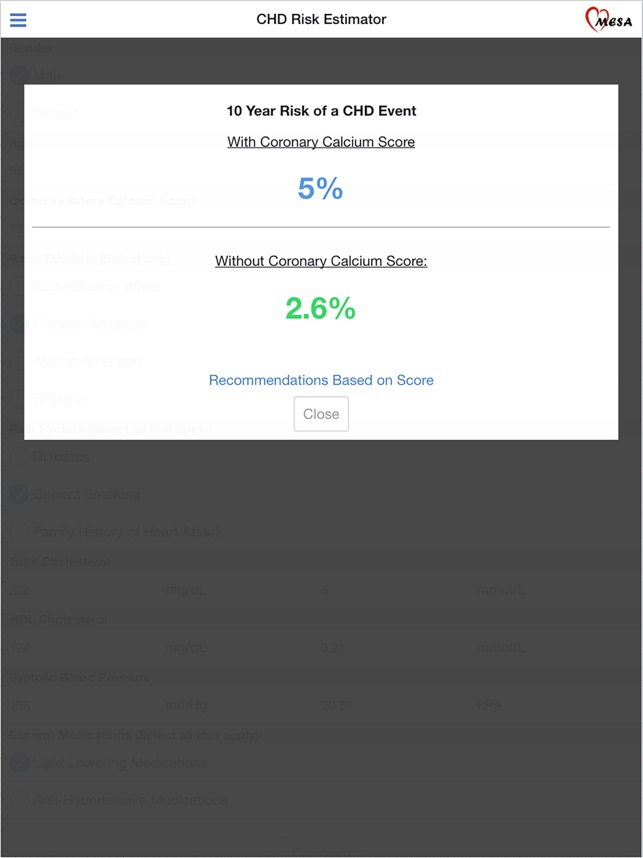
The MESA Risk Score, developed by the Multi-Ethnic Study of Atherosclerosis research group, is a clinical calculator designed to estimate 10-year coronary heart disease (CHD) risk. The system uniquely integrates coronary artery calcium (CAC) scores with traditional cardiovascular risk factors captured through its interface. Upon calculation, the tool generates a quantitative risk percentage and a corresponding "coronary age" metric, which is engineered to facilitate patient risk communication and inform decisions regarding preventive therapies.
Evidence & Research Context
- A large-scale validation study demonstrated that integrating coronary artery calcium (CAC) significantly improved risk prediction (C-statistic: 0.80 vs. 0.75) within the original MESA cohort (N=6,814).
- External validation in two independent cohorts (the HNR and DHS studies) confirmed robust discrimination and calibration, achieving C-statistics of 0.779 and 0.816, respectively.
- The risk algorithm was derived in a multi-ethnic population of asymptomatic adults aged 45-84, including White, African American, Hispanic, and Chinese American participants.
- Associated research details the derivation of a "coronary age," a transformation of the risk score that retains identical predictive power while enhancing its utility for risk communication.
Intended Use & Scope
This calculator is intended for clinicians to support risk stratification and decision-making for primary prevention of CHD. Its primary utility is to refine 10-year risk estimates and guide discussions on the intensity of preventive therapies. The score is an informational tool that augments, but does not replace, individualized clinical judgment and shared patient-provider decision-making.
Studies & Publications
Peer-reviewed research associated with this app.
Derivation of a Coronary Age Calculator Using Traditional Risk Factors and Coronary Artery Calcium: The Multi-Ethnic Study of Atherosclerosis
Blaha et al. (2021) · Journal of the American Heart Association
Describes the research-driven development of this app10-Year Coronary Heart Disease Risk Prediction Using Coronary Artery Calcium and Traditional Risk Factors: Derivation in the MESA (Multi-Ethnic Study of Atherosclerosis) With Validation in the HNR (Heinz Nixdorf Recall) Study and the DHS (Dallas Heart Study)
McClelland et al. (2015) · Journal of the American College of Cardiology
Successfully predicted 10-year heart disease risk using calcium scores and validated in two independent groups.
In the Media
MESA heart disease risk score performs well even without race modifiers
University of Washington researchers developed a race-free version of the MESA Risk Score to predict heart disease risk without perpetuating health disparities, using traditional risk factors and coronary artery calcium levels from CT imaging. "This change broadens the potential use of the score, since it can now be calculated for those who do not fit into one of the racial or ethnic groups of the original score and for those who do not wish to disclose their race," said doctoral student Quinn White. The study found virtually no difference in heart disease prediction accuracy between the race-inclusive and race-free versions.
Consider adopting the MESA 10-year CHD risk calculator
Dr. Robert A. Vogel from the University of Colorado at Denver developed the MESA Risk Score as a 10-year coronary heart disease risk calculator that offers significant advantages over widely used alternatives by incorporating coronary artery calcium scores and family history data. "I don't use the PCE very much. I use the MESA [Multi-Ethnic Study of Atherosclerosis]. I like it because it gives me options I don't have with the PCE," Dr. Vogel explained at the Annual Cardiovascular Conference at Snowmass. The calculator includes four ethnic categories and allows clinicians to assess risk with or without coronary artery calcium measurements.
The MESA App-Estimating Your Risk of Cardiovascular Disease With And Without Coronary Calcium Score
The Multi-Ethnic Study of Atherosclerosis (MESA) researchers developed the MESA Risk Score app to more precisely assess cardiovascular disease risk by incorporating coronary artery calcium scores alongside traditional risk factors. The app utilizes data from a diverse study of 6,814 asymptomatic participants aged 45-84 that has generated 69 publications informing understanding of coronary calcium value. According to a skeptical cardiologist, "the CACS in many patients dramatically lowers or increases the estimated risk of cardiovascular events the patient faces."
App Information
Developer
Johns Hopkins UniversityCategory
Evidence Profile
Validated in clinical trials · Initial evidence
Platforms
Updated
Aug 2017
© 2025 Johns Hopkins University
Tags



MESA Risk Score
Free