
AppsFromResearch
NASA Glenn Research Center: The Early Years icon

NASA Glenn Research Center: The Early Years

Evidence Tier:DOCUMENTED

Published in academic literature

For:Researchers & AcademicsGeneral Public & Enthusiasts

App Summary

This app provides a photographic retrospective of the first four decades of the NASA Glenn Research Center, offering a visual history of its foundational research for the public, students, and historians. The associated research documents the center's pivotal role in developing key technologies, including electric and air-breathing propulsion, advanced power systems, and materials for extreme environments. The authors conclude that these sustained research investments were critical to U.S. aerospace leadership, and this app provides a unique visual record to enhance the public's understanding of this scientific heritage.

App Screenshots

NASA Glenn Research Center: The Early Years screenshot 1 of 5NASA Glenn Research Center: The Early Years screenshot 2 of 5NASA Glenn Research Center: The Early Years screenshot 3 of 5NASA Glenn Research Center: The Early Years screenshot 4 of 5NASA Glenn Research Center: The Early Years screenshot 5 of 5

Detailed Description

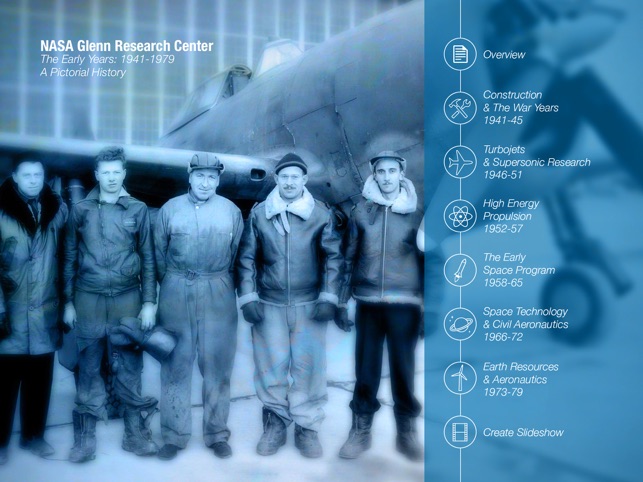
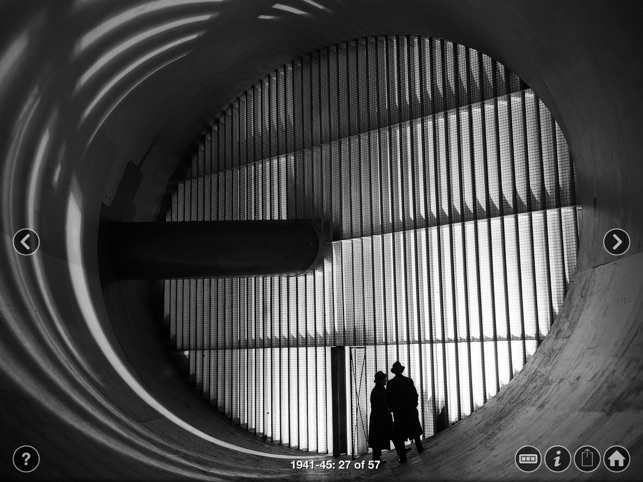
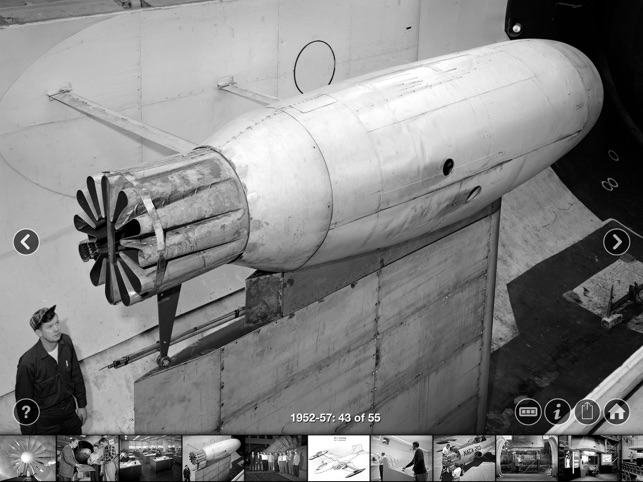
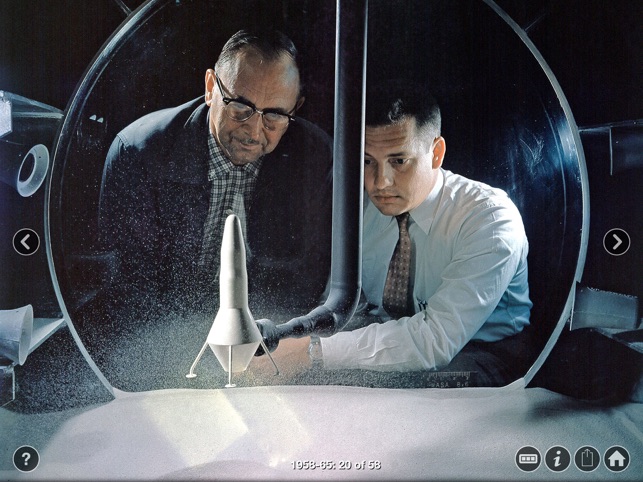
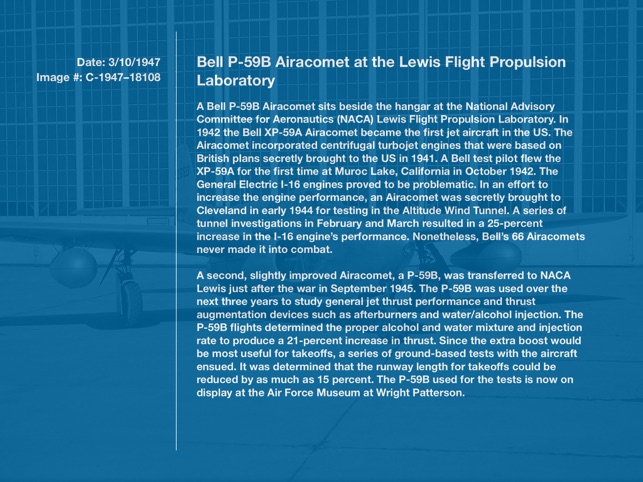
Functionality & Mechanism This educational tool, developed by the NASA Glenn Research Center, provides a curated photographic archive detailing the center's first four decades (1941-1979). The interface facilitates exploration of over 300 high-resolution images, each accompanied by detailed descriptive text. Content is organized to chronicle key research, personnel, and technological advancements in aeronautics and space exploration. Sessions involve systematic browsing of the collection to gain insight into the center's historical scientific contributions and its institutional evolution.

Evidence & Research Context

  • The app's content documents the institution's evolution from the National Advisory Committee for Aeronautics (NACA) Aircraft Engine Research Laboratory, established in 1942.
  • Associated research categorizes the center's historical contributions into six core competencies, including air-breathing propulsion, in-space propulsion, and materials for extreme environments.
  • A primary research focus documented in the archive is the development of electric propulsion (EP) technology, in which the center has played a pivotal role since 1956.
  • Historical reviews note that strategic institutional investments in unique testing infrastructure were critical to pioneering U.S. advances in aerospace technology.

Intended Use & Scope This tool is designed for educators, students, historians, and the general public as a historical reference. Its scope is a curated visual introduction to the scientific and engineering milestones of the NASA Glenn Research Center. The system is limited to the 1941–1979 period and is not a comprehensive technical database or a source for current mission data.

Studies & Publications

2 publications

Peer-reviewed research associated with this app.

Non-Evaluative Reference

Special Issue on Seventy Years of Aerospace Research and Technology Excellence at NASA Glenn Research Center

Lei et al. (2013) · Journal of Aerospace Engineering

Referenced in academic literature; no direct evaluation of the app
This special issue serves as a comprehensive historical review and forward-looking analysis of the research and technology development at the NASA Glenn Research Center (GRC) at Lewis Field over the past 70 years. The introductory paper chronicles the facility's evolution from its inception in 1942 as the Aircraft Engine Research Laboratory (AERL) under the National Advisory Committee for Aeronautics (NACA), through its pivotal contributions to World War II aviation, the space race, and the Apollo missions, to its current role in advancing aeronautics and space exploration. The issue organizes GRC's contributions into six core competencies: air-breathing propulsion; in-space propulsion and cryogenic fluids management; communications technology; power, energy storage, and conversion; materials and structures for extreme environments; and physical sciences in space. Through these categorizations, the publication highlights GRC's critical impact on U.S. leadership in the global aerospace marketplace and outlines its future strategic directions in areas such as alternative fuels, aviation safety, and uncrewed aircraft systems.
... Read More
Non-Evaluative Reference

History of Electric Propulsion at NASA Glenn Research Center: 1956 to Present

Patterson et al. (2012) · Journal of Aerospace Engineering

Referenced in academic literature; no direct evaluation of the app
This paper provides a brief overview of the history of electric propulsion (EP) at the National Aeronautics and Space Administration (NASA) Glenn Research Center (GRC). Since the inception of EP technology, GRC has played a pivotal role in developing the technology and transitioning it to flight. Research and development efforts by GRC's employees, grantees, and contractors brought operational EP systems to commercial satellites in the early 1990s and to NASA and other government agency missions starting in the late 1990s. GRC's early construction of unique EP test infrastructure and NASA's and GRC's sustained investments in EP research and development over several decades were strategic in the creation of technologies that continue to greatly benefit the competitiveness and capabilities of U. S. space systems and missions.
... Read More

NASA Glenn Research Center: The Early Years

Free