
NIOSH Sound Level Meter
Validated with strong research evidence · Supported by multiple studies
App Summary
App Screenshots
Detailed Description
Functionality & Mechanism
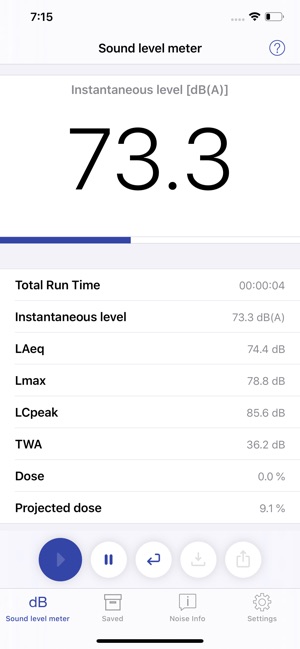
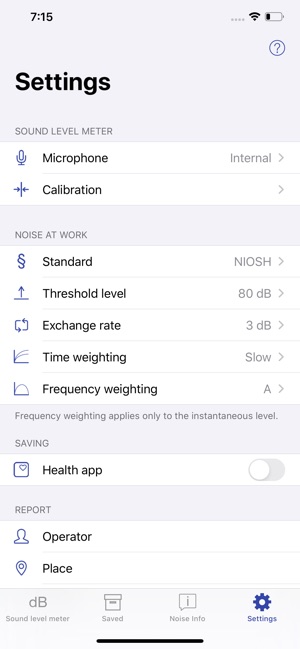
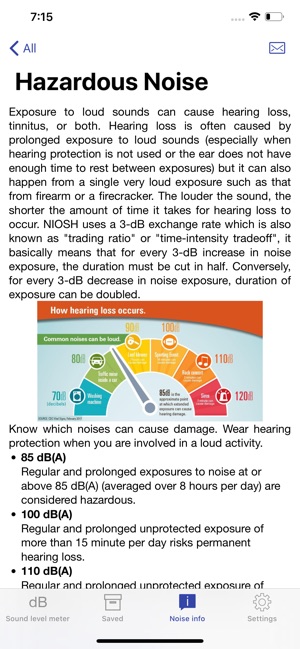
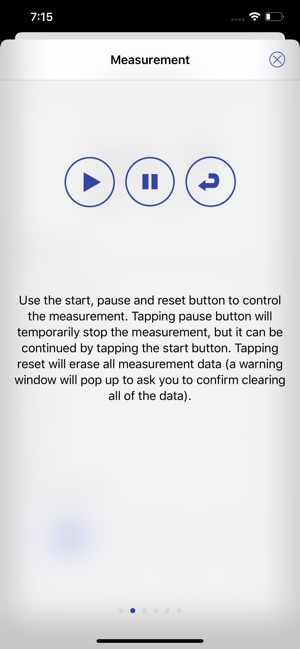
Developed by acoustics engineers at the National Institute for Occupational Safety and Health (NIOSH), the app functions as a mobile sound level meter and noise dosimeter. The system leverages the device's internal or a connected external microphone to capture acoustic data in real time. The interface displays critical occupational noise metrics, including time-weighted average (TWA), LAeq, peak levels, and projected noise dose according to NIOSH and OSHA standards. The system supports A, C, and Z weighting and includes a calibration module.
Evidence & Research Context
- A series of evaluation studies demonstrated that when paired with an external calibrated microphone, the app's measurements are accurate to within ±1 dB of a reference Type 1 measurement system.
- Validation studies confirmed the app can achieve compliance with most requirements for a Class 2 instrument under the IEC 61672/ANSI S1.4-2014 standard when used with a compatible external microphone.
- With the device's internal microphone, the app was validated by NIOSH in a reverberant chamber and demonstrated an accuracy of ±2 dBA.
- Associated research highlights that the use of an external, calibrated microphone significantly improves measurement precision and reliability compared to the device's built-in microphone.
Intended Use & Scope
This tool is intended for occupational safety professionals, industrial hygienists, researchers, and employers to conduct preliminary noise assessments and facilitate hearing loss prevention awareness. Its primary utility is for spot measurements and identifying potentially hazardous noise sources. The app is not a direct substitute for certified equipment required for regulatory compliance, which necessitates professional consultation and certified hardware.
Studies & Publications
Peer-reviewed research associated with this app.
Smartphone-based sound level measurement apps: Evaluation of directional response
Celestina et al. (2021) · Applied Acoustics
Sound level meter app with external microphone accurately measures sound from different directions.
Smartphone-based sound level measurement apps: Evaluation of compliance with international sound level meter standards
Celestina et al. (2018) · Applied Acoustics
NoiSee app with external microphone meets professional sound level meter standards for accuracy.
In the Media
NIOSH App Measures Workplace Sound Levels
NIOSH researchers developed the Sound Level Meter app to collect workplace noise exposure data and help workers make informed decisions about hearing hazards, with plans to use it as a crowdsourcing research tool. "A long-term goal is that this app will become a research tool that people can use for doing workplace surveys," said Capt. Chucri Kardous, a senior research engineer who worked on the app. The app is only available on iOS devices because NIOSH found that Android's fragmented marketplace with hundreds of different device configurations made testing and verification impossible in their laboratory.
New NIOSH Sound Level Meter App
NIOSH hearing loss researchers collaborated with app developer EA LAB to create the NIOSH Sound Level Meter app that measures and characterizes occupational noise exposure similar to professional instruments. The app met NIOSH testing criteria with "± 2 dB mean difference from the reference type 1 sound level meter" and achieved even closer agreement within "± 1 dB" when used with external calibrated microphones. The iOS-based app is now available freely on iTunes to occupational safety professionals and the general public.
App Information
Category
Evidence Profile
Validated with strong research evidence · Supported by multiple studies
Platforms
Updated
May 2026
© 2025 US Centers for Disease Control and Prevention
Tags
Relevant Links
Privacy Policy

NIOSH Sound Level Meter
Free