
Noise Score 2
Published in academic literature
App Summary
App Screenshots
Detailed Description
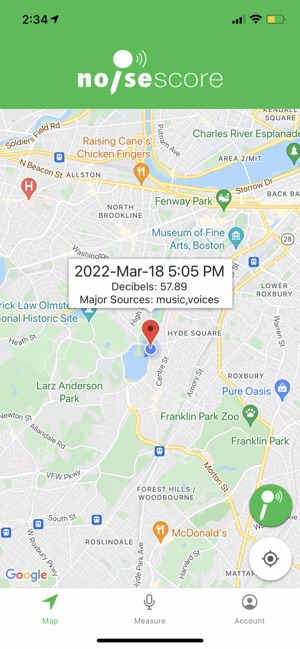
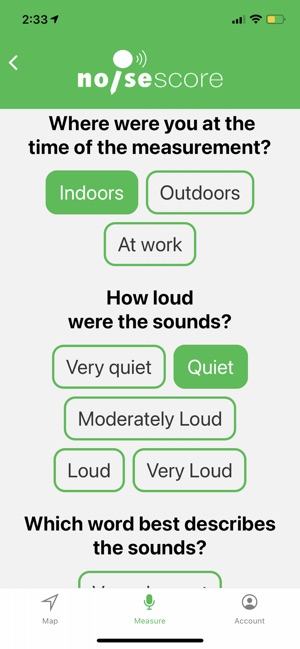
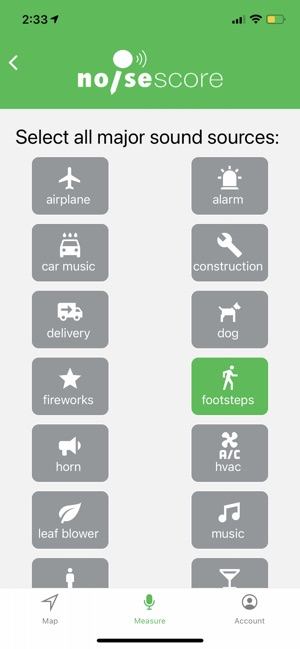
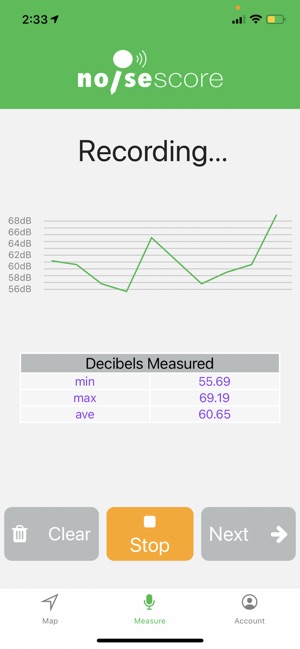
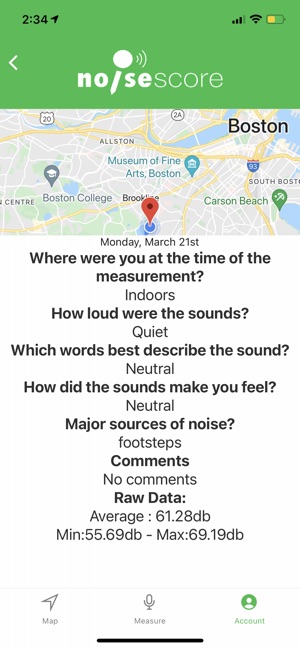
Functionality & Mechanism Developed by the advocacy group Noise and the City, Noise Score 2 facilitates citizen-led environmental sound monitoring. The system leverages a device's microphone to capture unweighted sound pressure levels (dB), prioritizing total noise including low-frequency sound. Concurrently, an integrated survey captures subjective perceptions of the acoustic environment. This dual-data approach is designed to map the spatial and temporal distribution of community sound levels, identifying both quiet areas and sources of significant noise pollution for research and advocacy.
Evidence & Research Context
- The app has been utilized as a primary data collection instrument in environmental health research to investigate urban soundscapes and community noise perception.
- Data gathered via the app contributed to a published study from Boston University School of Public Health analyzing the prevalence and acoustic characteristics of illegal firework activity.
- This research correlated low-frequency sound with community disturbance calls (911/311) and noted potential negative cardiovascular and mental health outcomes associated with such noise.
Intended Use & Scope Designed for researchers, community advocacy groups, and the general public, this app serves as a citizen science tool for crowdsourcing environmental noise data. Its primary utility is to map community soundscapes and inform advocacy efforts. The system is not a calibrated instrument for diagnostic or regulatory compliance and does not replace professional acoustic assessment.
Studies & Publications
Peer-reviewed research associated with this app.
Firework Activity and Environmental Sound Levels: Community Impacts and Solutions
Walker et al. (2021) · Cities & Health
The app successfully documented neighborhood differences in firework-related noise levels, particularly in low-frequency sound ranges.In the Media
Researcher Studies Impact of Community Noise on Health
Boston University researcher Erica Walker founded the Community Noise Lab in 2019 to address community noise issues through real-time sound monitoring, lab-based experiments, and community engagement activities. Walker describes her current approach as "storm-chasing science," explaining "I'm going right into the eye of the storm, likely with a high risk of failure, to figure out how to make my tools work equitably." She focuses on bridging environmental noise research with community needs while ensuring her tools work beyond privileged areas like Boston to places like Memphis and Birmingham.
NoiseScore app records and addresses environmental sound issues for communities
Boston University postdoctoral researcher Erica Walker developed NoiseScore to address community noise pollution issues, creating a real-time environmental soundscape measurement tool funded by the Radcliffe Institute for Advanced Study. The app allows users to record environmental sounds and answer survey questions about their feelings, generating "a live heat map, comprised of objective and subjective community responses" that depicts sound levels based on user-recorded decibels. Walker noted that "sound levels do impact our cardiovascular and mental health," emphasizing the need for more research on how perception affects these health impacts.
Noise on the Map: Using NoiseScore to Address Community Noise Issues
The Software & Application Innovation Lab (SAIL) at Boston University's Hariri Institute deployed NoiseScore 2.0 to help community residents document and visualize their environmental soundscape, collaborating with postdoctoral researcher Erica Walker from the Community Noise Lab. Walker, an environmental epidemiologist, explains that Community Noise Lab "was birthed from a very real iterative process, ignited by a noise spat with some very loud upstairs neighbors" and represents her decision to "move towards ACTION" rather than accept noise issues. The app enables communities to examine their unique noise problems and understand how sound impacts health and well-being.
Community Noise Lab Works with Communities Affected by Noise Pollution
Boston University School of Public Health's Erica Walker developed the Community Noise Lab to address noise pollution by working directly with affected communities, recognizing that the difference between sound and noise is subjective. Walker explains that "in the Fenway, if you ask them what's really bothering them, they're not going to tell you it's road traffic noise or aircraft noiseâthose aren't even in the top three," with residents instead citing outdoor concerts at Fenway Park as their primary concern. The lab partners with four Boston-area communities to measure both sound volume and noise irritation levels.
Postdoctoral researcher launches Community Noise Lab at Boston University
Dr. Erica Walker, a postdoctoral researcher at Boston University School of Public Health, launched Community Noise Lab to explore the relationship between community noise and health using real-time sound monitoring, smartphone technology, and community engagement activities. The Robert Wood Johnson Foundation funded her research with a two-year, $410,000 grant that will support a real-time sound monitoring network and upgrades to the lab's smartphone app, NoiseScore. "We hope to inform, empower, and impact the communities we work with, while using their experiences to strengthen and advance our research," Dr. Walker said.
With NoiseScore, Sound Metrics Becomes a Lifestyle Factor
Erica Walker developed NoiseScore to address community noise issues by allowing users to document their sound experiences through photos, videos, recordings, and personal descriptions. "I realized at that point that noise is just way bigger than myself," Walker said after discovering widespread noise complaints throughout Boston ranging from loud neighbors to airplanes and traffic. The app uploads user ratings to create a live map on the Noise and the City website, providing community-sourced sound data for healthier living environments.
NoiseScore app raises awareness of noise pollution in Boston
Harvard T.H. Chan School of Public Health graduate Erica Walker developed NoiseScore to map sound and noise pollution around the world in real-time, using user-submitted data that updates every minute. Walker explained that she wanted to create "something that had a real-time element, a well-rounded method of looking at noise complaints" after her static 2015-16 survey received 1,200 responses from 400 Boston sites. The Radcliffe Institute for Advanced Study at Harvard funded the project as part of their citizenship theme focus.
App Information
Developer
Boston UniversityCategory
Evidence Profile
Published in academic literature
Platforms
Updated
Mar 2022
© 2025 Boston University
Tags
Relevant Links
Privacy Policy

Noise Score 2
Free