
STOP HCC-HCV
Initial evidence from research studies
App Summary
App Screenshots
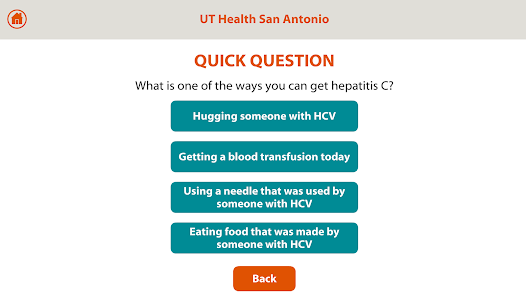
Detailed Description
Functionality & Mechanism
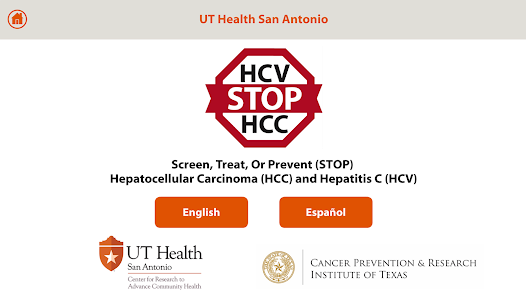
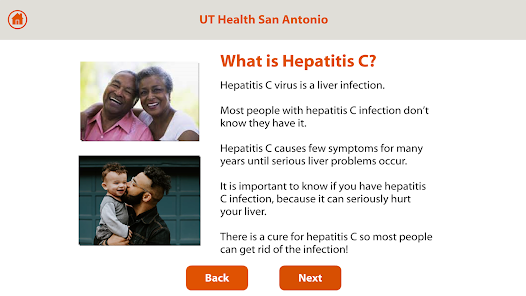
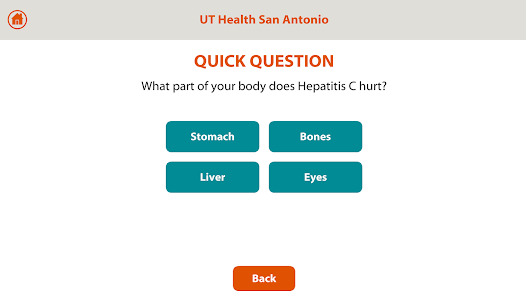
Developed by the STOP HCC-HCV Program, this tool delivers pedagogical content on hepatitis C (HCV). The interface guides the user through sequential modules covering HCV etiology, transmission, diagnosis, and treatment. To validate comprehension, the system integrates "teach-back" questions after key information is presented. All educational modules are designed for offline access after initial installation, facilitating use in diverse clinical and community settings without requiring a persistent internet connection.
Evidence & Research Context
- The app is a component of the broader STOP HCC-HCV program, which implements HCV screening, linkage to care, and hepatocellular carcinoma prevention initiatives within Federally Qualified Health Centers.
- Associated research from the program underscores the need for effective educational interventions to improve knowledge and attitudes regarding HCV among both providers and community members in high-risk populations.
- The app's design leverages the "teach-back" method, an established health literacy technique intended to confirm patient understanding of complex medical information and improve retention.
- The program's data infrastructure, described in a methodological paper, is designed for privacy-preserving analytics to support public health reporting and research in underserved communities.
Intended Use & Scope
This app is designed as an educational resource for patients, at-risk individuals, and the general public, and as a patient education aid for clinicians. Its primary utility is to provide foundational knowledge about HCV. It does not offer diagnostic services, personalized treatment recommendations, or medical advice. Users should consult a healthcare professional for diagnosis and care.
Studies & Publications
Peer-reviewed research associated with this app.
STOP-HCV-HCC Program: Privacy-Preserving Innovation for Remote Data Access Analytics at Federally Qualified Health Centers in South Texas
Craven et al. (2024) · Studies in Health Technology and Informatics
Describes the research-driven development of this appEducating Primary Care Providers and Associate Care Providers About Hepatitis C Screening of Baby Boomers: a Multi-practice Study
Flores et al. (2020) · Journal of Cancer Education
Both physicians and care team members improved their knowledge about hepatitis C screening after training.
In the Media
Research shows new education program may increase hepatitis C screenings
UT Health San Antonio and UT Southwestern researchers developed STOP HCC-HCV to increase hepatitis C screenings among underserved populations, using a shortened 50-minute training program for healthcare providers. The study involved 287 participants across five Federally Qualified Health Centers in San Antonio and South Texas, with 36% being primary care physicians and 64% associate care providers. "Hispanic populations are in dire need of HCV screening to avert complications of advanced disease such as liver cancer and end-stage liver disease, both of which can be deadly," said principal investigator Dr. Bertha Flores.
Liver cancer prevention project boosts hepatitis C screening and care in safety-net practices
UT Health San Antonio's Long School of Medicine developed STOP HCC-HCV to arrest the rise in Texas liver cancer by building primary care capacity to screen for hepatitis C virus infection and manage patients through teleconsultation. The multi-component strategy increased baby boomer screening rates for HCV infection from less than 1% to 48% across six safety-net practices serving low-income Hispanic communities. The program screened 13,334 of 27,700 baby boomers across the participating practices, with results published in Annals of Internal Medicine.
App Information
Category
Evidence Profile
Initial evidence from research studies
Platforms
Updated
Jul 2023
© 2025 University of Texas Health San Antonio
Tags
Developer Links
Privacy Policy


STOP HCC-HCV
Free