
AppsFromResearch
AD8 icon

AD8

Evidence Tier:CLINICAL GRADE

Validated in clinical trials

For:Clinicians & Healthcare ProfessionalsPatients & Caregivers

App Summary

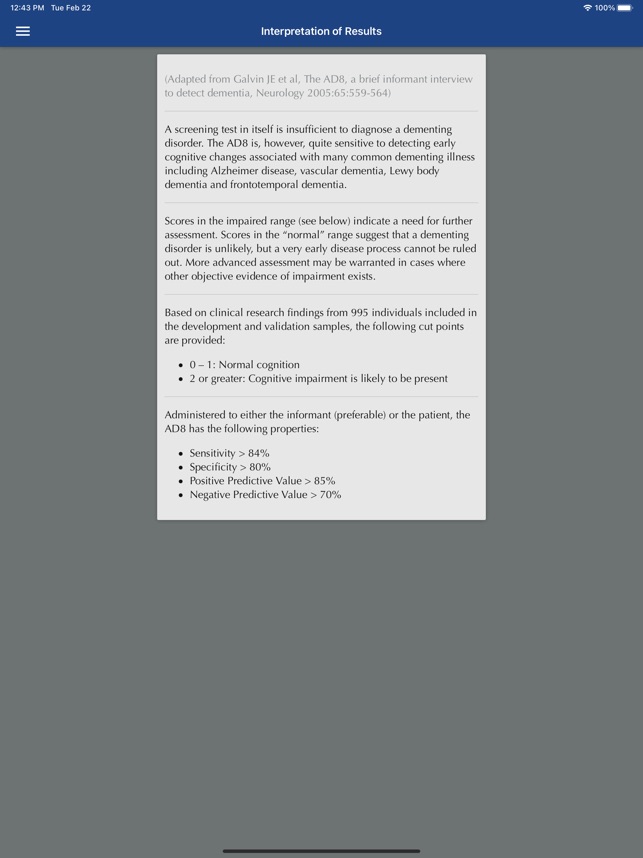
The AD8 is an 8-item informant-based screening tool designed to help clinicians and families detect early cognitive changes associated with various forms of dementia. A validation study (N=255) demonstrated the tool's excellent ability to discriminate between individuals with and without dementia (AUC = 0.92), establishing it as a valid and reliable measure. The associated research concludes the AD8 is a brief, sensitive screening device, and scores indicating impairment warrant further formal assessment by a medical provider.

App Screenshots

AD8 screenshot 1 of 15AD8 screenshot 2 of 15AD8 screenshot 3 of 15AD8 screenshot 4 of 15AD8 screenshot 5 of 15AD8 screenshot 6 of 15AD8 screenshot 7 of 15AD8 screenshot 8 of 15AD8 screenshot 9 of 15AD8 screenshot 10 of 15AD8 screenshot 11 of 15AD8 screenshot 12 of 15AD8 screenshot 13 of 15AD8 screenshot 14 of 15AD8 screenshot 15 of 15

Detailed Description

Functionality & Mechanism

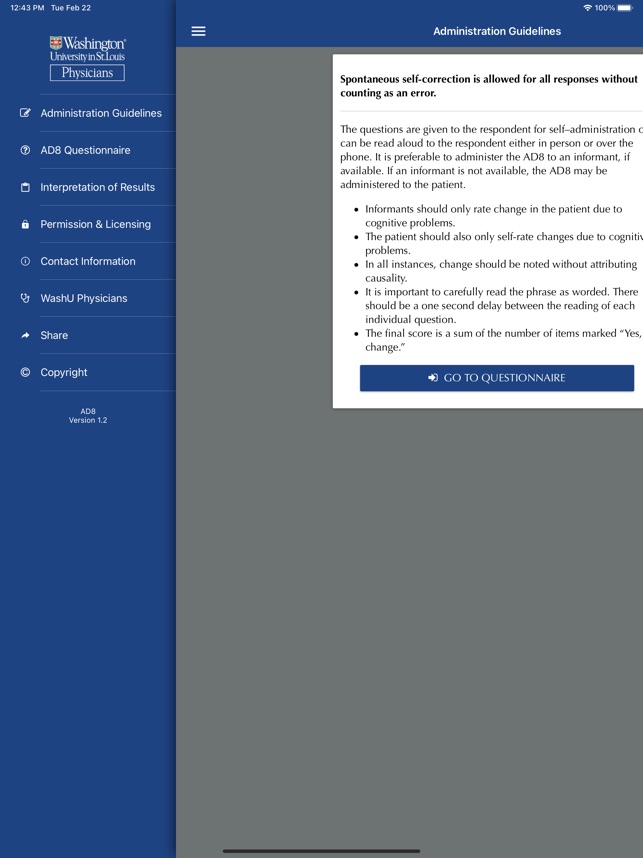
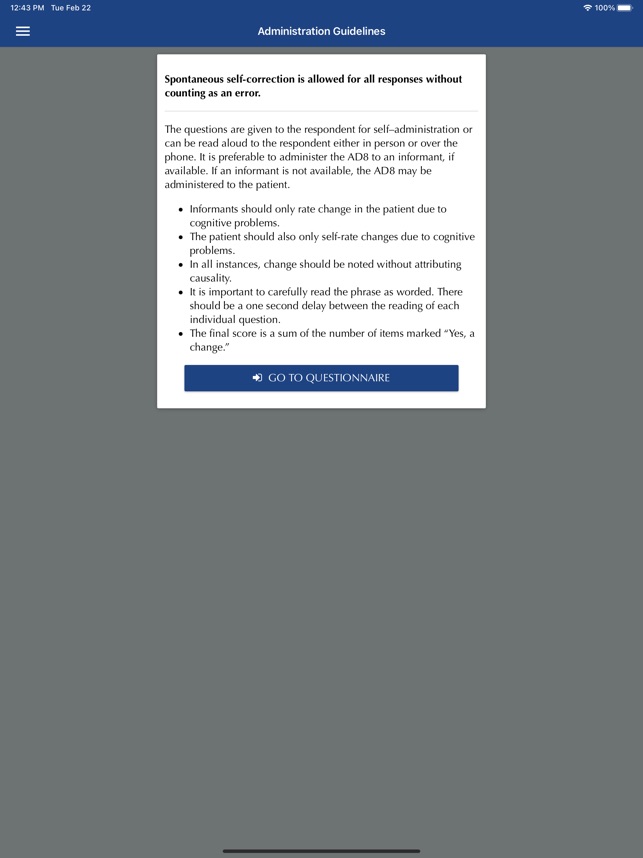
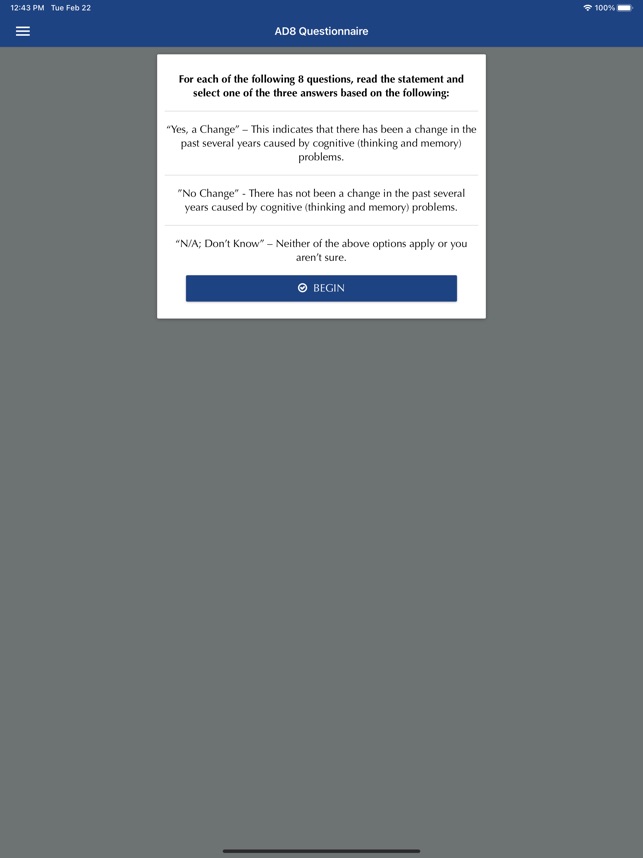
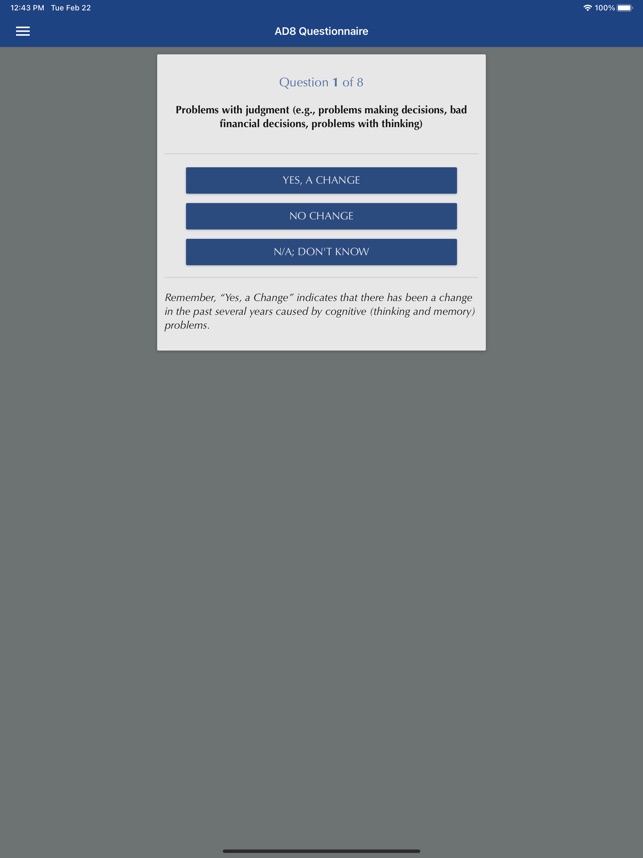
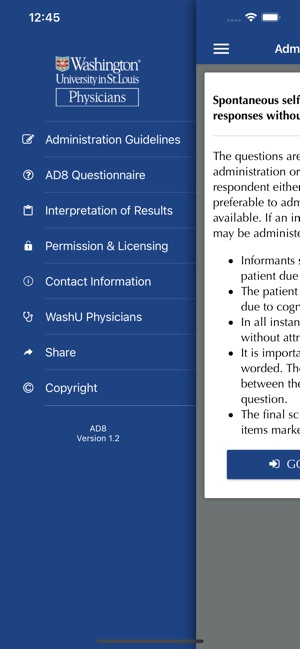
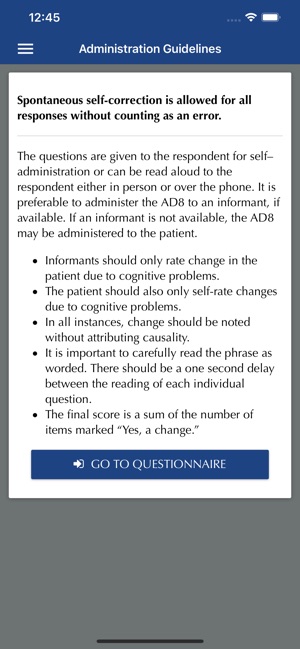
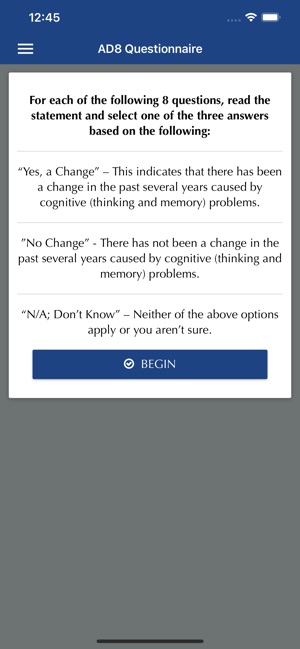
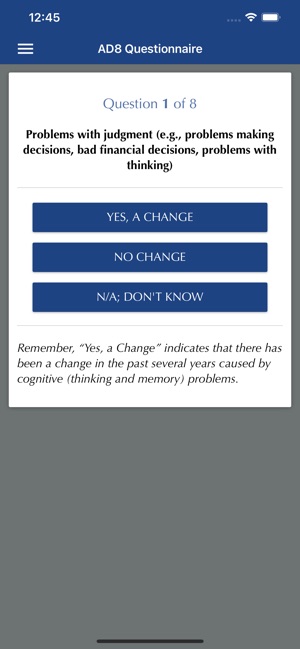
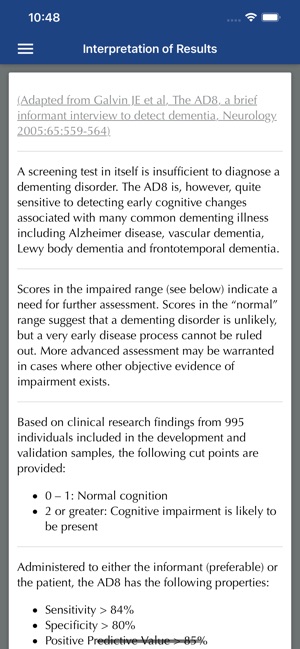
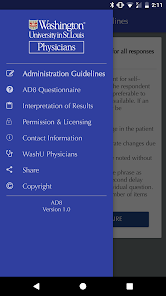
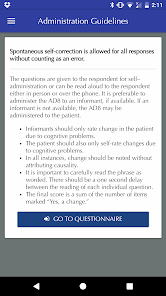
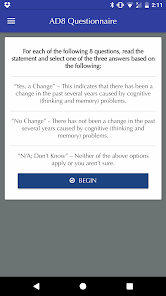
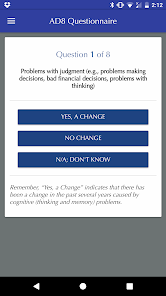
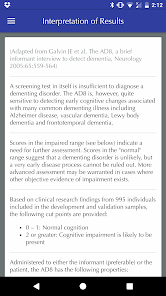
The AD8 application, developed by Washington University, implements the Ascertain Dementia 8-item Informant Questionnaire. The interface facilitates administration to an informant or, if unavailable, directly to the patient. The eight questions, which assess for intra-individual decline in memory, orientation, judgment, and function, can be self-administered or read aloud in person or by phone. The system provides integrated guidelines for administration and interpretation of results, with sessions typically completed in under three minutes.

Evidence & Research Context

  • A validation study in a clinical sample (N=255 patient-informant dyads) established strong concurrent validity with the Clinical Dementia Rating (CDR) (r=0.75), excellent internal consistency (Cronbach's alpha = 0.84), and high discriminative ability (AUC = 0.92).
  • The instrument's initial development demonstrated that a cut-off score of two endorsed items differentiates individuals with very mild dementia from those without, achieving 74% sensitivity and 86% specificity.
  • A subsequent psychometric analysis (N=403) using data from the National Health and Aging Trends Study confirmed a unidimensional measurement structure, robust reliability (Cronbach's alpha = 0.89), and no differential item functioning.
  • The instrument demonstrates robust reliability for both in-person and telephone administration (weighted kappa = 0.65-0.67) and very good interrater reliability (ICC = 0.80).

Intended Use & Scope

This application is designed for clinicians and researchers as a preliminary screening tool to detect early cognitive changes indicative of dementia. It facilitates the identification of individuals who require further diagnostic assessment. The AD8 is not a standalone diagnostic instrument; scores indicating impairment necessitate a comprehensive evaluation by a qualified medical provider.

Studies & Publications

3 publications

Peer-reviewed research associated with this app.

Validation Study

Item-level psychometrics of the Ascertain Dementia Eight-Item Informant Questionnaire

Ham et al. (2022) · PLoS ONE

Reliably measures dementia risk through structured informant questionnaire items.

The aim of this study is to evaluate the item-level psychometrics of the Ascertain Dementia Eight-Item Informant Questionnaire (AD-8) by examining its dimensionality, rating scale integrity, item fit statistics, item difficulty hierarchy, item-person match, and precision. We used confirmatory factor analysis and the Rasch rating scale model for analyzing the data extracted from the proxy versions of the 2019 and 2020 National Health and Aging Trends Study, USA. A total of 403 participants were included in the analysis. The confirmatory factor analysis with a 1-factor model using the robust weighted least squares (WLSMV) estimator indicated a unidimensional measurement structure (χ2 = 41.015, df = 20, p = 0.004; root mean square error of approximation = 0.051; comparative fit index = 0.995; Tucker–Lewis Index = 0.993;). The findings indicated that the AD-8 has no misfitting items and no differential item functioning across sex and gender. The items were evenly distributed in the item difficulty rating (range: −2.30 to 0.98 logits). While there were floor effects, the AD-8 revealed good reliability (Rasch person reliability = 0.67, Cronbach's alpha = 0.89). The Rasch analysis reveals that the AD-8 has excellent psychometric properties that can be used as a screening assessment tool in clinical settings allowing clinicians to measure dementia both quickly and efficiently. To summarize, the AD-8 could be a useful primary screening tool to be used with additional diagnostic testing, if the patient is accompanied by a reliable informant.
... Read More
Validation Study

Validity and reliability of the AD8 informant interview in dementia

Galvin et al. (2006) · Neurology

Accurately detects cognitive impairment and dementia through informant interviews.

Objective: To establish the validity, reliability, and discriminative properties of the AD8, a brief informant interview to detect dementia, in a clinic sample. Methods: We evaluated 255 patient–informant dyads. We compared the number of endorsed AD8 items with an independently derived Clinical Dementia Rating (CDR) and with performance on neuropsychological tests. Construct and concurrent validity, test–retest, interrater and intermodal reliability, and internal consistency of the AD8 were determined. Receiver operator characteristic curves were used to assess the discriminative properties of the AD8. Results: Concurrent validity was strong with AD8 scores correlating with the CDR (r = 0.75, 95% CI 0.63 to 0.88). Construct validity testing showed strong correlation between AD8 scores, CDR domains, and performance on neuropsychological tests. The Cronbach alpha of the AD8 was 0.84 (95% CI 0.80 to 0.87), suggesting excellent internal consistency. The AD8 demonstrated good intrarater reliability and stability (weighted kappa = 0.67, 95% CI 0.59 to 0.75). Both in-person and phone administration showed equal reliability (weighted kappa = 0.65, 95% CI 0.57 to 0.73). Interrater reliability was very good (Intraclass correlation coefficient = 0.80, 95% CI 0.55 to 0.92). The area under the curve was 0.92 (95% CI 0.88 to 0.95), suggesting excellent discrimination between nondemented individuals and those with cognitive impairment regardless of etiology. Conclusion: The AD8 is a brief, sensitive measure that validly and reliably differentiates between nondemented and demented individuals. It can be used as a general screening device to detect cognitive change regardless of etiology and with different types of informants.
... Read More

AD8

Free