BiAffect
Proven effective in research studies · Supported by multiple studies
App Summary
App Screenshots
Detailed Description
Functionality & Mechanism
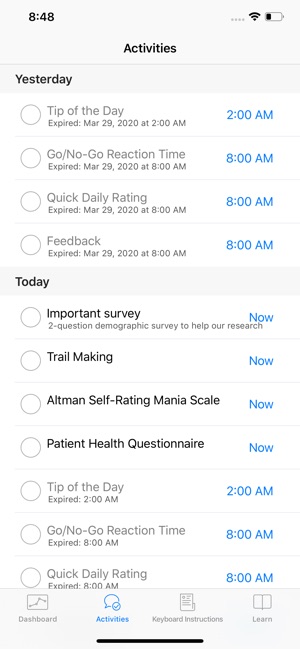
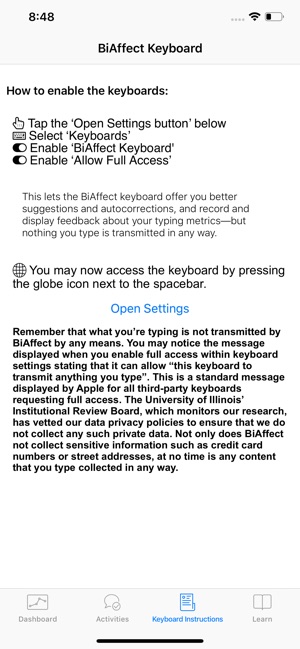
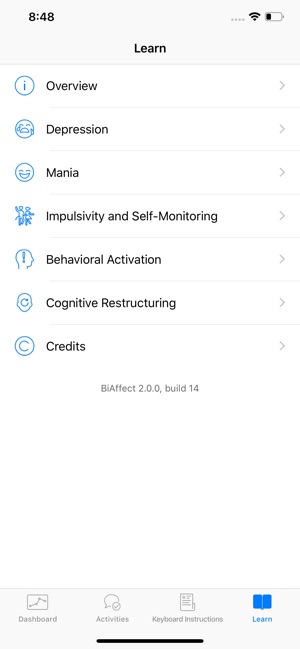
BiAffect is a research application designed for passive digital phenotyping of mood states. The system leverages a custom virtual keyboard that replaces the default interface to unobtrusively collect keystroke dynamics metadata, including typing speed, error rate, and session duration. This data, along with passive sensor information from the device's accelerometer, is captured during routine use. Participants may also complete periodic self-report questionnaires to correlate objective behavioral data with subjective mood states, facilitating longitudinal analysis.
Evidence & Research Context
- In an analysis of over 86,000 typing sessions from 147 users, more severe self-reported depression was significantly associated with more variable typing speed (P<.001), shorter session duration (P<.001), and lower accuracy (P<.05).
- A feasibility study in a cohort with bipolar disorder demonstrated that passively collected metadata could be used to create statistically significant models predicting clinician-rated depression (HDRS, conditional R²=.63) and mania (YMRS, R²=.34) scores.
- The platform's kinematic data has been used to develop models that predict chronological age, finding significant differences in prediction error between participants screening positive versus negative for bipolar disorder risk.
- The association between keystroke dynamics and mood was found to persist even after statistically controlling for confounding variables such as diurnal patterns and the effects of aging on typing performance.
Intended Use & Scope
This application is intended for researchers investigating digital biomarkers for mood disorders. Its primary utility is as a platform for passive data collection to explore correlations between keyboard dynamics and mental health states. The system does not provide diagnostic outputs or clinical guidance and is not a substitute for professional medical evaluation or treatment.
Studies & Publications
Peer-reviewed research associated with this app.
The Effects of Bipolar Disorder Risk on a Mobile Phone Keystroke Dynamics Based Biomarker of Brain Age
Zulueta et al. (2021) · Frontiers in Psychiatry
Keystroke patterns successfully predicted age and detected differences between bipolar and non-bipolar participants.
Effects of mood and aging on keystroke dynamics metadata and their diurnal patterns in a large open-science sample: A BiAffect iOS study
Vesel et al. (2020) · Journal of the American Medical Informatics Association
Typing patterns on smartphones were significantly associated with depression severity, supporting use as mood indicators.
In the Media
UIC Publicly Launches App Designed to Track Bipolar Disorder
University of Illinois at Chicago researchers developed BiAffect to predict manic and depressive episodes in people with bipolar disorder by tracking how they interact with their cellphones. In a pilot study of 30 participants, researchers found that people experiencing manic episodes tended to type quickly and override spellcheck prompts, while those in depressive episodes wrote shorter messages. The app launched publicly in Apple's app store in 2018, requiring users to participate in ongoing research to help identify digital biomarkers of mood disorders.
App developed at UIC to track mood, predict bipolar disorder episodes
Researchers at the University of Illinois at Chicago developed BiAffect to predict and monitor manic and depressive episodes in people with bipolar disorder, using artificial intelligence to analyze keyboard dynamics metadata such as typing speed, rhythm, and mistakes. "We think that this crowd-sourced app-based study will soon lead to digital technologies that act as an 'early alert system' for people with bipolar disorder to help them see manic and depressive episodes coming," said Peter Nelson, professor of computer science and dean of the UIC College of Engineering. The app is now available for free download in the App Store and welcomes users both with and without mood disorders to participate in the ongoing research study.
App Information
Developer
University of IllinoisCategory
Evidence Profile
Proven effective in research studies · Supported by multiple studies
Platforms
Updated
Jun 2026
© 2025 University of Illinois
Tags
Relevant Links
Privacy Policy


BiAffect
Free