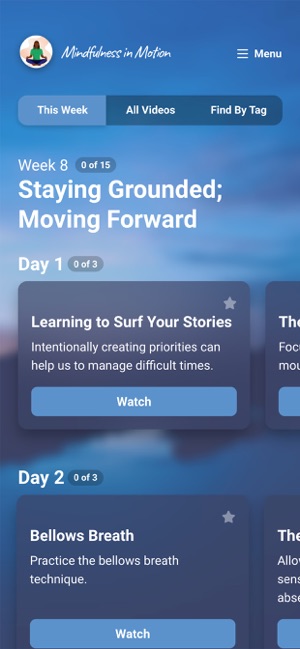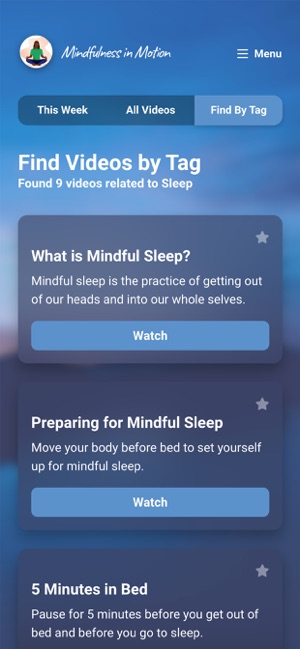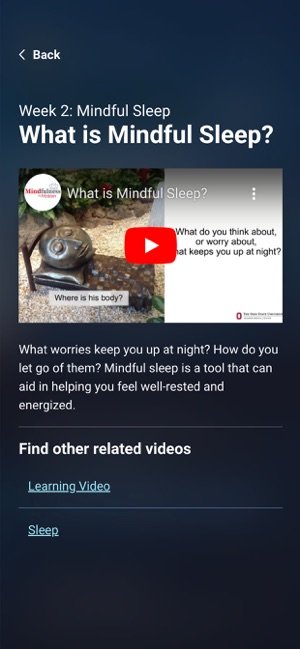

This app offers educational videos, guided meditations, and gentle stretches to help people with sickle cell disease (SCD) use mindfulness-based strategies to cope with chronic pain. The app's design is based on a biopsychosocial model of care, as the associated research advocates for mindfulness training to help patients modulate emotional and physical responses to pain. The authors conclude that incorporating such non-pharmacological tools into a patient-centered plan can improve quality of life and help individuals more effectively manage their condition.
App Screenshots
Detailed Description
Functionality & Mechanism
Developed for individuals with sickle cell disease (SCD), this system delivers mindfulness-based self-management strategies through a mobile interface. The platform provides access to a library of over 120 educational videos, guided meditations, and gentle stretching routines designed to impart physical and mental coping skills. Users select content based on their needs, and the system monitors engagement through video completion records and brief integrated surveys, facilitating progress tracking and reinforcing the application of mindfulness principles in daily life.
Evidence & Research Context
Associated research posits that a biopsychosocial model, which incorporates neurologic and psychological factors, is required for the effective management of chronic pain in sickle cell disease (SCD).
The authors propose mindfulness-based pain management training as a core component of this model to help individuals recognize pain triggers and modulate emotional and physical responses.
The app's intervention model is informed by research on 'Mindfulness in Motion,' a preliminary trial of which demonstrated feasibility (97% retention) and significant increases in resiliency in a non-SCD, high-stress population.
Intended Use & Scope
This tool is designed for individuals with sickle cell disease as an adjunct therapy for self-managing the psychosocial and physical challenges of the condition. It delivers supportive educational content but does not provide medical advice or replace clinical care, including prescribed pharmacotherapy. The app should be utilized in consultation with a healthcare professional as part of a comprehensive treatment plan.
Childerhose et al. (2023) · New England Journal of Medicine
Referenced in academic literature; no direct evaluation of the app
Chronic pain is the most common complication affecting adults with sickle cell disease (SCD).1 Pain profoundly affects people's quality of life, functional ability, and health care utilization. Clinicians are often unsuccessful at addressing chronic pain in SCD, especially among the large number of patients for whom nonopioid analgesics aren't sufficient and those who have developed opioid tolerance. Why aren't we doing better?
We believe the medical community is looking at sickle cell pain through the wrong lens — treating it as a hematologic problem, while overlooking the neurologic, psychological, and social aspects of chronic pain. Given the current understanding of the neuropsychology of pain, the health care system has the ability to manage sickle cell pain more effectively. Doing so will require accepting a broader understanding of the experience of pain and devoting adequate resources to addressing its multiple dimensions.
The biopsychosocial model helps capture people's experience of chronic pain by affirming that biologic, neuropsychological, and socioenvironmental elements play a role in pain-related processes. Biologically, acute vaso-occlusive events in SCD cause tissue inflammation and nociceptive pain. This concept remains the primary model used in clinical practice to understand sickle cell pain and justify analgesic therapy.
Many adults with SCD, however, have chronic daily pain without indicators of vaso-occlusive pain. Adults with a chronic-pain phenotype have nerve damage, chronic inflammation, and sometimes central sensitization. They frequently have allodynia and hyperalgesia. Even patients who have received successful curative therapies, such as a bone marrow transplant or gene therapy, may continue to have chronic pain. These findings suggest that chronic pain in adults with SCD is complex and that a model based principally on hematologic processes is inadequate for understanding and managing it.
Chronic pain that is affected by neuropsychological factors is common to many disease processes, and the medical field's understanding of the basis for this type of pain has advanced over the past decade. Prolonged or repeated episodes of nociceptive pain result in neural changes that enhance pain sensitivity, heighten pain anticipation and aversion, and cause synaptic networks involved in emotion and cognition to prioritize painful stimuli over pleasurable ones. In addition, emotional trauma associated with pain experienced on a single occasion can enhance negative emotions during future episodes. All these factors contribute to a subjective experience of pain as prolonged, persistent, overwhelming, and urgent, even in the absence of nociceptive stimuli.
How is this experience reflected in common health care scenarios? One hypothetical example involves an adult with SCD who is being treated with long-term opioid therapy and comes to an emergency department with severe pain. If she appears to be in distress and her diagnostic tests suggest acute vaso-occlusive pain, she will probably be admitted for treatment and receive analgesics adjusted to a dose to relieve her pain. If she doesn't display the expected signs of distress, and if her lab work doesn't support a diagnosis of a vaso-occlusive event, however, there is a good chance that she will be labeled as "drug seeking." This label, which delegitimizes the patient's account of her pain, is powerful. Once she is labeled a "drug seeker," the patient may be sent home without treatment at the physician's discretion.
This scenario illustrates why relying on the hematologic model of sickle cell pain provides insufficient guidance for clinical decision making. Is the patient exaggerating or falsifying pain if there is no apparent nociceptive stimulus? Does the patient "deserve" aggressive pain treatment? Will opioid treatment help the patient, or will it potentiate a harmful dependence? The hematologic model doesn't encompass factors affecting pain that derive from experiences with various forms of structural violence, including historical inequity, trauma, and racism. These factors affect not just the life circumstances of adults with SCD, but the neuroanatomy and synaptic processing that underlie their experience of pain.
Historically, adults with SCD, the majority of whom are people of color, have been undertreated for chronic pain. Well into the 20th century, the medical profession maintained, without basis, that people of color are less sensitive to pain than White people. In today's vernacular, labels such as "drug seeker" and "overutilizer" serve to minimize sickle cell pain and dismiss the patient's reported subjective experience.
In semistructured interviews conducted by one of our teams, adults with SCD reported profound distress associated with what should have been a powerful act of self-care: seeking hospital-based administration of parenteral opioids for pain flares. They further reported that racism and bias against SCD are woven into their clinical encounters. These findings, which align with reports from other researchers,2 point to a fundamental tension. Adults with SCD must seek acute pain relief in a White-dominated health care system. The system may arbitrarily grant or refuse their request for pain relief, a reality that embodies racism in that such encounters are marked by White authority over the bodies of people of color. Such experiences are profoundly traumatizing for patients.
The harmful effects of the health care system dismissing the pain of adults with SCD go beyond an immediate lack of pain relief for patients. Uncertainty about access to treatment forces patients to devote more cognitive resources and, at the behavioral level, more time and effort, to obtaining pain treatment. Neurologically, the repeated failure of pain-relief efforts enhances awareness of, attention to, and distress caused by nociceptive stimuli and produces a prolonged reduction in the threshold for pain perception. Negative or unpredictable experiences seeking pain relief reinforce the neural processes that give rise to chronic pain. In addition, emotions play a powerful role in learning. A single experience that causes emotional trauma can greatly amplify the degree of distress associated with subsequent pain episodes.3
What adults with SCD seek as patients is relief from pain that is often excruciating. Opioids continue to occupy a central place in the treatment of acute and chronic pain in people with SCD, as reflected in the most recent American Society of Hematology pain guidelines. Treatment must be carefully managed to avoid hyperalgesia, tachyphylaxis, treatment failure, addiction, and accidental overdose.
While ensuring that adults with SCD have reliable and unimpeded access to pharmacotherapy, we also need to offer them a broader range of strategies based on medicine's emerging understanding of the neuropsychological basis of chronic pain.4 Our patients tell us that they want a pain plan that encompasses emotional support, validation, cognitive strategies, and pharmacotherapy. Interventions involving cognitive behavioral techniques, training in mindfulness-based pain management, and multidisciplinary team approaches have reduced pain associated with other chronic conditions. Multilevel interventions that are part of a patient-centered model of pain management could represent a more effective approach to improving quality of life among people with SCD and chronic pain (see box).5
Components of a Biopsychosocial Approach to Pain Management in SCD.*
• Mindfulness-based pain-management training to help people recognize pain triggers and modulate emotional and physical responses to pain.
• Educational strategies that empower adults with SCD to recognize and alter the personal and societal conditions that exacerbate pain.
• Options to incorporate psychological services on the basis of patient need, including cognitive and dialectical behavioral therapy, long-term psychotherapy, addiction counseling, and more intensive therapies, when warranted.
• A clinical pain-management approach based on acceptance and validation of the patient's subjective experience of pain, with the primary goal of satisfactory pain relief rather than opioid rationing.
• Prompt and unimpeded access to acute pain management in outpatient infusion centers, emergency departments, and inpatient settings, when needed.
• Respectful, compassionate, and trauma-informed treatment throughout the health care system, with the recognition that SCD is among the most painful of all health conditions.
*
SCD denotes sickle cell disease.
Broadly, the medical community needs to recognize the ways in which patients' interactions with the health care system create distress and amplify pain and take steps to repair broken care processes. The barriers, delays, and uncertainties that adults with SCD face in obtaining access to pain treatment ultimately intensify their pain and increase the urgency of pain-avoidant behavior, while undermining both patient and institutional goals.
The approaches outlined above will require substantial health care system investment. We believe such investment is justified to improve the quality of care for adults with SCD, who have a lifelong, debilitating disease. If we can help them address the many dimensions of their chronic pain effectively, they may begin to perceive the health care system as a resource in managing their disease, rather than an obstacle to realizing improved health and well-being.
Klatt et al. (2015) · Journal of Visualized Experiments
Improved work engagement and resiliency compared to control group in high-stress workplace environments.
A pragmatic mindfulness intervention to benefit personnel working in chronically high-stress environments, delivered onsite during the workday, is timely and valuable to employee and employer alike. Mindfulness in Motion (MIM) is a Mindfulness Based Intervention (MBI) offered as a modified, less time intensive method (compared to Mindfulness-Based Stress Reduction), delivered onsite, during work, and intends to enable busy working adults to experience the benefits of mindfulness. It teaches mindful awareness principles, rehearses mindfulness as a group, emphasizes the use of gentle yoga stretches, and utilizes relaxing music in the background of both the group sessions and individual mindfulness practice. MIM is delivered in a group format, for 1 hr/week/8 weeks. CDs and a DVD are provided to facilitate individual practice. The yoga movement is emphasized in the protocol to facilitate a quieting of the mind. The music is included for participants to associate the relaxed state experienced in the group session with their individual practice. To determine the intervention feasibility/efficacy we conducted a randomized wait-list control group in Intensive Care Units (ICUs). ICUs represent a high-stress work environment where personnel experience chronic exposure to catastrophic situations as they care for seriously injured/ill patients. Despite high levels of work-related stress, few interventions have been developed and delivered onsite for such environments. The intervention is delivered on site in the ICU, during work hours, with participants receiving time release to attend sessions. The intervention is well received with 97% retention rate. Work engagement and resiliency increase significantly in the intervention group, compared to the wait-list control group, while participant respiration rates decrease significantly pre-post in 6/8 of the weekly sessions. Participants value institutional support, relaxing music, and the instructor as pivotal to program success. This provides evidence that MIM is feasible, well accepted, and can be effectively implemented in a chronically high-stress work environment.