
AppsFromResearch
myRhythmWatch icon

myRhythmWatch

Evidence Tier:CLINICAL GRADE

Validated in clinical trials

For:Researchers & AcademicsClinicians & Healthcare ProfessionalsGeneral Public & Enthusiasts

App Summary

myRhythmWatch uses Apple Watch accelerometer data to help individuals, clinicians, and researchers assess and monitor 24-hour rest-activity rhythms, which are linked to various health outcomes including cognitive impairment. A preliminary pilot study (N=40) established the platform's feasibility in older adults with and without mild cognitive impairment, finding that more fragmented rhythms were associated with worse processing speed. The associated research concludes that this system provides a feasible and scalable approach for characterizing health risk factors, supporting its use in future clinical trials and for personal health awareness.

App Screenshots

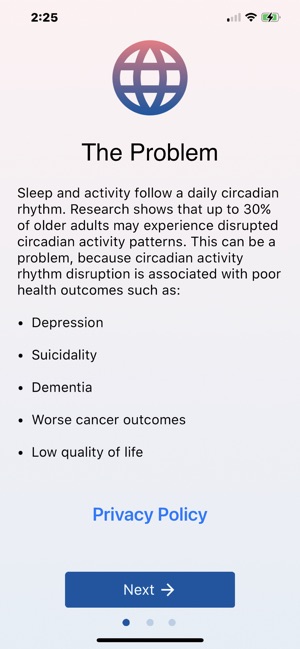
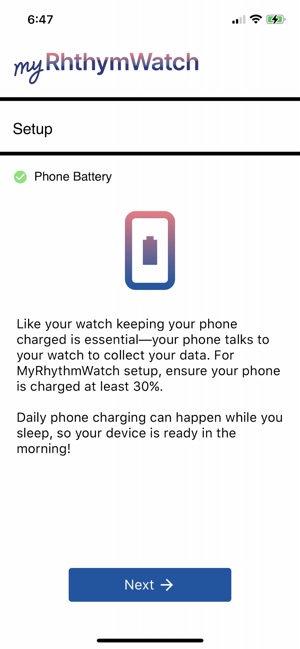
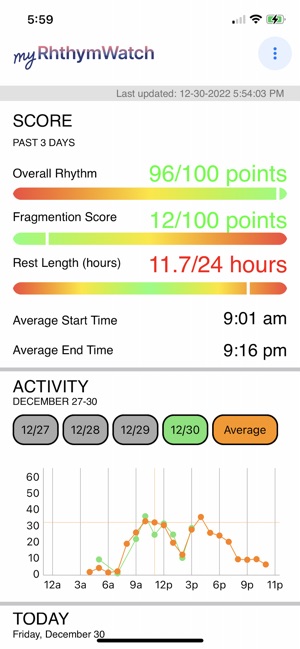
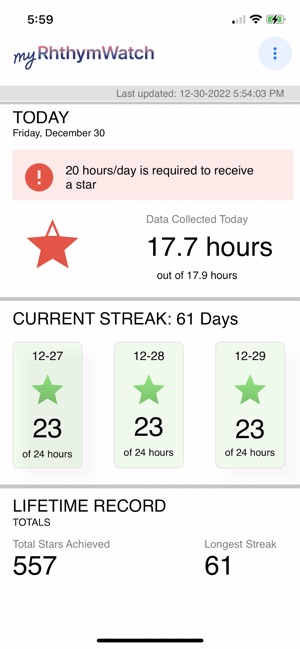
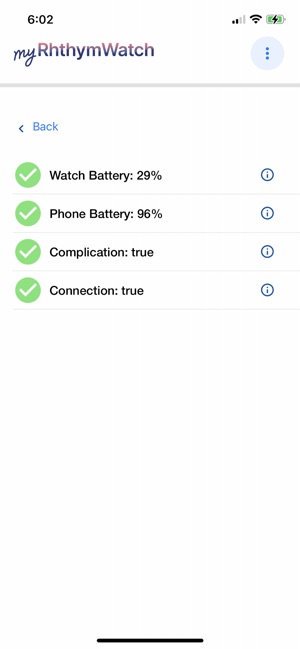
myRhythmWatch screenshot 1 of 6myRhythmWatch screenshot 2 of 6myRhythmWatch screenshot 3 of 6myRhythmWatch screenshot 4 of 6myRhythmWatch screenshot 5 of 6myRhythmWatch screenshot 6 of 6

Detailed Description

Functionality & Mechanism

myRhythmWatch is a mobile health platform developed for the passive quantification of 24-hour rest-activity rhythms (RARs). The system captures raw accelerometer data through a continuously worn Apple Watch for a minimum of three days. This data is synchronized via HealthKit and Bluetooth to a web-based service where nonparametric and extended-cosine RAR variables are computed. The interface then visualizes these metrics, providing a longitudinal assessment of rhythm stability, amplitude, and fragmentation to facilitate rhythm monitoring.

Evidence & Research Context

  • A validation study (N=23) comparing Apple Watch data to a research-grade ActiGraph device demonstrated good-to-excellent consistency (ICC=0.84) and strong correlations (Spearman R=0.7–0.9) for key rest-activity rhythm metrics.
  • A pilot feasibility study (N=40) in older adults, including individuals with mild cognitive impairment (MCI), confirmed the system is a viable and acceptable tool for longitudinal data collection in this population.
  • In the same pilot study, specific rhythm characteristics, such as fragmentation and activity onset timing, were significantly associated with neuropsychological performance on memory and processing speed tasks.
  • The platform was designed to provide a scalable, real-time method for circadian rhythm assessment, addressing the practical limitations of traditional actigraphy for large-scale research and clinical applications.

Intended Use & Scope

This platform is intended for researchers and clinicians for the longitudinal assessment of rest-activity rhythms. It serves as a tool for risk factor characterization and monitoring, not for clinical diagnosis. The derived metrics are device-specific and should not be directly compared with values from other actigraphy systems. Interpretation requires professional context and is not a substitute for clinical evaluation.

Studies & Publications

3 publications

Peer-reviewed research associated with this app.

Validation Study

Comparison of rest-activity rhythm metrics from apple watch and ActiGraph devices

Zhang et al. (2025) · Sleep

Apple Watch measurements showed good-to-excellent consistency with ActiGraph for rest-activity rhythm monitoring.

Abstract Study Objectives Objective rest–activity rhythm (RAR) disturbances are linked with major disease outcomes. If consumer wearables yield RAR measures comparable to traditional research devices, these popular devices could provide a scalable option for clinical applications of RAR monitoring, e.g. risk factor screening. Methods We asked a convenience sample of participants (analytic n = 23; mean age = 27 years; 80% female) to wear Apple Watch and ActiGraph devices on separate wrists for one week. We derived a time series of activity counts from the raw accelerometer data, then extracted nonparametric (interdaily stability [IS], relative amplitude [RA], intradaily variability [IV]), and extended-cosine (pseudo-F, amplitude, up-mesor, acrophase, down-mesor) RAR variables. Spearman correlation coefficients (R) assessed association. Intraclass correlation coefficients (ICCs) assessed both agreement (closeness of values) and consistency (similarity of rankings) of RAR measures from the two devices. Results The devices' RAR measures were highly correlated (Spearman R range: 0.7–0.9, p < .001). Agreement ICCs indicated good reliability for most metrics (ICC = 0.74–0.85), except for amplitude (which is highly dependent on the activity count's scale; ICC = 0.01). Agreement ICCs had wide confidence intervals; most reached at least the moderate agreement range (e.g. IS agreement ICC = 0.77; 95% CI: 0.47 to 0.90). Consistency ICCs were higher and exhibited narrower 95% CIs, with estimates in the good-to-excellent range (e.g. IS consistency ICC = 0.84; 95% CI: 0.61 to 0.92). Conclusions Good-to-excellent consistency ICCs indicate that these devices yield similar participant rank-orderings on these RAR measures. However, there was systematic disagreement, suggesting absolute values from different devices' measures should not be pooled. Statement of Significance Consumer wearable devices could potentially be used in clinical-translational applications of sleep/circadian science, e.g. using the Apple Watch to monitor rest–activity rhythm (RAR) factors that are associated with disease risk. We evaluated if RAR measures derived from the Apple Watch's raw accelerometer data had consistency and agreement with RAR measures from a research-grade device. We found that, although RAR measures from these devices were strongly correlated and highly consistent, there was moderate agreement indicative of systematic discrepancies between the two devices' RAR measures. These findings show this consumer-wearable approach can be used to detect between-subject differences in RAR risk factors, but absolute measures should not be pooled across devices until further study determines and resolves sources of measurement discrepancies.
... Read More
Pilot/Feasibility Study

Detecting Sleep/Wake Rhythm Disruption Related to Cognition in Older Adults With and Without Mild Cognitive Impairment Using the myRhythmWatch Platform: Feasibility and Correlation Study

Jones et al. (2025) · JMIR Aging

Successfully collected sufficient sleep/wake rhythm data from all participants using consumer wearables.

Abstract Background Consumer wearable devices could, in theory, provide sufficient accelerometer data for measuring the 24-hour sleep/wake risk factors for dementia that have been identified in prior research. To our knowledge, no prior study in older adults has demonstrated the feasibility and acceptability of accessing sufficient consumer wearable accelerometer data to compute 24-hour sleep/wake rhythm measures. Objective We aimed to establish the feasibility of characterizing 24-hour sleep/wake rhythm measures using accelerometer data gathered from the Apple Watch in older adults with and without mild cognitive impairment (MCI), and to examine correlations of these sleep/wake rhythm measures with neuropsychological test performance. Methods Of the 40 adults enrolled (mean [SD] age 67.2 [8.4] years; 72.5% female), 19 had MCI and 21 had no cognitive disorder (NCD). Participants were provided devices, oriented to the study software (myRhythmWatch or myRW), and asked to use the system for a week. The primary feasibility outcome was whether participants collected enough data to assess 24-hour sleep/wake rhythm measures (ie, ≥3 valid continuous days). We extracted standard nonparametric and extended-cosine based sleep/wake rhythm metrics. Neuropsychological tests gauged immediate and delayed memory (Hopkins Verbal Learning Test) as well as processing speed and set-shifting (Oral Trails Parts A and B). Results All participants meet the primary feasibility outcome of providing sufficient data (≥3 valid days) for sleep/wake rhythm measures. The mean (SD) recording length was somewhat shorter in the MCI group at 6.6 (1.2) days compared with the NCD group at 7.2 (0.6) days. Later activity onset times were associated with worse delayed memory performance (β=−.28). More fragmented rhythms were associated with worse processing speed (β=.40). Conclusions Using the Apple Watch-based myRW system to gather raw accelerometer data is feasible in older adults with and without MCI. Sleep/wake rhythms variables generated from this system correlated with cognitive function, suggesting future studies can use this approach to evaluate novel, scalable, risk factor characterization and targeted therapy approaches.
... Read More

myRhythmWatch

Free