

OSUWMC Mindfulness In Motion
Proven effective in research studies · Supported by multiple studies
App Summary
App Screenshots

Detailed Description
Functionality & Mechanism
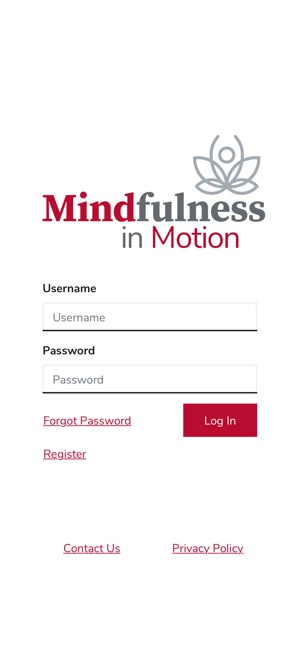
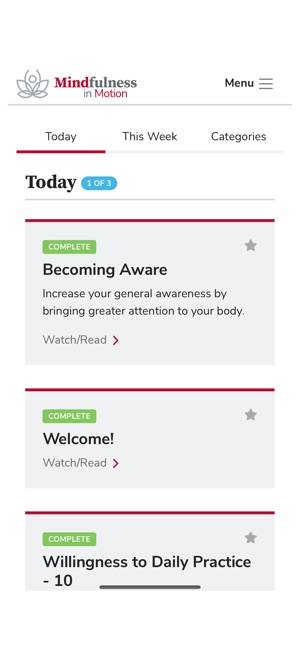
The OSUWMC Mindfulness In Motion system delivers a structured, 8-week mindfulness-based intervention. The program initiates with a baseline survey, followed by weekly modules containing thematic content. The interface provides access to a library of over 150 guided practices, including meditations, gentle yoga, and breathing exercises, with session durations ranging from 2 to 20 minutes. Participants engage with reflection questions to reinforce learning, and the program concludes with a post-intervention survey to measure progress and capture outcomes.
Evidence & Research Context
- An evaluation study of the virtual intervention (N=275) among healthcare professionals demonstrated significant reductions in perceived stress and self-reported respiration rates (from 13.24 to 9.69 bpm post-session), alongside increased resilience.
- A comparative analysis (N=223) indicated that the program's virtual delivery format produced outcomes equivalent or superior to in-person delivery, particularly for reducing emotional exhaustion and perceived stress.
- A follow-up study (N=66) of healthcare professionals found that intervention outcomes, including reduced burnout, decreased stress, and enhanced resilience, were sustained for an average of 12.2 months post-program.
- The underlying intervention protocol is monitored for implementation fidelity, ensuring consistent delivery across cohorts.
Intended Use & Scope
This app is designed as a structured wellness intervention for healthcare professionals and other high-stress populations to mitigate burnout and build resilience. It serves as an organizationally supported, evidence-based program for stress reduction. The system is not a diagnostic tool and does not provide clinical treatment for psychiatric disorders; users with significant mental health concerns should consult a qualified clinician.
Studies & Publications
Peer-reviewed research associated with this app.
Assessment of Virtual Mindfulness-Based Training for Health Care Professionals: Improved Self-Reported Respiration Rates, Perceived Stress, and Resilience
Merrigan et al. (2023) · Global Advances in Integrative Medicine and Health
Healthcare workers who used the mindfulness program showed reduced breathing rates, lower stress, and increased resilience.
The Necessary Thread of Mindfulness Intervention Fidelity Assurance: Enabling an Organizational Strategy to Promote Health Care Professional Well-Being
Klatt et al. (2021) · Global Advances in Health and Medicine
Describes the research-driven development of this appIn the Media
Teaching mindfulness to calm stress in caregivers
The Ohio State University's Dr. Maryanna Klatt developed OSUWMC Mindfulness In Motion as an eight-week program combining group meetings with individual practice to help healthcare workers build resilience and avoid burnout. The program has been implemented across diverse settings including "schoolchildren, police departments, bank employees in Denmark, patients and staff at The Ohio State University Wexner Medical Center and at four other hospitals in the state." Dr. Klatt, a clinical professor of Family and Community Medicine, created the program about two decades ago when mindfulness was still met with skepticism from students.
OSU Wexner Medical Center awarded state grant for workforce safety
The Ohio State University's Wexner Medical Center developed OSUWMC Mindfulness In Motion to reduce healthcare worker burnout, using a personalized prompting system with wearable biofeedback devices. "Our system pushes personalized prompts to a study participant's cell phone to encourage them to pause and engage in mind-body protective exercises based on reaching a given threshold of physiological readings from a wearable biofeedback device," said Maryanna Klatt, the app's developer. The project received nearly $1.5 million in state funding through Ohio's Bureau of Workers' Compensation grant program.
Study identifies long-term benefits of mindfulness intervention to reduce stress, burnout
The Ohio State University Wexner Medical Center developed Mindfulness in Motion to reduce stress and build resilience among healthcare employees, using an eight-week intervention program with small-group mindfulness sessions. Study creator Maryanna Klatt emphasized that "demonstrating sustainability of the results of an intervention is nearly as important as demonstrating the effectiveness of the intervention, yet this is rarely done." Analysis of 66 participants showed three of four outcomes including burnout, perceived stress, and resilience remained significantly improved more than a year after completing the program.
Mindfulness Program Decreases Burnout in Healthcare Workers, Study Finds
The Ohio State University Wexner Medical Center developed the Mindfulness in Motion program to combat healthcare worker burnout using nonjudgmental, present-moment awareness techniques. The study found a 27% reduction in participants meeting burnout criteria, while resilience scores increased from 29.2 to 31.6 and work engagement scores rose from 3.9 to 4.3. Launched in 2008 in the surgical intensive care unit, the program has since expanded to all staff members at the medical center.
Mindfulness program reduces stress, builds resilience in health care professionals
Ohio State University researchers developed the OSUWMC Mindfulness In Motion program to reduce burnout and stress among healthcare professionals, using an eight-week mindfulness training approach. The study of 267 healthcare workers at Ohio State Wexner Medical Center demonstrated a 27% reduction in burnout after completing the program, with lead researcher Maryanna Klatt noting that "when an organization invests preventively in a program like Mindfulness in Motion for any faculty and staff, it makes a real difference when a crisis like an unexpected pandemic happens."
App Information
Developer
Ohio State UniversityCategory
Evidence Profile
Proven effective in research studies · Supported by multiple studies
Platforms
Updated
Jan 2023
© 2025 Ohio State University