
AppsFromResearch
TabCAT icon

TabCAT

Evidence Tier:CLINICAL GRADE

Validated in clinical trials · Supported by multiple studies

For:Researchers & AcademicsClinicians & Healthcare Professionals

App Summary

The Tablet-based Cognitive Assessment Tool (TabCAT) provides a suite of automated cognitive tests and questionnaires for assessing and monitoring adults in clinical and research settings, including primary care. A series of validation and evaluation studies (N=79 to N=2135) have demonstrated the platform's high reliability and accuracy (AUCs up to .99) in detecting cognitive impairment across diverse international populations, often outperforming standard paper-based tests. The associated research concludes that by integrating into clinical workflows, the tool can increase diagnostic rates for cognitive disorders and improve clinician confidence, providing a scalable solution for earlier detection.

App Screenshots

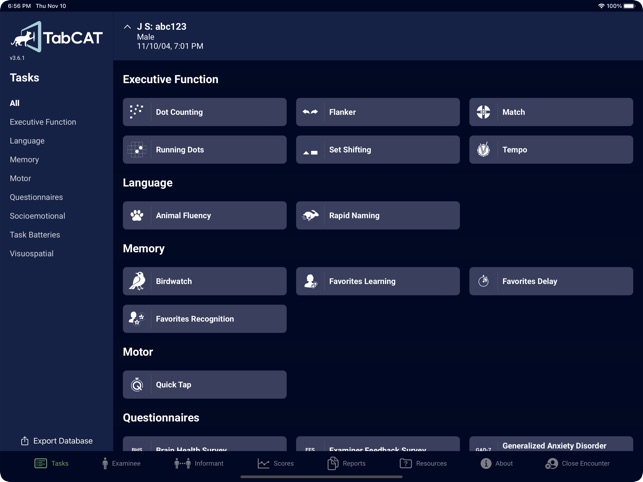
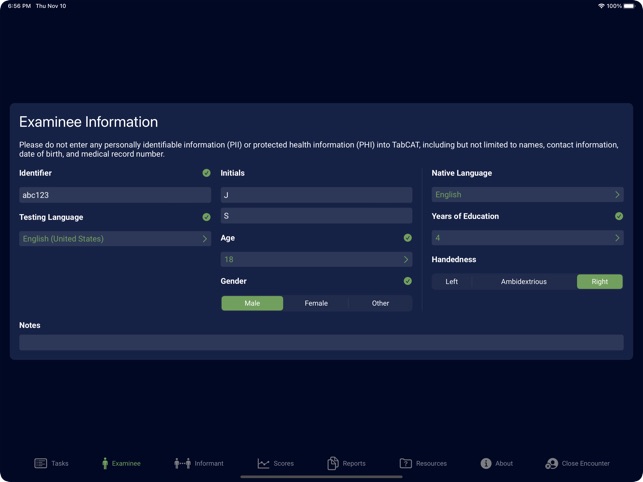
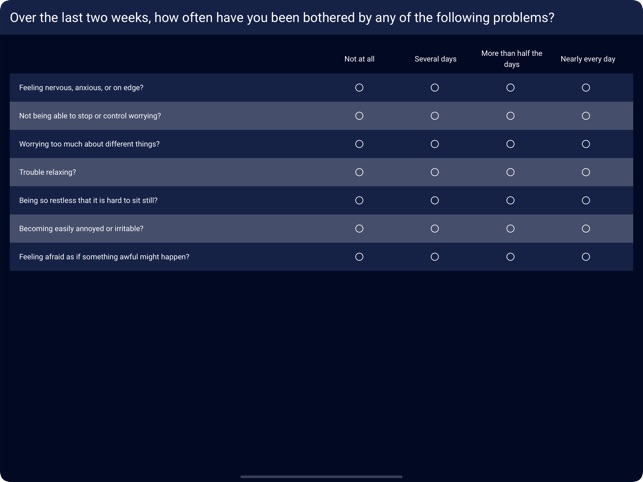
TabCAT screenshot 1 of 3TabCAT screenshot 2 of 3TabCAT screenshot 3 of 3

Detailed Description

Functionality & Mechanism

The Tablet-based Cognitive Assessment Tool (TabCAT), developed at the University of California, San Francisco, is a platform for administering standardized clinical and research assessments. It delivers a suite of modules evaluating executive function, memory, language, and visuospatial skills. The system leverages automated administration and scoring to ensure high-precision measurement and incorporates subject-, informant-, and examiner-facing questionnaires. Sessions are designed for use in diverse settings for the assessment and longitudinal monitoring of cognitive abilities in adults.

Evidence & Research Context

  • A large-scale validation study (N=2477) of the TabCAT-EXAMINER executive functioning battery established robust test-retest reliability and confirmed its validity against independent neuropsychological tests in cohorts with cognitive aging and neurodegenerative disease.
  • An implementation study in a primary care setting (N=2733 patients) found that integration of the TabCAT-Brain Health Assessment (BHA) was associated with a significant increase in clinician-diagnosed cognitive disorders (OR: 1.72).
  • Multiple international validation studies (e.g., in German, Israeli, and Peruvian populations) have demonstrated the tool's high accuracy in detecting cognitive impairment, outperforming standard screening instruments like the MoCA and MMSE across diverse cultural contexts.
  • Validation in a Peruvian Andean cohort (N=258) indicated the tool maintains greater accuracy (AUC=77.4%) than legacy screening tools in low-educated populations when adjusted for sociodemographic factors.

Intended Use & Scope

TabCAT is intended for clinicians and researchers for cognitive screening and longitudinal monitoring in adult populations. The platform's primary utility is to standardize the assessment of cognitive domains to support clinical evaluation. The tool is not a standalone diagnostic; results must be interpreted by a qualified professional within a comprehensive clinical workup.

Studies & Publications

5 publications

Peer-reviewed research associated with this app.

Validation Study

Development and validation of the TabCAT-EXAMINER: A tablet-based executive functioning battery for research and clinical trials

Sanderson-Cimino et al. (2025) · Journal of the International Neuropsychological Society

Reliably measures executive function and validly distinguishes between clinical groups.

Abstract Objective: The National Institutes of Health (NIH) Executive Abilities: Measures and Instruments for Neurobehavioral Evaluation and Research (EXAMINER) is a validated laptop-based battery of executive functioning tests. A modified tablet version of the EXAMINER was developed on the UCSF Tablet-based Cognitive Assessment Tool (TabCAT-EXAMINER). Here we describe the battery and investigate the reliability and validity of a composite score. Methods: A diagnostically heterogeneous sample of 2135 individuals (mean age = 65.58, SD = 16.07), including controls and participants with a variety of neurodegenerative syndromes, completed the TabCAT-EXAMINER. A composite score was developed using confirmatory factor analysis and item response theory. Validity was evaluated via linear regressions that tested associations with neuropsychological tests, demographics, clinical diagnosis, and disease severity. Replicability of cross-sectional results was tested in a separate sample of participants ( n = 342) recruited from a frontotemporal dementia study. As this separate sample also collected longitudinal TabCAT-EXAMINER measures, we additionally assessed test-retest reliability and associations between baseline disease severity and changes in TabCAT-EXAMINER scores. Results: The TabCAT-EXAMINER score was normally distributed, demonstrated high test-retest reliability, and was associated in the expected directions with independent tests of executive functioning, demographics, disease severity, and diagnosis. Greater baseline disease severity was associated with more rapid longitudinal TabCAT-EXAMINER decline. Conclusions: The TabCAT-EXAMINER is a tablet-based executive functioning battery developed for observational research and clinical trials. Performance can be summarized as a single composite score, and results of this study support its reliability and validity in cognitive aging and neurodegenerative disease cohorts.
... Read More
Validation Study

Peruvian validation and standardization of the TabCAT-brain health assessment

Mu et al. (2025) · Frontiers in Public Health

Accurately detected cognitive impairment in Peruvian older adults, showing higher accuracy than standard screening tests.

IntroductionDetecting cognitive impairment in low-educated and marginalized populations may result in under- or over-estimation of diagnoses due to reliance on non-validated approaches and normative data. This study validates and standardizes TabCAT-BHA for older adults living in the Andean region of Peru using regression-based normalization.MethodsTwo hundred fifty-eight participants were assessed with the MMSE, RUDAS, and TabCAT-BHA. Classified as either cognitively healthy or impaired based on Clinical Dementia Rating criteria.ResultsBy incorporating sex, place of residence, age, and years of education as covariates, the TabCAT-BHA demonstrated greater accuracy in detecting cognitive impairment (AUC = 75.3%) compared to the MMSE (AUC = 66.4%) and RUDAS (AUC = 71.4%). After incorporating only significant sociodemographic predictors, TabCAT-BHA obtained better AUC (77.4%) compared to MMSE (66.6%) and RUDAS (71.9%).DiscussionThe TabCAT-BHA proves to be a valid tool for detecting cognitive impairment, and incorporating sociodemographic factors improves its accuracy in marginalized settings of Peru.
... Read More

TabCAT

Free