
AppsFromResearch
The Social Brain App icon

The Social Brain App

Evidence Tier:DOCUMENTED

Published in academic literature

For:Researchers & AcademicsGeneral Public & Enthusiasts

App Summary

The Social Brain App is a gamified platform enabling the public to participate in large-scale neuroscience experiments by playing games that assess social decision-making. The app's design is grounded in the associated research, which shows that the hippocampus creates a "cognitive map" to track complex social relationships, much like it does for physical space. By crowd-sourcing data, the authors aim to build a deeper understanding of the neural basis of social behavior and its relevance to psychiatric conditions marked by social deficits.

App Screenshots

The Social Brain App screenshot 1 of 8The Social Brain App screenshot 2 of 8The Social Brain App screenshot 3 of 8The Social Brain App screenshot 4 of 8The Social Brain App screenshot 5 of 8The Social Brain App screenshot 6 of 8The Social Brain App screenshot 7 of 8The Social Brain App screenshot 8 of 8

Detailed Description

Functionality & Mechanism

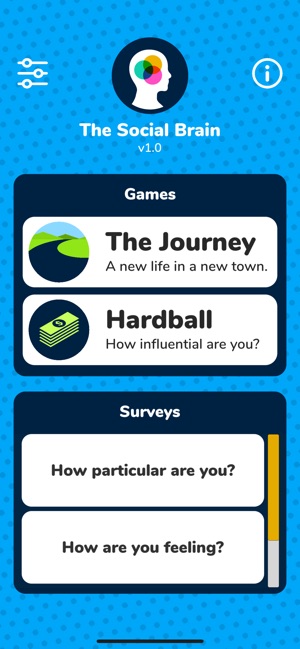
Developed by researchers at the Icahn School of Medicine at Mount Sinai, The Social Brain App is a data collection platform for large-scale neuroscience experiments. The system presents users with a series of gamified scenarios designed to simulate social decision-making and navigation. Through role-playing modules, the interface captures behavioral data on how individuals interact with virtual characters and navigate complex social hierarchies. Participation directly contributes anonymized data to a massive online study investigating the neurobiology of social behavior.

Evidence & Research Context

  • Associated neuroimaging research demonstrates that the human hippocampus computes a geometric map of social relationships, or a "social space," framed by perceived power and affiliation.
  • In a foundational fMRI study, stronger covariance between hippocampal activity and navigation within this conceptual "social space" correlated with higher self-reported social skills.
  • The app's design is grounded in a theoretical framework that posits the hippocampus supports multidimensional cognitive maps for organizing experience, extending beyond physical navigation to abstract social contexts.
  • The platform is explicitly described in associated research as a crowd-sourcing tool developed to gather social decision-making data for large-scale neuroscience investigations.

Intended Use & Scope

This app is intended for the general public to use as citizen scientists and for researchers to utilize for data collection. Its primary utility is as an instrument for scientific investigation into social cognition. The platform is not a diagnostic tool, a therapeutic intervention, or a social skills training program and provides no individualized feedback.

Studies & Publications

3 publications

Peer-reviewed research associated with this app.

Non-Evaluative Reference

The neural basis of human social behavior

Schiller et al. (2023) · Mount Sinai Reports

Referenced in academic literature; no direct evaluation of the app
This overview highlights research led by the Icahn School of Medicine at Mount Sinai regarding the neurobiological mechanisms underlying human social interaction. A primary focus is the work of Dr. Daniela Schiller, which posits that the hippocampus—traditionally associated with spatial navigation and memory—actively computes a geometric representation of social relationships. This "social space" maps individuals as coordinates within a two-dimensional framework, where the accuracy of this mapping correlates with social aptitude and psychological well-being. Complementing this, research by Dr. Xiaosi Gu explores "social controllability," identifying neural mechanisms that facilitate forward-thinking strategies to influence social outcomes. The article further outlines broad clinical applications being pursued by Mount Sinai researchers, investigating social deficits across psychiatric conditions such as PTSD, addiction, borderline personality disorder, and autism. Finally, it introduces novel data collection methods via "The Social Brain App," a gamified platform designed to crowd-source social decision-making data for large-scale neuroscience experiments.
... Read More
Non-Evaluative Reference

Memory and Space: Towards an Understanding of the Cognitive Map

Schiller et al. (2015) · The Journal of Neuroscience

Referenced in academic literature; no direct evaluation of the app
More than 50 years of research have led to the general agreement that the hippocampus contributes to memory, but there has been a major schism among theories of hippocampal function over this time. Some researchers argue that the hippocampus plays a broad role in episodic and declarative memory, whereas others argue for a specific role in the creation of spatial cognitive maps and navigation. Although both views have merit, neither provides a complete account of hippocampal function. Guided by recent reviews that attempt to bridge between these views, here we suggest that reconciliation can be accomplished by exploring hippocampal function from the perspective of Tolman's (1948) original conception of a cognitive map as organizing experience and guiding behavior across all domains of cognition. We emphasize recent studies in animals and humans showing that hippocampal networks support a broad range of domains of cognitive maps, that these networks organize specific experiences within the contextually relevant map, and that network activity patterns reflect behavior guided through cognitive maps. These results are consistent with a framework that bridges theories of hippocampal function by conceptualizing the hippocampus as organizing incoming information within the context of a multidimensional cognitive map of spatial, temporal, and associational context. SIGNIFICANCE STATEMENT Research of hippocampal function is dominated by two major views. The spatial view argues that the hippocampus tracks routes through space, whereas the memory view suggests a broad role in declarative memory. Both views rely on considerable evidence, but neither provides a complete account of hippocampal function. Here we review evidence that, in addition to spatial context, the hippocampus encodes a wide variety of information about temporal and situational context, about the systematic organization of events in abstract space, and about routes through maps of cognition and space. We argue that these findings cross the boundaries of the memory and spatial views and offer new insights into hippocampal function as a system supporting a broad range of cognitive maps.
... Read More

The Social Brain App

Free